VW Crafter Tyre Pressure: Check, Set, and Maintain
Learn how to check and set tyre pressure on the VW Crafter. This practical guide covers TPMS, temperature effects, and safe maintenance to improve safety and efficiency.


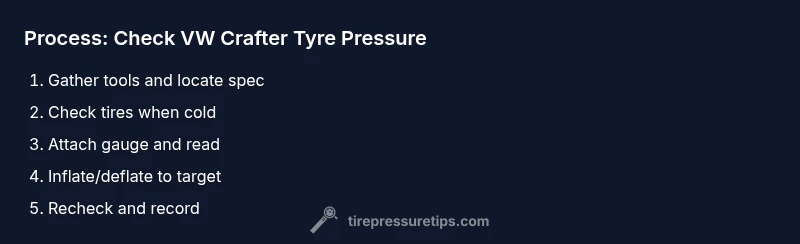
By following these steps, you will accurately check and adjust tyre pressure on your VW Crafter, using TPMS indicators and a reliable gauge. You'll learn how temperature, load, and driving affect readings, how to interpret the dashboard warning, and when to seek professional help. Gather a tire gauge, a gauge reference, and a reliable source for recommended pressures.
Why tyre pressure matters for VW Crafter
Maintaining correct tyre pressure is essential for safety, handling, and fuel efficiency on your VW Crafter. Underinflated tyres can reduce steering response, increase tire wear, and raise the risk of heat buildup that may cause a blowout. Overinflation, on the other hand, can make the ride harsher, reduce the contact patch, and accelerate wear in the center tread. For a vehicle like the Crafter that often carries heavy loads or propels cargo, proper inflation helps distribute weight evenly between the front and rear axle, maintains even tread wear, and preserves suspension performance. Regular checks also help extend tire life and keep TPMS alerts from becoming nuisance signals. In short, correct tyre pressure supports safe driving, better fuel economy, and predictable braking performance, which matters whether you’re navigating city streets or highways with a full cargo load. The Tire Pressure Tips team emphasizes: start with the manufacturer-recommended pressures, then confirm with a reliable gauge and your own driving data.
Tools & Materials
- Calibrated tyre pressure gauge(Digital or mechanical; ensure accuracy to ±1 psi)
- Vehicle door jamb placard / owner's manual(Exact VW Crafter pressures for your model/year)
- Air compressor or inflation device(For adjustments on the road or service station)
- Valve cap tool or spare valve caps(Easier valve cap removal and reinstallation)
- Notepad or digital log(Record readings over time)
Steps
Estimated time: 30-45 minutes
- 1
Prepare and locate the spec
Before touching a tire, gather your gauge, consult the door placard and manual, and confirm distinct front/rear values if applicable. Record the exact numbers for your Crafter’s configuration. This minimizes cross-model guesswork and keeps your inflation precise.
Tip: Double-check front vs. rear axle specs and note any load-based variations. - 2
Check tyre temperature and cold condition
Ensure tires are cold: the vehicle has been stationary for several hours or driven only briefly since last use. Temperature affects readings, so a cold measurement yields the most accurate result.
Tip: Avoid measuring after a short drive or on a hot day. - 3
Remove valve caps and prepare to read
Take off the valve caps, inspect the valve stems for damage, and keep caps in a safe place. Attach your gauge firmly to the valve stem and read the pressure displayed.
Tip: Make sure the gauge seats squarely to avoid false readings. - 4
Read the current pressure
Note the value on the gauge and compare it with the VW Crafter spec for your model. If the reading is significantly different, you’ll need to adjust before driving further.
Tip: If you’re unsure, recheck with a second gauge to confirm. - 5
Inflate or deflate to target pressure
If underinflated, add air in small increments and recheck. If overinflated, release air gradually and recheck until you reach the target range.
Tip: Use controlled bursts and recheck multiple times to avoid overshoot. - 6
Recheck and reseal
After adjusting, recheck all four tires (and the spare if you rotate) to verify consistency. Replace valve caps firmly to protect against leaks.
Tip: Keep a simple log of all four corners for future reference. - 7
Document and verify under load
If you carry heavy cargo or passengers, recheck pressures after loading and during long journeys. Confirm that the readings align with the manufacturer’s guidance for loaded scenarios.
Tip: Temperature and load can shift required pressures noticeably. - 8
Inspect and maintain a record
Review readings monthly and after seasonal changes. Use your notes to detect slow leaks or sensor drift and to plan tyre maintenance.
Tip: A quick monthly check prevents surprises on the road.
Frequently Asked Questions
Where can I find the official tyre pressure specification for my VW Crafter?
The official specs are on the door jamb placard by the driver’s door and in the owner's manual. They vary by model, wheel size, and load. If you can’t locate them, contact a dealer or VW support for your VIN.
Check the door label near the driver's seat and consult the owner's manual for the exact pressures.
Is TPMS enough, or should I also check manually?
TPMS provides a warning when pressure is low, but it’s not a replacement for manual checks. Always verify with a reliable gauge to ensure accuracy.
TPMS helps, but you should still check with a gauge to confirm the numbers.
What should I do if I notice a slow leak?
If you suspect a slow leak, inspect the tire for punctures, nails, or bead leaks. If a leak is present, repair or replace the tire as advised by a technician before driving long distances.
Look for punctures or bead leaks and get it checked as soon as possible.
How often should I check tyre pressure on a VW Crafter?
Check at least once a month and before long trips. Recheck after loading heavy cargo or after significant temperature changes.
Do a quick monthly check and before big trips.
Can temperature changes affect tyre pressure?
Yes. Cold temperatures tend to reduce tyre pressure, while hot temperatures increase it. Recheck after seasonal shifts.
Temperature changes will affect readings; adjust as needed.
How should I handle the spare tire pressure?
Check the spare tire pressure as part of routine maintenance and ensure it sits within the same range as the other tires if it’s a full-size spare.
Don’t forget to check the spare; it’s part of safe maintenance.
Watch Video
What to Remember
- Check tyres cold for accuracy
- Always follow VW Crafter spec on placard
- Verify TPMS readings with a manual gauge
- Record readings to monitor trends over time