Tire Pressure Door or Tire: Reading Placards and Maintaining Proper Pressure
A practical, step-by-step guide to understanding the tire pressure door placard vs the tire sidewall, how to check and adjust pressure, and how to maintain safe and efficient tires.


Goal: Learn to read the tire pressure door placard and the tire sidewall, distinguish the door jamb label from the tire itself, and confidently check and adjust your tire pressure using a gauge. You will find practical steps, safety notes, and links to authoritative sources. By the end, you will be able to maintain optimal tire pressure for safety, fuel economy, and tread life.
Understanding the tire pressure door vs tire label
For many drivers, there is confusion between the 'tire pressure door' (the placard located on a door jamb) and the tire itself. The door pressure placard tells you the vehicle’s recommended tire pressure when tires are cold. The tire sidewall shows the maximum pressure the tire can safely handle, not the target for your car. According to Tire Pressure Tips, learning the difference is a foundational step toward safer driving and better fuel economy. The Tire Pressure Tips team found that most readers benefit from a simple rule: base your target pressure on the placard rather than the tire’s maximum. In practice, that means reading the label in your door frame, then checking the actual tires with a gauge before you inflate. This distinction helps prevent underinflation and overinflation, both of which can affect handling and tire wear. As you get comfortable with this, you will see how small pressure tweaks can improve ride quality and fuel efficiency. This block establishes the core concept you will apply in the rest of the guide.
Why accurate tire pressure matters
Maintaining correct tire pressure is a foundational safety practice that affects handling, braking distance, tire wear, and fuel economy. When tires are underinflated, the contact patch increases and the tire overheats, which can shorten tire life and raise the risk of a blowout on demanding roads. Overinflation, on the other hand, reduces the tire contact patch, yielding a harsher ride and uneven wear across the tread. In practical terms, consistent, correct pressure helps the vehicle respond predictably to steering inputs, cornering forces, and braking. The Tire Pressure Tips analysis highlights that regular pressure checks support overall vehicle performance and occupant safety, especially in seasonal temperature swings where pressure naturally shifts. In short, proper tire pressure is a simple, effective lever for safety and efficiency that every driver can manage with the right routine.
Reading the door jamb placard correctly
The door jamb placard lists recommended cold tire pressures for the vehicle as a whole, typically for the front and rear tires. Units are usually pounds per square inch (psi) in the United States or kilopascals (
Reading tire sidewall markings: when to trust them
The tire sidewall carries important information, including the maximum inflation pressure listed by the tire maker. This number is not the target you should use for your vehicle, and inflating beyond this limit can be dangerous. Sidewall numbers also reflect load and speed ratings and are intended for maximum permissible pressure under certain conditions. Use the placard values for everyday inflation goals and reserve the sidewall maximum for special circumstances only. This distinction helps you avoid accidentally overfilling tires during aggressive inflation or after heat buildup from driving. Understanding sidewall data helps you interpret tire characteristics, but it should not replace the door placard as your primary reference.
Checking tire pressure with the right tools
To get accurate readings, you need a reliable gauge and a source of clean, conditioned air. Digital gauges provide quick readings and store recent values, while basic analog gauges are inexpensive and dependable if you keep the gauge in good condition. An air compressor, or access to station air, is essential for adjusting underinflated tires. In addition, a clean valve stem and a spare valve cap help maintain accuracy and seal. Before you begin, ensure you are in a safe, flat area away from traffic. Check all four tires and the spare if applicable. Cleanliness of the valve stems matters; dirt or moisture can distort readings and lead to erroneous inflation.
Setting the recommended pressure for your vehicle
If a tire reads below the placard value, inflate in small increments and recheck after each addition. If it is above the target, release air gradually and recheck. Do not rely on a single measurement; take multiple readings to confirm accuracy. Remember to measure when tires are cold, ideally after the car has sat for at least three hours. After you reach the target pressure, reinstall the valve caps and verify that the TPMS warning light does not reset after a drive. Maintain an ongoing log of readings to notice slow leaks or gradual changes over time.
Temperature effects and seasonal guidance
Temperature changes have a direct impact on tire pressure. Cold temperatures typically cause a drop in pressure, while heat from driving or ambient temperatures can increase it. In winter, check tire pressure more frequently and consider adjusting based on the placard values rather than your memory of the previous reading. In hot weather, small inflations can occur after driving; recheck after a cool-down period to avoid overinflation. A routine that accounts for temperature ensures consistency in performance, handling, and fuel economy.
Common mistakes and quick fixes
Common mistakes include inflating tires to the sidewall maximum, not accounting for temperature changes, and assuming the TPMS alone guarantees correct pressure. A quick fix is to set a reminder to check pressures monthly and before long trips, especially after seasonal shifts. Another pitfall is neglecting the spare tire; the spare may also require attention in some vehicles. If you notice persistent fluctuations, investigate potential slow leaks from nails, faulty valves, or wheel damage. Regular maintenance reduces the risk of tire failure and improves overall vehicle safety.
Integrating TPMS data with manual checks
Tire Pressure Monitoring System (TPMS) alerts you when a tire falls below a threshold, but it does not tell you the exact target pressure for each tire. Manual checks with a gauge are still essential to ensure the pressures match the placard recommendations. Use TPMS readings as a trigger to perform a precise gauge measurement, then adjust to the placard values. This complementary approach gives you a robust, reliable pressure management routine that protects tire life, fuel economy, and vehicle handling.
AUTHORITY SOURCES
For further reading, consult established references on tire pressure and safety:
- https://www.nhtsa.gov/road-safety/tires
- https://www.consumerreports.org/cars-t-driving/how-to-check-tire-pressure
- https://www.sae.org/
These sources offer official guidelines and industry perspectives to supplement your practice with trusted information.
Tools & Materials
- Tire pressure gauge(Choose a gauge with clear readability and unit options (psi or kPa). Calibrate if possible.)
- Air compressor or service station access(Needed to adjust underinflated tires; ensure it can deliver small, controlled pressure increases.)
- Owner's manual or placard location(Used to verify the recommended pressure; placard is usually on the driver door jamb.)
- Valve caps and a clean cloth(Protect valve stems from dirt and moisture; wipe stems before measuring.)
- Notebook or digital log(Record readings for trend tracking and leak detection.)
Steps
Estimated time: 30-45 minutes
- 1
Gather tools and prepare the workspace
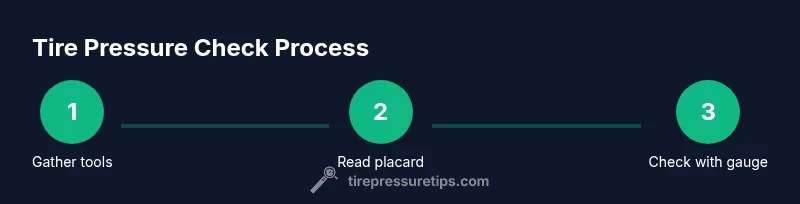
Collect a reliable tire pressure gauge, an air source, and your placard or manual. Park on a flat, shaded surface away from traffic to ensure accurate readings and safe activity.
Tip: Verify all four tires and the spare (if present) at the same session for consistency. - 2
Find the recommended pressure
Look up the door jamb placard for the recommended cold tire pressures for front and rear tires. Do not use the tire sidewall maximum number as your target.
Tip: If the placard is hard to read, consult the owner's manual or the manufacturer’s website. - 3
Prep the tire and remove the valve cap
Wipe the valve stem and remove the cap to access the Schrader valve. Keep the cap in a safe place and inspect the valve stem for damage.
Tip: If the valve shows cracking or leakage, replace it before inflating. - 4
Measure current pressure
Attach the gauge to the valve stem, press straight on, and read the stabilized measurement. Record the reading for that tire.
Tip: Take a second reading to confirm accuracy before deciding on inflation. - 5
Inflate or deflate to target pressure
If underinflated, add air until you reach the target; if overinflated, release air gradually and recheck. Do this in small increments.
Tip: Small adjustments prevent overcorrection and overshoot of the target pressure. - 6
Re-check and reseal
Re-measure after inflation/deflation to confirm alignment with the placard. Reinstall the valve cap and ensure the TPMS warning light is not active after a drive.
Tip: Document readings to detect slow leaks or seasonal drift over time.
Frequently Asked Questions
What is the tire pressure door placard and where is it located?
The door placard (or door jamb label) shows the vehicle’s recommended tire pressure for cold tires. It is usually located on the driver’s door jamb or in the owner’s manual.
The door placard is the tire pressure guide found on the door jamb or in the manual.
Should I inflate tires to the sidewall maximum pressure?
No. The sidewall maximum is the tire's limit, not the target for your vehicle. Use the placard values instead.
Do not inflate to the maximum on the sidewall; use the placard value.
Can TPMS alone tell me when to check tire pressure?
TPMS alerts you when a tire is below the threshold, but it does not provide the exact target pressure. Manual checks are still necessary.
TPMS tells you when pressure is low but you still need to measure with a gauge.
Is it better to check tire pressure when cold?
Yes. Checking while cold ensures you read accurate, stable pressures.
Always check tire pressure when cold for accuracy.
How often should I check tire pressure?
Check at least monthly and before long trips, especially with temperature changes.
Plan a monthly check and before trips since pressure changes with weather.
What should I do if I notice a slow leak?
Look for punctures, valve stem wear, or wheel damage. If found, repair professionally.
If you have a slow leak, get the tire inspected and repaired quickly.
Watch Video
What to Remember
- Know the door placard vs tire markings to set the correct pressure.
- Use a reliable gauge and cold readings for accuracy.
- Don’t rely on sidewall maximums as the target pressure.
- TPMS supports safety but manual checks remain essential.
- Regular checks protect safety, fuel economy, and tire life.