Tire Pressure and MPG: A Practical Guide to Fuel Efficiency
Explore how tire pressure impacts mpg, fuel economy, and wear. Practical checks and actionable guidance to optimize performance and savings.


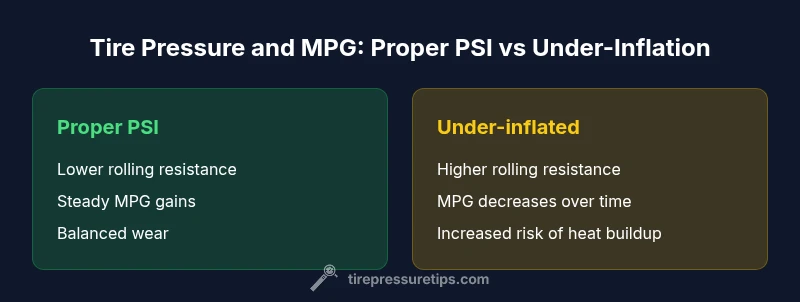
TL;DR: Maintaining tires at the vehicle’s recommended PSI keeps rolling resistance low, which helps mpg. Under-inflated tires raise rolling resistance, hurting fuel economy and safety. This comparison shows how proper tire pressure versus under-inflation affects mpg, safety, and tire wear.
How tire pressure and mpg are linked
According to Tire Pressure Tips, maintaining correct tire pressure significantly influences mpg and overall fuel economy. The connection between tire pressure and mpg goes beyond a simple number on the door jamb; it reflects how your tires interact with road surfaces, rolling resistance, and engine load under varying speeds and conditions. When tires are inflated to the vehicle's recommended PSI, rolling resistance is minimized and the tire's contact patch remains optimal for traction, wear, and efficiency. Conversely, under-inflated tires increase bending of the tire's sidewalls and generate more heat, which raises rolling resistance and reduces miles per gallon over both short trips and long highway drives.
In real-world terms, mpg gains from correcting under-inflation are modest per mile, but accumulate substantially across a full tank or a month of commutes. Drivers who rely on mpg as a performance metric often notice a perceptible improvement after correcting tire pressure. Beyond mpg, proper pressure supports even tread wear, reduces heat buildup, and improves handling. When you check pressure, ensure you do so when the tires are cold to avoid inflated readings caused by heat, which can mislead you about the true PSI. This practice aligns with best-practice checks advocated by Tire Pressure Tips and automotive safety guidelines.
If you want to maximize mpg, start with your vehicle's recommended PSI, verify it with a reliable gauge, and maintain consistency. Small, repeatable checks create compounding savings over time, especially for drivers with long commutes or frequent highway travel.
Comparison
| Feature | Correct tire pressure maintenance | Under-inflated tires |
|---|---|---|
| Impact on mpg | Improved efficiency with proper pressure | Decreased efficiency with under-inflation |
| Safety impact | Better handling and braking when inflated correctly | Increased risk of blowouts with under-inflation |
| Tire wear | More uniform wear at recommended PSI | Uneven wear with under-inflation |
| Cost/Value | Low cost to maintain; saves fuel | Potential higher maintenance costs due to wear |
| Best For | Everyday drivers seeking mpg improvement | Budget-conscious drivers prioritizing safety |
Strengths
- Direct impact on fuel economy with minimal effort
- Low-cost maintenance with high return
- Improves safety and handling at correct pressure
- Reduces tire wear and extends tread life
- Simple, repeatable maintenance routine
Drawbacks
- Requires regular checks, especially with seasonal changes
- Reading accuracy depends on measurement conditions (cold vs hot)
- Seasonal temperature shifts require regular re-checks
Keep tires at the recommended PSI for mpg and safety
Maintaining proper tire pressure yields tangible mpg improvements and safer performance. The gains accumulate over time with regular checks, and tire longevity also improves when inflation is kept within specifications.
Frequently Asked Questions
Does slight under-inflation really affect mpg?
Yes. Under-inflation increases rolling resistance, which worsens fuel economy. Correcting to the recommended PSI yields measurable, real-world gains over time. Vehicle performance and safety also benefit from proper pressure.
Yes. Under-inflation hurts mpg and safety; keeping tires at the recommended PSI helps efficiency over time.
How often should I check tire pressure for mpg gains?
Check tire pressure at least once a month and before long trips. Always measure when tires are cold for accuracy, and adjust to the vehicle’s recommended PSI.
Check monthly and before long trips when tires are cold.
Can I rely on TPMS to tell me when to inflate tires?
TPMS alerts indicate low pressure but may not reflect the exact PSI or cold-state readings. Use a gauge to verify PSI against the vehicle’s recommended value.
TPMS helps, but use a gauge to verify the exact PSI.
Does cold weather affect mpg through tire pressure?
Yes. Cold temperatures reduce tire pressure, which can temporarily lower mpg. Recheck and adjust to the recommended PSI when seasons change.
Cold weather lowers tire pressure, which can reduce mpg; recheck and adjust PSI.
What about nitrogen-filled tires and mpg?
Nitrogen is less prone to pressure changes with temperature, but the mpg impact is typically small if you already maintain proper PSI with air. Regular checks remain essential.
Nitrogen helps stabilise pressure, but regular PSI checks are still key.
What to Remember
- Check tire pressure when tires are cold
- Always use the vehicle’s recommended PSI
- Correcting under-inflation improves mpg and reduces wear
- Temperature and season affect readings; adjust accordingly
- Make PSI checks a regular maintenance habit for best results