Tire Pressure and Altitude: A Practical Comparison
Explore how altitude affects tire pressure readings and performance. This comparison guides TPMS interactions, temperature effects, and safe adjustment practices for high-elevation driving.


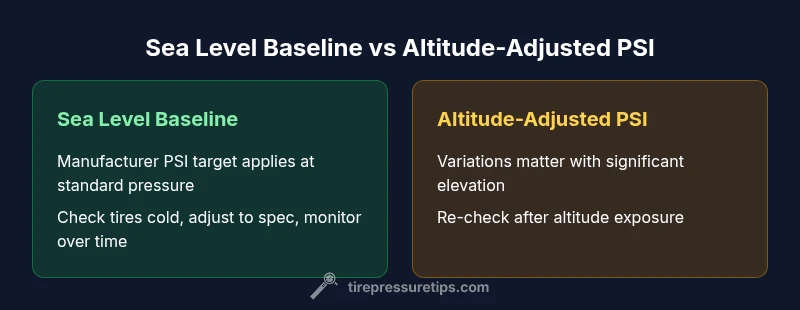
At higher altitudes, ambient air pressure and temperature change, which can subtly affect tire pressure readings and performance. The practical takeaway: check your tires when cold, compare against the vehicle’s recommended PSI, and adjust as needed after travel to altitude. Regular checks help prevent underinflation or overinflation during mountain drives.
How altitude affects tire pressure readings
Tire pressure and altitude intersect in subtle but important ways. As you ascend, ambient air pressure and air temperature both fall, which can influence how a tire’s internal gas behaves. The tires themselves are sealed volumes, but the air surrounding them and the surface they contact change temperature and heat transfer rates, affecting measured PSI. According to Tire Pressure Tips, the practical effect is a mix of temperature-driven pressure changes and the long-term consequences of road conditions at altitude. When you start a trip in the mountains, you may notice readings inching up or down as the tires warm from braking and rolling resistance, and then stabilizing as they cool. The key takeaway for tire pressure and altitude is to use your vehicle’s recommended PSI as the baseline and to validate that baseline under the specific elevation and temperature conditions you encounter. This discipline helps you avoid creeping underinflation during steep descents or overinflation when hot tires expand. The science behind altitude effects is grounded in gas behavior, but the actionable guidance remains simple: check cold tires, compare to spec, and adjust cautiously after altitude exposure. This approach also ties into the broader topic of tire pressure maintenance that Tire Pressure Tips promotes for safe and efficient driving.
Practical implications for driving at elevation
Altitude influences grip, cornering, and braking feel because tire contact patch and pressure distribution shift with elevation-related temperature changes and road surfaces. A marginal change in psi can alter steering response, tire wear patterns, and rolling resistance, which, in turn, affects fuel efficiency and vehicle dynamics. For SUVs and light trucks often used in mountainous regions, keeping tires near the recommended PSI is important for avoiding over- or under-inflated conditions during climbs or descents. Another consideration is load: carrying heavy gear or family occupants at altitude increases the contact patch demand, so a light adjustment toward the higher end of the manufacturer range may help preserve handling stability in cooler air. In short, altitude can magnify small pressure deviations into noticeable performance differences, especially when combined with temperature swings and varying road grip. As you plan trips through elevation changes, integrate tire pressure checks into your pre-trip routine and stay mindful of how altitude interacts with your vehicle’s suspension and tires.
How temperature interacts with altitude and TPMS
Temperature is a dominant variable in tire pressure dynamics, and altitude compounds its effects via cooler night temps and air density shifts. TPMS provides a useful safety signal, but it reports relative pressure conditions rather than absolute growth or shrinkage from elevation. A cold-respected PSI is the anchor; thermal cycles can push readings higher or lower than that baseline as you drive through cooler air and then as you heat tires during long climbs. The Tire Pressure Tips approach emphasizes pairing TPMS alerts with a manual gauge check to confirm actual tire pressure. When you descend back to lower elevations and warmer temperatures, you may observe a rebound in PSI readings. In practice, treat altitude as a temperature and heat-transfer variable rather than an independent adjustment factor, and align your inflation with the manufacturer’s spec under the current ambient conditions.
Step-by-step: check and adjust tire pressure at altitude
- Start with cold tires before departure; cold means the car has been parked for several hours and not recently driven. 2) Locate the manufacturer-recommended PSI on the door jamb placard or owner’s manual, and set your target accordingly. 3) Use a high-quality tire pressure gauge and check all four tires, ensuring the gauge readings are taken with tires cold. 4) If readings deviate from the target, adjust in small increments (2-3 psi) and recheck after tires cool. 5) During long ascents, monitor pressure changes with TPMS and consider adjusting if you note persistent underinflation or overinflation after altitude exposure. 6) After returning to lower elevations, recheck to restore to baseline. 7) Record your observations for future trips through similar altitude conditions. The process is not just about one-off inflation but a consistent routine that acknowledges altitude’s impact on conditions and vehicle behavior.
Vehicle-specific considerations and manufacturer guidance
Every vehicle has its own recommended tire pressures that account for weight distribution, suspension geometry, and tire design. Some manufacturers slightly adjust PSI targets for high-altitude use or note caveats for heavy loads in mountainous environments. When you travel to elevation, verify whether your specific model includes altitude-related guidance or requires a recheck of PSI after major altitude changes. If you drive a vehicle with tire load ratings or run-flat tires, the manufacturer’s guidance for those configurations is crucial. By aligning with the vehicle’s documented targets, you ensure consistent handling, predictable wear, and optimal fuel efficiency across elevation changes. As you adopt altitude-aware inflation practices, remember that TPMS does not replace manual checks and that tires should be cold when setting pressures. Tire Pressure Tips emphasizes using the vehicle’s spec as the universal baseline and then adapting to conditions when you know you’ll face significant altitude variation.
Common misconceptions and pitfalls
A common myth is that altitude itself automatically changes tire pressure in a sealed system. In reality, the tire’s internal pressure remains governed by the gas laws and temperature, while ambient pressure and road conditions shape the readings you observe. Another pitfall is inflating for short, hot drives—since PSI rises with temperature, inflating during or after a hot drive can lead to overinflation once tires cool. Likewise, relying solely on TPMS without a manual gauge check can leave sneaky errors unnoticed, especially in cold weather when air density shifts. Finally, some drivers believe altitude makes PSI targets unnecessary; in truth, altitude changes can accentuate small deviations, so a proactive check routine is safer and more effective than assuming “one size fits all”.
Case scenarios: mountain driving vs long highway at altitude
In mountain driving, sustained climbs can heat tires significantly, potentially increasing PSI; yet nighttime or shaded stretches can cool tires rapidly, lowering PSI. For long highway trips through high elevations, maintain a disciplined inflations schedule and verify PSI after significant ambient changes (like climbing a pass and then descending into a rainforest valley). The best approach is to treat altitude as an environmental factor that demands disciplined checks rather than a standalone adjustment rule. By targeting the manufacturer’s PSI and adjusting for temperature and load, you keep handling predictable and wear even.
Tools and best practices for checking pressure at altitude
Carry a reliable handheld gauge and a small portable air compressor. When possible, check pressure when tires are cold, after parking for several hours, and before any mountain drive. Keep a small notebook or digital log of your PSI readings by tire position and altitude level; this makes it easier to identify trends when you return to similar routes. Regularly verify gauge accuracy with shop-grade gauges to avoid skewed readings. Finally, remember that altitude is a context for pressure management, not a reason to neglect routine maintenance like tire rotation, tread depth checks, and valve stem inspection.
Comparison
| Feature | Sea Level Baseline | Altitude-Adjusted PSI |
|---|---|---|
| Target PSI (per manufacturer) | Standard sea-level target | Adaptive target for elevation and temperature during trips |
| When to adjust | Only when baseline fails under specific conditions | During altitude exposure and extreme temps |
| Impact on handling | Consistent handling if PSI is correct | Potential improvement in stability with altitude-aware pressure |
| TPMS behavior | Unchanged baseline signal | More accurate readings when adjusted to elevation |
| Maintenance effort | Low with regular checks | Moderate with planned altitude-based checks |
Strengths
- Improved handling and braking when pressures match elevation conditions
- Better tire wear balance with altitude-aware inflation
- More predictable fuel economy and rolling resistance in mountains
- Enhanced safety by aligning PSI with actual operating conditions
Drawbacks
- Requires extra checks and discipline to maintain targets
- Possibility of overinflation if adjustments are made without cooling
- Not all vehicles benefit equally from altitude-specific targets
- Infrequent trips through high altitude may not justify frequent adjustments
Altitude-aware tire pressure management improves safety and performance
Adjust to elevation-specific targets when needed, validate with cold checks, and re-check after altitude exposure. A disciplined routine reduces risk and ensures consistent handling across elevation changes.
Frequently Asked Questions
Does altitude automatically change tire pressure?
Altitude itself does not automatically change the air inside tires, but ambient temperature and pressure shift with elevation affect PSI readings. The tire remains sealed, but environmental conditions can cause observed changes. Use a cold-setup baseline and verify with a manual gauge when traveling through elevation changes.
Altitude changes environmental conditions, not the tire's internal air by itself. Use a cold baseline and verify with a gauge when heading into elevation.
Should I adjust PSI for altitude?
Yes, consider altitude-related factors such as temperature and load. Use the manufacturer’s PSI as a baseline and adjust within a safe range when you’ll operate at high elevations, then re-check after returning to lower elevations.
Yes, adjust for altitude as needed, then re-check after returning to lower elevations.
How often should I check tire pressure at high altitude?
Check before long climbs, after exposure to altitude, and periodically during a trip with substantial elevation changes. If temperatures swing dramatically or you carry heavy loads, check more frequently.
Check before, during, and after altitude exposure, especially with big temperature swings.
Can TPMS readings be wrong at altitude?
TPMS signals can reflect ambient temperature and pressure shifts; always corroborate TPMS readings with a manual gauge to confirm actual tire pressure at elevation. This reduces false positives or negatives during altitude changes.
TPMS can mislead if you don't verify with a gauge at elevation.
What is the best practice for inflating cold vs hot tires at altitude?
Inflate tires when they are cold and use the cold PSI target from the manufacturer. Avoid inflating while hot, since heat raises readings. After the tires cool, re-check and adjust as needed to maintain the correct baseline.
Inflate cold, re-check after tires cool, avoid inflating while hot.
What to Remember
- Check tires when cold before elevation travel
- Compare readings to manufacturer PSI; adjust cautiously
- Use TPMS in conjunction with a manual gauge
- Log altitude-related PSI changes for future trips
- Re-check pressures after returning to lower elevations