Recommended Tire Pressure for Quads: A Practical Guide
Discover the recommended tire pressure for quads with load, terrain, and TPMS guidance. A practical, data-informed guide from Tire Pressure Tips to improve safety, traction, and tire life.


According to Tire Pressure Tips, the recommended tire pressure for quads depends on load, terrain, and tire size, but most ATVs perform best in a low-psi range. For a typical quad, target similar front and rear pressures within manufacturer guidance, adjusting upward for cargo or passengers and downward for light loads. Always verify with the vehicle manual and TPMS readings for precise values.
Why tire pressure matters for quads
ATVs and quads operate on varied terrain, from rocky trails to sandy washes. The tire contact patch is the only link between the vehicle and the ground, so pressure directly affects traction, steering, and heat buildup. The recommended tire pressure for quads depends on tire size, weight distribution, and terrain, but staying within the low-psi range generally yields the best blend of grip and comfort. According to Tire Pressure Tips, small deviations from the manufacturer’s recommended pressures can compound under load, reducing drivetrain efficiency and increasing tire wear. When you balance front and rear pressures, you improve stability, cornering, and ride quality across different riding styles and conditions.
This guidance is anchored in field testing and manufacturer data, but always verify against your quad’s specific specifications and the TPMS readings that monitor air pressure in real time.
Reading the quad's user manual and label
Manufacturers publish exact PSI ranges tailored to the frame, wheel size, and suspension geometry of each quad. The first step is to locate the recommended tire pressures for your model in the owner’s manual or the tire placard on the frame. If your quad is used, look for tire size codes on the sidewall and cross-check with the manufacturer’s online specs. When you find the numbers, write them down and use them as your baseline. Even if you notice favorable handling at a different pressure in practice, return to the official range for safety, especially when carrying passengers or gear. This baseline guides all subsequent adjustments, including those driven by terrain or anticipated loads.
Front vs rear pressure: finding the balance
In many quads, front and rear pressures are intended to be similar, but subtle differences can exist depending on weight distribution and handling characteristics. A slight rear pressure increase can help with traction when climbing hills, while a marginally lower front pressure can improve steering feel on loose surfaces. The key is to make small incremental changes (0.5–1 psi at a time) and test under controlled conditions. Always maintain even contact patches to avoid uneven tire wear and unpredictable steering. If in doubt, revert to the manufacturer’s recommended values and consult a dealer for model-specific guidance.
Adjusting for load, riders, and terrain
Load and terrain dictate how you should tune tire pressure. A solo rider on hard pavement can stay near the lower end of the recommended range, while a full load toward the rear may require a higher overall pressure to maintain a consistent contact patch. On soft or sandy terrain, dropping pressure slightly increases floatation and improves traction, but avoid underinflation that risks bead failure or rim damage. For cargo or extra passengers, increase pressures by small steps (usually 1–2 psi) and re-check after a short ride to confirm stability. Keep a log of changes to help you reproduce successful settings.
Checking pressure accurately: tools and technique
Use a dedicated tire pressure gauge and compare readings to the quad’s official numbers when cold. TPMS provides instant feedback, but it isn’t a replacement for manual checks. A gauge with a narrow measurement range (0–15 psi) helps detect minor changes. To measure correctly, let the tires cool after a ride (at least 2–3 hours or overnight) and record the baseline. When inflating, avoid overcorrecting—go in small steps, check frequently, and recheck after a few miles of riding to account for heat buildup.
Common mistakes and how to avoid them
- Relying solely on TPMS without cross-checking with a gauge.
- Using a hot tire reading as the target pressure.
- Overinflating for comfort on rough trails, which reduces traction.
- Ignoring load changes or terrain when adjusting pressure.
- Mixing tire sizes or types without rechecking the recommended range.
Avoid these pitfalls by sticking to manufacturer ranges, using a reliable gauge, and validating adjustments with real-world testing on your typical terrain.
TPMS on quads: what to know
Some ATVs come with TPMS, but not all. If your quad lacks TPMS, you must rely on manual measurements and a routine check cadence. For TPMS-equipped quads, learn the sensor locations, typical alert thresholds, and how the system responds to temperature changes and dynamic loads. Use TPMS as a supplementary tool, not a sole source of truth. Regular calibration and battery checks (where applicable) will keep the system accurate and reliable.
Seasonal and temperature effects
Tire pressure is sensitive to ambient temperature. In cold weather, pressures will read lower than in warm conditions. Conversely, in high heat, pressures rise. If you ride in shifting climates, check pressures more frequently and adjust to maintain the target range. This tire-pressure vigilance protects the seal, bead seating, and tread wear, especially on longer off-road trips where temperature swings are common.
Quick checklist before every ride
- Confirm the tire pressures match the quad’s specified range for your load.
- Check front and rear pressures separately and adjust as needed.
- Use a reliable gauge and verify cold readings when possible.
- Inspect tires for signs of uneven wear, cracks, or punctures.
- If you use TPMS, ensure sensors are active and batteries are healthy.
- Record any adjustments to build a personal reference for future rides.
Typical ATV tire pressure ranges by load scenarios
| Category | Front Pressure | Rear Pressure | Notes |
|---|---|---|---|
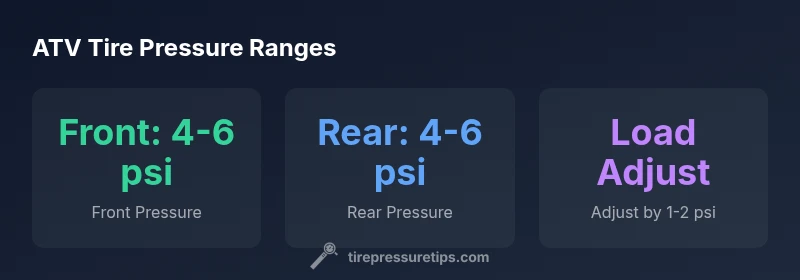
| Solo ride on hard surface | 4-6 psi | 4-6 psi | Base pressures per manual; check TPMS |
| Solo ride on soft/off-road | 4-5 psi | 4-5 psi | Lower range for softer terrain |
| Two-up or cargo | 5-7 psi | 5-7 psi | Increase by 1-2 psi depending on weight |
Frequently Asked Questions
What is the baseline recommended tire pressure for quads?
Baseline pressures are model-specific and found in the owner’s manual or tire placard. Typical ranges are around a few psi, but always start from the manufacturer’s numbers and adjust only after test rides.
Start with the manufacturer’s spec and fine-tune after test rides.
Do ATVs require different pressures for front and rear tires?
Yes, some models benefit from slight differences. Check the manual for exact front and rear targets, then make small adjustments if needed.
Some models have small front-rear differences; verify with the manual.
How often should I check ATV tire pressure?
Check before every ride if possible, or at least weekly. TPMS helps, but manual checks ensure accuracy.
Check before riding, or weekly if no trip is planned.
Can overinflation or underinflation cause handling issues?
Yes. Overinflation reduces grip and increases ride stiffness; underinflation can cause bead damage and poor handling. Stay within the recommended range.
Both extremes are risky; keep within the recommended range.
What should I do if TPMS reads low but there’s no leak?
Inspect valves and rim seals, and recheck after cooling. If readings persist, inspect for slow leaks or take the quad to a professional.
Check for leaks and recheck; seek service if needed.
Are TPMS sensors common on ATVs?
TPMS is present on some quads but not universal. If your model lacks TPMS, rely on regular manual checks.
Some quads have TPMS; others rely on manual checks.
“Maintaining correct tire pressure is a safety and performance lever for ATVs; even small deviations can alter handling, traction, and tire wear.”
What to Remember
- Follow manufacturer specs as the baseline.
- Balance front and rear pressures for stability.
- Adjust for load and terrain in small steps.
- Use TPMS alongside a reliable gauge for accuracy.