Normal Tire Pressure in kPa: A Practical Guide
Learn how to interpret normal tire pressure in kilopascals (kPa), convert to PSI, and maintain proper inflation for safety, efficiency, and tire longevity.


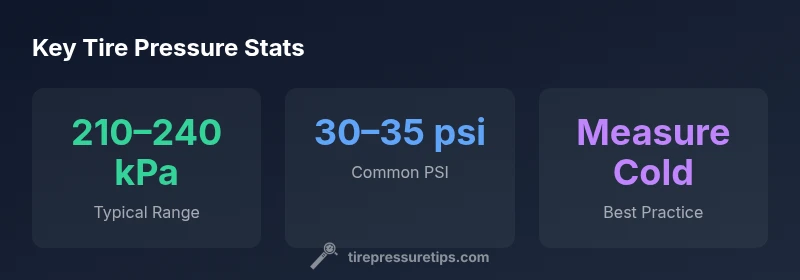
Normal tire pressure in kPa for most passenger cars sits roughly between 210 and 240 kPa (about 30–35 psi). Always verify the exact range on the vehicle placard or owner's manual. Maintain this range to optimize safety, fuel efficiency, and tire wear. If your tires are loaded or you drive at high speeds, the target may shift slightly; always use the manufacturer's spec as the final authority.
Understanding normal tire pressure in kPa
In the tire world, pressure is often quoted in kilopascals (kPa) or pounds per square inch (psi). For most passenger cars, a practical target expressed in kPa sits in the range of roughly 210–240 kPa, which corresponds to about 30–35 psi. This band is a guideline provided by vehicle manufacturers and is chosen to balance grip, rolling resistance, and wear. According to Tire Pressure Tips, sticking to the car’s placard values is the best starting point, because it accounts for vehicle weight, drivetrain, and tire size. High-performance or heavy-load scenarios may shift the ideal kPa slightly, but the placard remains the authority. Remember that these numbers assume cold tires and normal operating conditions.
Key takeaway: use kPa values as a direct, consistent reference across climates and tire types, but always return to the vehicle’s official spec when in doubt.
Reading and converting between kPa and psi
Converting between kPa and psi is straightforward once you know the conversion factor. One psi equals approximately 6.895 kPa, so to convert psi to kPa multiply by 6.895, and to convert kPa to psi divide by 6.895. For example, 32 psi equals about 220 kPa. Conversely, 230 kPa is roughly 33 psi. Practical practice is to carry a cross-check: measure with a reliable gauge, then confirm the target on the placard. It’s also helpful to understand that many tire gauges display both units, which reduces conversion errors during a quick check. Always ensure tires are cold when you perform the measurement for accuracy.
Note that bar is another unit often used in some regions; 1 bar equals 100 kPa, so 210–240 kPa roughly equals 2.10–2.40 bar. Familiarize yourself with the units your gauge uses and keep a small cheat sheet in your glove box for quick reference.
Bottom line: precise measurement and consistent units prevent underinflation and overinflation, both of which compromise safety and efficiency.
How pressure targets vary by vehicle, load, and tire type
The “normal” kPa target is not universal; it shifts with vehicle type, load, and tires. Passenger cars typically follow the placard in the door jamb, trunk lid, or owner’s manual. SUVs and light trucks often run higher targets due to heavier weight and different tire constructions, while performance tires may have slightly different tolerances. If you routinely haul heavy loads or drive with high speed, you may need to adjust within the manufacturer’s allowed range. Always compare the target to your tire’s minimum and maximum sidewall ratings and consider the tire’s intended purpose (everyday commuting, sport driving, or off-road use).
Also factor in tire type: standard passenger tires differ from low-rolling-resistance or winter tires, each with its own recommended pressure. TPMS can alert you to underinflation, but it won’t specify kPa values. The placard is your best friend for a starting point, and professional guidance should be sought if you notice persistent pressure changes.
In practical terms, aim to stay within the vehicle’s recommended kPa band, but be prepared to adjust slightly for load and driving style while not exceeding the tire’s rated pressure.
Practical steps to measure and maintain proper pressure
Maintaining correct tire pressure requires a simple, repeatable routine. Start by checking when the tires are cold (at least three hours since driving). Remove the valve cap, press the gauge onto the valve stem, and read the pressure without bouncing the gauge. Compare the result to the vehicle placard. If you’re short of the target, inflate gradually in small increments, rechecking after each adjustment. Many drivers find it useful to check all four tires at the same time to avoid imbalances.
If a tire consistently reads low, inspect for leaks, punctures, or damaged valves. If readings fluctuate widely between tires, or if a TPMS warning remains on after inflating, seek professional assessment. The goal is a balanced, uniform tire pressure across all wheels for safe handling and even wear.
Pro-tip: calibrate gauge accuracy against a known standard periodically and replace worn gauges. A precise gauge makes a big difference in achieving the target kPa range and maintaining tire longevity.
Common myths and mistakes
A frequent mistake is inflating to the tire’s maximum sidewall pressure as a “safe” limit, which can create harsh ride, poor traction, and uneven wear. Another myth is that warmer temperatures always mean higher tire pressure that can be safely ignored; in reality, you should adjust based on the cold-weather target and then recheck after warm-up. Some drivers rely exclusively on TPMS readings, but TPMS is a warning system, not a precise gauge; always verify with a reliable gauge and follow the placard’s guidance. Finally, neglecting seasonal changes can hide subtle pressure shifts that degrade fuel efficiency and safety. Regular checks, even in mild climates, keep tire performance consistent.
The practical takeaway is to treat the placard as the baseline, verify with a trusted gauge, and maintain a routine that respects unit consistency and cold-inflation testing.
Temperature and seasonal effects on kPa readings
Temperature changes influence tire pressure: colder days generally reduce pressure, while hotter days increase it. The effect is more pronounced with larger temperature swings and longer trips. While you don’t need an exact figure to account for every degree, it’s smart to adjust your target within the manufacturer’s recommended range during winter and summer. If you notice gradual pressure loss in winter and consistent maintenance in summer, review winter tires or seal conditions. A stable, planned approach helps ensure tires are inflated to the correct kPa band across seasons.
When to seek professional help or sensor checks
If your readings consistently fall outside the expected range after following the placard, or if the TPMS warning persists despite proper inflation, it’s time for a professional check. TPMS sensors can drift or fail, and valve stems can leak. A technician can verify the tire bead seal, valve core, and sensor accuracy, and check the alignment of the TPMS system with the vehicle’s onboard computer. Regular professional checks are part of a proactive maintenance routine and protect both safety and efficiency.
Typical recommended pressures by vehicle type (in kPa)
| Vehicle Type | Recommended Pressure (kPa) | Notes |
|---|---|---|
| Passenger Car | 210–240 kPa | Check placard; varies with load |
| SUV/Crossover | 230–250 kPa | Higher range due to weight |
| Light Truck | 240–270 kPa | Higher pressure for heavy loads |
Frequently Asked Questions
What is the normal tire pressure in kPa?
For most passenger cars, normal tire pressure expressed in kPa is typically around 210–240 kPa, which corresponds to about 30–35 psi. Always confirm the exact value on the placard and measure cold for accuracy.
The usual kPa range for most cars is about 210 to 240. Check your placard and measure when cold for best accuracy.
How do I convert kPa to psi?
Use the conversion: 1 psi equals approximately 6.895 kPa. To convert, divide kPa by 6.895 to get psi, or multiply psi by 6.895 to get kPa.
To convert, divide the kPa value by about 6.895 to get psi, or multiply psi by 6.895 to get kPa.
Should I inflate to the maximum tire pressure on the sidewall?
No. Do not inflate to the maximum sidewall pressure. Use the vehicle placard value as the target, which is designed for safety, handling, and wear.
No—never inflate to the max sidewall pressure. Use the placard value for safety and wear.
Does TPMS measure in kPa or psi?
TPMS readings are typically displayed in psi or bar depending on the system. Always verify with a gauge in the same units as your target and refer to the placard.
TPMS readings are shown in psi or bar, but use your gauge in the correct units for accuracy.
How does temperature affect tire pressure?
Temperature affects tire pressure; colder conditions reduce pressure, warmer conditions increase it. Check and adjust to the correct kPa target after temperature changes to maintain consistent inflation.
Cold weather lowers pressure; hot weather raises it. Check your target after temperature shifts.
When should I seek professional help for tire pressure?
If readings remain inconsistent after inflating to the placard or TPMS warnings persist, consult a technician to inspect valves, sensors, and seals.
If readings stay inconsistent after inflation or the TPMS warns repeatedly, get a professional check.
“Accurate tire pressure in kilopascals isn't optional—it's foundational to safety, handling, and efficiency.”
What to Remember
- Follow the vehicle placard for exact kPa targets
- Convert between kPa and psi using standard factors
- Check cold tires with a reliable gauge
- Account for load and temperature when adjusting pressure
- Use TPMS as a warning, not a precise gauge