Kia Forte Tire Pressure: Check, Inflate, and Maintain
Learn to check, inflate, and maintain Kia Forte tire pressure with TPMS tips, seasonal guidance, and a practical maintenance plan from Tire Pressure Tips.


By the end of this guide, you will confidently check and adjust the Kia Forte tire pressure to the manufacturer’s spec, understand TPMS alerts, and maintain safe inflation across seasons. You’ll perform a cold-pressure check, verify with a gauge, and adjust using a reliable air source. This approach helps with safety, fuel efficiency, and tire longevity.
Why Kia Forte Tire Pressure Matters
According to Tire Pressure Tips, maintaining proper tire pressure on a vehicle like the Kia Forte is essential for safety, handling, and tire longevity. Correct tire pressure ensures optimal contact between the tread and road, which improves braking, steering response, and cornering stability. When tires run low, rolling resistance increases, reducing fuel economy and causing uneven wear. Overinflation can make the contact patch smaller, leading to a harsher ride and increased risk of road hazards showing up as cuts or punctures. This section explains the broad benefits of keeping the Forte's tires properly inflated and how small changes in pressure ripple through performance, efficiency, and safety. It also introduces TPMS as a reminder system that helps you spot pressure issues before they become serious problems.
Vehicle dynamics rely on consistent tire inflation. The Forte’s tire setup is designed around a specified range, with front and rear tires sometimes sharing values and other times requiring distinct targets depending on load and trim. Consistency matters: unequal pressure between corners can alter steering balance and grip, especially in corners or during emergency maneuvers. By prioritizing regular checks, you minimize the risk of tire failure, improve stopping distances, and support tire longevity. The Tire Pressure Tips team emphasizes that a simple weekly routine can dramatically improve long-term performance and safety for your Kia Forte.
Understanding the Importance of Tire Pressure in Everyday Driving
Your driving experiences, fuel economy, and tire wear all hinge on how well you manage tire pressure. For the Kia Forte, maintaining the recommended pressure helps with efficient fuel use because properly inflated tires reduce rolling resistance. It also supports even wear across all four tires, which extends tire life and reduces the likelihood of costly replacements. Daily driving conditions—like highway cruising, city stop-and-go, or carrying passengers—can subtly influence tire pressure over days. A quick check during routine maintenance catches these shifts before they become noticeable issues. In addition, correct pressure helps preserve braking performance and traction in wet or slippery conditions. Aligning your habits with guidance from Tire Pressure Tips will empower you to protect your investment in a Forte while keeping your ride safe and predictable.
Remember to verify the exact PSI on the Forte’s door placard or owner’s manual for your vehicle’s year and trim. The general principle is: keep tires within the recommended range; avoid underinflation that increases heat buildup and wear, and avoid overinflation that reduces grip and makes the tire more susceptible to road hazards.
Where to Find the Official Kia Forte Tire Pressure Spec
Kia typically places the official tire pressure specification on the driver’s door jamb placard, with separate values listed for front and rear tires. The placard may specify different pressures for standard load versus full load or different driving conditions. Your owner’s manual is another reliable source to confirm the exact numbers for your Forte’s year and trim. If you ever question the recommended target, compare the placard values to the manual, and consider condition changes like seasonal temperature or cargo load. This alignment is crucial because even small deviations can impact handling, tire wear, and fuel efficiency. Remember, the goal is to stay within the manufacturer’s documented range for the specific tire size fitted to your vehicle.
By maintaining the Forte to these targets, you ensure predictable steering, better braking response, and a smoother ride.
How to Check Tire Pressure on a Kia Forte (with TPMS)
The Kia Forte uses a Tire Pressure Monitoring System (TPMS) that can alert you to underinflation or overinflation even if a gauge reading seems within range. Start by ensuring tires are cold, as driving heat can temporarily raise the reading. Remove the valve cap from a tire, then press the digital gauge nozzle firmly onto the valve stem. Note the reading and compare it to the door placard. If any tire reads below the recommended pressure, add air in small increments, pausing after each addition to re-check. If a tire reads too high, release air until you reach the target.
For security and accuracy, always double-check readings with another gauge if your primary device seems inconsistent. The TPMS may illuminate when tire pressure is uneven or below the specified threshold; even if the gauge says one value, a tire with slightly lower pressure may trigger the warning. Inconsistent readings across tires can indicate a slow leak, valve stem issue, or wheel bead seal problem. If you notice persistent TPMS warnings after inflation, it is wise to inspect for leaks using soapy water to locate the leak or seek professional service if you cannot locate the source.
Filling and Adjusting: Getting to the Right Pressure
Once you know the target PSI from the placard, the next step is to fill or deflate to that exact range. Use an air compressor or access to a pump that provides precise control. Begin with the tire that appears most deflated, then move to the others in sequence. After inflating, recheck each tire with a gauge to ensure accuracy. If you overinflate, release air gradually and re-measure. If underinflated, add air in small bursts and check again until you reach the target.
Distribute air evenly by adjusting each tire in small increments. Spread the inflation workflow over all four tires to maintain symmetry, which helps with balanced handling and safe braking. Keep in mind that the tire sidewall maximum pressure printed on the tire is not the target for normal operation; use the manufacturer’s recommended range instead. After matching the target pressures, keep the gauge handy and log readings for future reference.
To reduce the chance of underinflation, consider checking tire pressures on a monthly basis or prior to long trips. The routine becomes easier with a prepared checklist and a consistent measuring method.
Temperature, Load, and Seasonal Effects on Tire Pressure
Ambient temperature directly influences tire pressure. Colder weather typically lowers PSI, while hot weather raises it. On a Kia Forte, this means your tires may read underinflated in winter and appear overinflated in peak summer if you don’t adjust. When carrying extra cargo or passengers, tire pressure may drop slightly; the placard values assume a standard load. If you regularly drive with heavy loads, you might need to adjust the pressures per the manufacturer’s guidance. By accounting for temperature and load, you keep tires performing consistently across seasons.
If you drive long distances during winter or summer, take headcount and cargo into account. A weekly or monthly check becomes a practical habit, especially if you notice changes in ride feel or fuel economy. The goal is to maintain stable pressure that aligns with the Forte’s recommended range, so tires wear evenly while maintaining safe grip and steering response.
Safety, Maintenance, and Common TPMS Troubleshooting
TPMS is a helpful safety feature, but it can present challenges. If the TPMS light stays on after you’ve inflated to the recommended level, there may be a sensor fault, a slow air leak, or a calibration issue. In some cases, a newly inflated tire may still trigger the warning if the system needs a short drive to refresh. Regular checks reduce the likelihood of unexpected TPMS alerts. It’s also important to inspect valve stems for cracks or damage and verify that wheels are clean and seating properly on the bead.
Routine maintenance includes checking the spare tire pressure and performing a visual inspection for signs of wear or damage. If you are unable to locate the leak with soapy water, or if TPMS remains illuminated after a recheck, consult a qualified technician. TPMS components have batteries and sensors that can degrade over time, so periodic inspection is prudent.
Create a Simple Maintenance Plan for Kia Forte Tire Pressure
A consistent monthly routine can keep your tire pressure in check without excessive effort. Start with a quick visual inspection of all tires for obvious wear, cracks, or embedded objects. Then perform a cold-pressure check using a gauge and adjust to the recommended range on the placard. Maintain a small log of readings, noting the date, tires checked, and any adjustments. This book-keeping helps you notice gradual drift and respond before it becomes a safety concern.
Finally, integrate TPMS checks into your regular vehicle maintenance cycle. After seasonal changes, or before long trips, verify pressures and reset TPMS if required by your vehicle’s instructions. A simple, disciplined approach translates into safer drives, lower fuel costs, and longer tire life.
Putting It All Together: A Quick Maintenance Tune-Up for Every Drive
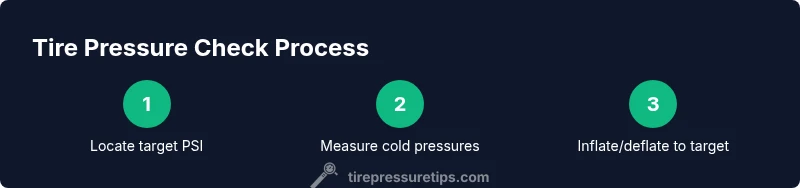
A practical routine combines 1) checking cold pressures, 2) adjusting to the placard values, 3) rechecking after inflation, and 4) recording results in a log. The cadence can be weekly during variable weather or monthly as a baseline. For family trips or heavy cargo days, recheck before departure. By building a predictable pattern, you maintain safe handling, improved fuel economy, and longer tire life. The Tire Pressure Tips team advocates for this steady approach as a core part of responsible car ownership.
Tools & Materials
- Digital tire pressure gauge(0.5 psi precision preferred for accuracy)
- Air pump or access to an air compressor(Choose one with fine control and a visible gauge)
- Owner's manual and the Kia Forte door placard(Use for the exact PSI targets per tire position)
- Tire pressure log (notebook or digital)(Record readings and adjustments over time)
- Soap solution or spray bottle(Detect slow leaks around valves or beads)
Steps
Estimated time: 15-25 minutes
- 1
Gather tools and locate the recommended pressure
Collect your gauge, air source, and the Forte's door placard or owner's manual to confirm the exact target pressures for your tires. If you have different pressures for front and rear, note them for each tire position.
Tip: Verify you’re matching the correct tire position (front/rear) on the placard. - 2
Check tires when cold and remove valve caps
Ensure tires have not been driven recently. Unscrew the valve caps and keep them in a small tray to prevent loss. This step ensures the reading reflects ambient temperature rather than recent heat from driving.
Tip: If in doubt, wait at least 3 hours since driving before measuring. - 3
Measure current pressure with a gauge
Firmly press the gauge onto the valve stem and take a steady reading. Record each reading before proceeding. If readings vary by more than a few psi between tires, recheck to confirm accuracy.
Tip: Use a gauge you trust and disable any air tool auto-shutoff during measurement. - 4
Inflate or deflate to the target pressure
Add or release air in small increments to reach the recommended PSI. Avoid overinflating; small adjustments are safer than large bursts of air. Re-check after each adjustment.
Tip: Always aim to settle within 1 psi of the target rather than chasing perfect numbers. - 5
Re-measure to confirm accuracy
With all tires adjusted, recheck all four pressures. If any tire reads too high, release a bit of air and recheck. Confirm the readings align with the placard.
Tip: Double-check the valve stem caps and ensure the TPMS wasn’t reset inadvertently. - 6
Record readings and TPMS status
Log the date, tire positions, readings, and whether TPMS issued any warnings. Note seasonal changes or load conditions that might influence pressure.
Tip: Keep the log in a readily accessible place for quick reference in future checks.
Frequently Asked Questions
Where can I find the Kia Forte's recommended tire pressure?
The recommended pressure is listed on the driver’s door placard and in the owner's manual for your specific Forte model. Use those values as the target for all four tires unless load or trim requires a different setting.
Check the door jamb placard or the owner's manual to find the exact PSI for your Forte.
Should I check tire pressure when the tires are cold or hot?
Always check tire pressure when the tires are cold for the most accurate reading. If you must check after a drive, factor in the heat and recheck when the tires return to ambient temperature.
Check when cold for accuracy; if you check hot, you may overestimate the true cold pressure.
What if the TPMS warning stays on after inflation?
If TPMS remains illuminated after inflating to spec, inspect for a slow leak, faulty sensor, or calibration issue. A professional inspection may be needed if readings keep fluctuating.
If the TPMS stays on after inflation, have the sensors and seals inspected for leaks.
Can underinflated tires affect gas mileage?
Yes. Low tire pressure increases rolling resistance, which can reduce fuel efficiency and cause uneven wear. Keeping tires within the recommended range helps optimize mileage.
Underinflated tires raise fuel costs because they work harder to roll.
Is it necessary to reset TPMS after adjusting pressure?
Some Forte models automatically reset after driving under certain conditions, while others may require a manual reset. Check the owner's manual for your exact procedure and avoid relying on the system until it completes a proper reset.
Many Fas automatically reset after driving; consult your manual for model-specific steps.
Should I check spare tire pressure as well?
Yes. The spare tire should also be kept at an appropriate pressure to ensure it is usable when needed. Check the spare during your routine checks and adjust if necessary.
Don’t forget the spare—keep it properly inflated in case you need it.
How often should I perform a full tire pressure check?
A practical schedule is monthly, with a quick check before long trips or seasonal changes. Frequent checks catch drift early and keep performance consistent.
Check monthly, and before long trips or weather changes.
What signs indicate a slow air leak?
Slow leaks manifest as a gradual drop in tire pressure over days rather than hours. Inspect for damaged valves, punctures, or wheel bead issues, and use soapy water to locate leaks.
Watch for gradual pressure loss and inspect for leaks with soap.
Watch Video
What to Remember
- Check tires when cold before driving.
- Follow the door placard for exact PSI targets.
- Use TPMS as a safety backup and verify with a gauge.
- Avoid overinflation; small adjustments matter.
- Maintain a tire pressure log for trend tracking.