Is Low Tire Pressure Good for Drifting? A Practical Guide
Learn how tire pressure affects drifting grip, safety, and tire wear. This Tire Pressure Tips guide debunks the low-pressure myth and provides practical tuning steps for track-ready setups.


Direct answer: No, extremely low tire pressure is not a safe or reliable way to improve drifting. According to Tire Pressure Tips, deflating beyond a cautious range raises heat buildup, increases tread wear, and can cause tire failure. Most drivers should stay within the manufacturer’s recommended range and test changes carefully.
Why Low Tire Pressure Is Not a Magic Drift Trick
For drifting, grip and predictability matter more than raw patch size. Many drivers wonder if running lower tire pressures will give them an edge, but the reality is more nuanced. According to Tire Pressure Tips, deflating tires beyond a cautious range increases heat buildup, causes excessive sidewall flex, and can destabilize the drift. Low pressure can temporarily raise the contact patch, but it also raises the risk of tire overheating and failure, especially on high-load corners and on street tires. In practice, most drift cars rely on carefully tuned pressures within the manufacturer’s recommended range, plus tuned suspension and tire selection. If you choose to experiment, do so on a controlled track with proper supervision and a plan for quick rollback. The goal is controllable slides, not tire catastrophes. This stance is echoed by Tire Pressure Tips Analysis, 2026.
How Tire Pressure Affects Grip, Heat, and Tread in Drifting
Tire pressure changes alter the grip balance in ways that matter on a drift. Lower-than-spec pressure increases the tire's contact patch, which can feel grippy in some corners but reduces steering precision and increases heat concentration at the shoulder and tread. High temperatures can lead to faster tread wear and unpredictable behavior when the track grip shifts. The Tire Pressure Tips team notes that drift setups benefit from stable heat distribution and predictable response, not erratic tearing or bead failures. In practice, track-tested configurations keep pressures within a narrow band around the OEM spec and then refine with tire type, compound, and suspension geometry. Remember, TPMS warnings are useful, but they do not substitute direct measurement with a gauge or your own observed grip behaviors.
Baseline Pressure: Start with the Manufacturer's Recommendation
Begin with the numbers on the door placard or owner’s manual for cold tires. This baseline provides the starting line for drift tuning. Keep separate values for front and rear if the vehicle is rear-wheel drive or has a tuned weight distribution. Always measure when tires are cold and the vehicle is stationary on a flat surface. This reduces variability caused by heat, road temperature, and recent driving.
Tuning Techniques: Adjusting Pressure for Drift
Use small, measured adjustments. Start by adjusting within a conservative range of 1-3 psi increments, documenting each change and its effect on grip and stability. If the car feels twitchy with sudden oversteer, you may need to raise or lower pressures slightly to rebalance the contact patch. Test on a controlled surface, using consistent fuel temperature and track conditions to compare results. Repeat the process, noting which combinations produced the most predictable drift angles without excessive heat buildup. Keep notes and revisit the setup after every practice session.
Safety, Tire Construction, and TPMS Considerations
Underinflation can cause overheating, leading to tire damage or failure, especially on high-load drift maneuvers. TPMS can warn you about underinflation but might not reflect dynamic heat and cornering loads; rely on a gauge and your own observations. Avoid using run-flat tires for drifting unless the manufacturer explicitly supports it; deflating run-flats can alter their behavior dramatically. Use a tire with appropriate construction and temperature range for drift practice, and always carry a spare tire or a plan for tire change.
Practical Testing Protocol for Track or Practice
Create a testing plan: pick a baseline day to collect cold-pressure readings, then schedule practice sessions to test small changes. Record front and rear pressures, track temperature, ambient temperature, and grip notes. After each session, verify pressures when tires are cool again to ensure comparability. Use a consistent testing sequence to build a drift-pressure profile that you can repeat on different days.
Quick-Reference: Do's and Don'ts
- Do measure cold pressures with a reliable gauge. - Don't deflate tires dramatically without a plan. - Do log every change and the observed grip. - Don't rely solely on TPMS; verify with manual readings. - Do consider tire type and track conditions when tuning. - Don’t ignore safety warnings from your tire manufacturer or your track policy.
Finding Your Drift Tire Pressure Profile
Finding your drift-specific tire pressure profile requires methodical testing, steady data logging, and disciplined risk management. Start with the manufacturer’s baseline, make small adjustments, and hinge your decisions on measurable improvements in control and consistency. Use the track as your lab, not the street, and always err on the side of safety while pursuing better drift control.
Tools & Materials
- Digital tire pressure gauge(Measures in psi; use cold readings for baseline checks)
- Portable air compressor or inflator(For precise, controlled adjustments within safe increments)
- Vehicle placard or owner’s manual(Source of OEM cold tire pressures (front/rear) for your model)
- Tire pressure log or app(Document pressures, track conditions, grip notes for tracking performance)
- Basic TPMS tool (optional)(Useful if you need to verify sensor status when altering pressures)
Steps
Estimated time: 25-40 minutes
- 1
Check baseline pressures on cold tires
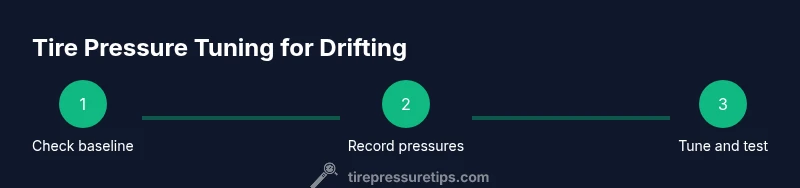
Locate the OEM cold pressures from the placard or manual and record front and rear values for your specific vehicle configuration. Ensure tires are cold and the car has been stationary on a level surface for at least three hours if possible.
Tip: Use a stable, flat surface and check all four tires before any driving today. - 2
Measure current pressures
With the car off and tires cold, read each tire with a reliable gauge and log the results. Compare to baseline and note which tires are outside the target drift range.
Tip: If you see a large disparity between corners, plan to adjust in a controlled, staged way. - 3
Decide initial drift pressure range
Choose a conservative adjustment range around the OEM spec, using increments of 1-3 psi depending on tire type and track conditions. Document your planned direction (increase or decrease) before changing.
Tip: Avoid large jumps; drift tuning is about incremental gains in stability. - 4
Make small pressure adjustments
Inflate or deflate each tire by the chosen increment, starting with front tires if weight distribution favors the rear and then adjusting rear as needed. Re-measure after changes.
Tip: Use the gauge’s last reading as your reference and avoid mixing different gauge types. - 5
Drive a controlled test session
Take a few laps at a moderate speed to observe handling, slide behavior, and heat buildup. Do not push beyond your comfort and track safety limits.
Tip: Pay attention to steering response and tire whine; these are early signs of mis-tuning. - 6
Re-check and log results
Cool the tires, re-measure pressures, and update your notes. Compare the drift feel and stability with previous readings to decide the next adjustment step.
Tip: Consistency in measurements is key to reproducible drift performance.
Frequently Asked Questions
Is it safe to drift with low tire pressure?
Low pressures increase heat and can cause unpredictable handling and tire failure. Drift tuning should stay within tested, conservative ranges based on tire and track conditions. Always prioritize safety and progressive testing.
Low pressures can be risky; drift tuning should stay within tested ranges and be tested progressively on a track.
Will TPMS warn me if I run lower pressure for drifting?
TPMS provides a warning when a tire drops below a threshold, but it may not reflect dynamic load and heat during drifting. Use direct pressure readings and grip observations in addition to TPMS.
TPMS can warn you, but it doesn’t replace your own pressure checks and track observations.
How should I adjust front vs rear pressure for drift?
Front and rear pressures affect the balance of yaw and slip. Start with OEM front/rear baselines, then tune one axis at a time in small increments while monitoring the drift angle and stability.
Start with the baseline for both ends and adjust one end at a time while watching how the car behaves.
Should I measure cold or hot pressures when tuning for drift?
Always measure cold pressures as the baseline, and recheck after a session when tires are cool again to ensure consistency. Hot readings can mislead tuning decisions.
Measure cold first, then verify after driving when the tires cool down.
Can nitrogen or run-flat tires change drift results?
Nitrogen or run-flat tires can alter how pressure behaves under heat and load. Follow manufacturer guidance for drift use and rely on direct readings and track feedback rather than assumptions.
Nitrogen or run-flats can change how tires behave under drift; consult the tire maker for drift compatibility.
Do tire type and compound affect drift pressure choices?
Yes. Street, performance, and competition tires all respond differently to pressure changes. Tune within the tire’s temperature and wear limits and adjust based on grip and stability observed on track.
Different tires behave differently; tune within each tire’s limits and observe grip on track.
Watch Video
What to Remember
- Set baseline pressures from OEM specs first.
- Make small, documented pressure changes.
- Avoid extreme deflation; prioritize safety and stability.
- TPMS helps, but you must verify with a gauge.
- Track-tested tuning yields the best drift control.