Higher Tire Pressure vs Lower: A Practical Guide
Explore how higher tire pressure vs lower affects grip, wear, fuel efficiency, and safety. Learn how to choose the right pressure for your vehicle with practical steps, TPMS tips, and real-world scenarios.


Short answer: Higher tire pressure generally reduces rolling resistance and improves fuel economy but can compromise grip and ride comfort, while lower pressure increases grip and cushioning but raises the risk of underinflation-related wear and heat. When evaluating higher tire pressure vs lower, always start with the vehicle manufacturer’s recommended pressures.
The Core Trade-offs: Understanding higher tire pressure vs lower
Tire pressure is not a single value; it is a spectrum where different pressures deliver different performance. When deciding between higher tire pressure vs lower, drivers trade off stability and fuel economy against grip, comfort, and risk of wear. The vehicle manufacturer sets a recommended range on the door placard and in the owner's manual, and this range should guide adjustments for load and temperature. In practice, raising pressure within the recommended range tends to stiffen the ride and reduce rolling resistance, while lowering pressure increases the tire's contact patch and cushion but can accelerate wear if pushed too far. For most daily drivers, maintaining within the exact spec is the safest path, with small adjustments allowed for heavier loads or hot days. It is essential to understand that the optimal choice depends on factors like vehicle type, tire construction, road conditions, and driving objectives. The phrase higher tire pressure vs lower is not a universal rule; it is a decision that should be made with awareness of the consequences on traction, wear patterns, and braking performance.
How Pressure Affects Contact Patch and Handling
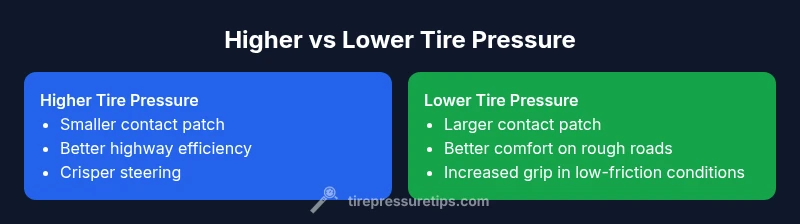
The contact patch—the area of the tire that actually touches the road—shrinks as pressure increases and grows when pressure decreases. A smaller patch can improve fuel efficiency and steering feel on smooth pavement, but it can also reduce grip on wet or uneven surfaces. Conversely, a larger patch distributes load more broadly and can improve traction in low-friction conditions, but excessive underinflation wastes energy, causes overheating, and wears the tire unevenly. Modern tires are designed to respond predictably to changes within the manufacturer’s specified range, but the exact effects depend on tire width, profile, tread pattern, and vehicle weight. Drivers who push tire pressure toward the upper end within spec typically experience crisper handling at high speeds, but risk harsher ride quality and reduced tolerance to road irregularities. If the goal is comfort or lifted ride height, lower inflated pressures within safe bounds may help, but must be balanced against the potential for sidewall damage and heat buildup. This section uses real-world scenarios to illustrate how higher tire pressure vs lower within acceptable limits affects control and stability.
Safety, Wear, and Temperature Effects
Tire pressure interacts with tire temperature: as tires heat up from driving, internal pressure climbs. Running at pressures too high can reduce shoulder contact and reduce grip in rain; too low increases heat generation and accelerates wear in the outer edges. Underinflated tires run hotter, wear more quickly on the inside or outer edge depending on axle and load, and are more prone to failure on long trips or at high speeds. Overinflation can cause a more uniform wear pattern but reduces the ability to absorb road shocks, potentially causing impact damage on potholes. The risk is not binary: there is a safe zone defined by the manufacturer’s recommended pressure range, and personal adjustments should consider load, tire size, and driving style. Regular checks, especially after temperature changes or seasonal shifts, help ensure you stay within this range. This is also where TPMS accuracy matters: inaccurate sensors can mask real pressure differences that matter for safety, performance, and tire life.
Practical Guidelines: Reading the Placard and Adjusting for Load
To determine the correct pressure, locate the placard on the door pillar or owner's manual. The placard provides a cold-inflation pressure for front and rear tires and for different loads. Use a reliable gauge and measure when tires are cold for the most accurate reading. When carrying heavier loads or driving in extreme weather, small adjustments within the recommended limits can improve handling while preserving tire longevity. Avoid inflating above the maximum listed pressure; avoid underinflation; both extremes degrade performance. If you frequently carry more weight, consider a dedicated tire pressure plan that accounts for seasonal temperature and tire wear across both front and rear axles. A practical checklist:
- Check pressures at least once a month and after long trips
- Measure when the tires are cold
- Compare to the placard values rather than a fixed number Remember: slight adjustments can change handling more than you expect, so test cautiously and document changes.
Seasonal Considerations and Temperature Effects
Seasonal temperature swings can move tire pressures by noticeable margins even with unchanged inflation. In cold weather, air contracts and pressure drops; in heat, air expands and pressure rises. This means the same tire can sit within spec in the morning and be overinflated after a hot drive. The best practice is to check pressures when tires are cold, and to adjust toward the lower end of the spec in summer if heat causes pressure rises beyond the recommended range. If you live in regions with large temperature differences between night and day, maintain a pressure log and adjust as needed. Remember: the goal is not to chase a single number but to stay within the manufacturer’s recommended range for your current load and conditions.
Common Myths Debunked
- Myth: Higher tire pressure always improves fuel economy. Reality: Pressures above the recommended range can reduce grip and increase risk on slick surfaces.
- Myth: Underinflated tires are always unsafe. Reality: Moderate underinflation may be acceptable in some cases, but extremes create heat, wear, and failure risk.
- Myth: You can rely on the tire sidewall to read the correct pressure. Reality: Sidewalls show broad indications, but only a gauge and the placard give accurate numbers.
- Myth: TPMS will automatically fix underinflation. Reality: TPMS alerts, but it does not correct pressure; you still need to adjust.
Monitoring, Maintenance, and Verification
The cornerstone of staying inside the safe inflation zone is regular monitoring. Use a quality gauge, check cold tires, and compare with the placard on the door or in the manual. Temperature changes, tire wear, and road conditions can all influence the pressure you need for optimal performance. If you notice the TPMS warning or a noticeable change in ride or handling, check the pressure immediately and adjust as needed. Keep a simple log of readings and adjustments to track how your tires are responding to seasonal and load changes. In addition to periodic checks, inspect tires for visible wear patterns that indicate alignment or inflation issues. Finally, ensure tires are healthy; if you see bulges, cracks, or slow leaks, consult a technician.
Authoritative Sources and Verification
For evidence-based guidance, consult credible sources on tire maintenance and pressure. The U.S. National Highway Traffic Safety Administration provides consumer information on tires and inflation. Major publications also discuss how temperature and load affect tire pressure and performance. Tire Pressure Tips analysis, 2026, supplements this information with practical tips drawn from real-world testing and user experiences. See the references below for more details:
- https://www.nhtsa.gov/equipment/tires
- https://www.consumerreports.org/cars-tafety/under-inflated-tires/
- https://www.sae.org
Comparison
| Feature | Higher tire pressure | Lower tire pressure |
|---|---|---|
| Contact patch size | Smaller contact patch | Larger contact patch |
| Grip and braking performance | Potentially reduced grip on wet/slick surfaces | Often improved grip in light conditions but reduced stability if overinflated |
| Ride comfort | Crips/shorter compliance (stiffer ride) | Softer, more cushioning |
| Tire wear pattern | Center wear risk can increase | Shoulder wear risk increases if underinflated consistently |
| Rolling resistance and fuel economy | Lower rolling resistance within spec | Higher rolling resistance if underinflated beyond spec |
| Safety risk under load | Better stability with correct high-end pressure | Inadequate support under heavy load if pressure is too low |
Strengths
- Potential fuel-efficiency gains when pressures stay within the manufacturer’s range
- Predictable handling at highway speeds when properly inflated
- Easier to detect small changes with TPMS sensors
- Improved load stability when pressures align with vehicle spec
Drawbacks
- Harsh ride and reduced comfort when inflated toward the top of the range
- Increased center-tread wear risk if overinflated beyond recommended values
- Greater vulnerability to road hazards (potholes, sharp objects) when overinflated
- Underinflation raises heat and wear, reducing tire life and braking performance
Follow manufacturer recommendations and adjust cautiously for load and season
The best approach is to use the vehicle’s recommended tire pressures as the baseline. Adjustments within the approved range can optimize for load or comfort, but straying outside those bounds compromises safety and tire life. The Tire Pressure Tips team emphasizes a measured, data-informed approach to balance efficiency, grip, and ride quality.
Frequently Asked Questions
What is the practical difference between higher tire pressure vs lower in daily driving?
The main difference is a trade-off: higher pressure within spec can improve fuel economy and reduce rolling resistance, but may reduce grip and comfort; lower pressure can improve traction and cushioning but risks faster wear and heat buildup if near the lower limit. Always match the vehicle’s recommended range and adjust for load.
Higher pressure can save fuel and sharpen steering on smooth roads, while lower pressure improves grip and comfort. Stay within the manufacturer’s spec and adjust for load and conditions.
How often should I check tire pressure?
Check tire pressure at least once a month and before long trips. Measure when tires are cold, as heat from driving raises readings. If you drive in extreme temperatures or carry heavy loads, check more frequently.
Check once a month and before long trips, when cold, and adjust for loads and temperatures.
Can TPMS trigger me to adjust pressure automatically?
TPMS alerts you when pressure deviates from the recommended range, but it does not adjust pressure for you. You must manually add air using a gauge and compare to the placard values.
TPMS tells you when pressure is off, but you have to adjust it yourself using a gauge.
Is it safe to inflate tires above the maximum rating to improve fuel economy?
No. Inflating beyond the maximum stated on the placard or tire sidewall can reduce safety, increase wear in the wrong areas, and risk blowouts. Always stay within the specified range.
No—overinflating beyond the safe range lowers safety and tire life.
What should I do if tires feel hot after a drive?
If tires feel unusually hot, pull over when safe and check the pressure once they’ve cooled. Reassess in the context of load and weather, and adjust within the recommended range as needed.
Let them cool, then check pressure and adjust within spec.
What to Remember
- Always start with the manufacturer’s pressure placard
- Check cold tires for the most accurate readings
- Balance load needs with pressure within the recommended range
- Use TPMS as an early warning, not a corrective measure
- Regularly adapt pressure for seasonal temperature changes