Best Way to Lower Tire Pressure: Safe, Practical Guide
Learn the best way to lower tire pressure safely with practical steps, tools, and safety notes. This guide explains when deflation is appropriate, how to measure accurately, and how to avoid underinflation while maintaining tire performance.


Lowering tire pressure safely begins with the vehicle’s recommended range. Use a reliable gauge, release air in small 1–2 psi increments, and recheck after tires cool. Do not deflate below the tire’s minimum rating, and avoid rapid changes. The best way to lower tire pressure is to follow the manufacturer’s guidance and use gradual releases for accurate, even results across all tires.
Why Lowering Tire Pressure Correctly Matters
The decision to lower tire pressure affects grip, wear, fuel efficiency, and braking performance. The best way to lower tire pressure is not a one-size-fits-all move; it requires alignment with the vehicle’s published specifications and the current driving context. According to Tire Pressure Tips, the safest approach is to start from the manufacturer’s recommended cold psi range, then adjust gradually in small increments. Reading tire pressure while tires are cold provides the most accurate baseline because warm tires read higher due to heat inside the tire. By following a deliberate deflation plan, you can improve contact patch behavior on soft surfaces, prevent pinch flats when carrying heavy loads, and keep steering responsive. The key is to stay within safe limits and verify all four tires reflect the same level of deflation when necessary. In practice, tire pressure is a dynamic parameter that changes with temperature, load, and road conditions—and actions should be taken with care rather than rushing toward comfort or fuel economy alone.
When Lowering Tire Pressure Is Appropriate
Not every situation calls for deflating tires. Lowering tire pressure can improve traction on loose surfaces like gravel or sand, help with ride comfort on rough roads, or balance handling when carrying heavier loads. It’s important to note that deflation should be used judiciously and never exceed the manufacturer’s minimum specification. If you’re testing new pressures, start with small changes and monitor tire wear and fuel economy over several days. Restoring to the recommended range when switching to highway driving preserves safety and performance. The Tire Pressure Tips team emphasizes context: the same vehicle’s pressures may differ between off-road and highway conditions, so keep the goal in mind—stability and control under expected conditions.
Temperature and Pressure: What Drivers Should Know
Air expands when tires warm up during driving and contracts as they cool. Temperature changes influence pressure readings, so measurements taken after driving on hot pavement may read higher than the actual cold pressure. For accuracy, check pressures when tires are cold and allow a few minutes of rest after inflation/deflation to stabilize readings. If you live in climates with extreme temperatures, remember that baseline pressures can drift with weather, so recheck regularly. Reliable tire maintenance matches weather-aware planning with adherence to the placard values and manufacturer guidance, ensuring safer performance across seasons.
Safety Limits and Manufacturer Recommendations
Always start with the vehicle’s placard or owner's manual to determine the safe operating range for each tire. Even if performance cues tempt you toward lower pressures, you must remain above the tire’s minimum inflation and within the axle-specific targets. Underinflation increases heat buildup and wear, while overinflation reduces contact patch and dampens grip. If you’re unsure, rely on the OEM specifications and your TPMS readings as guides, not final arbiters. The goal is to maintain stable, even contact with the road while accommodating load, terrain, and temperature shifts.
How Underinflation Affects Handling and Wear
Lower pressures change the tire’s shape, increasing the sidewall collapse under load and altering handling characteristics. This can improve comfort on rough surfaces but may also cause uneven wear along the edges and increase heat buildup in the tire’s shoulder areas. Persistent underinflation can compromise cornering stability and braking distance, particularly in wet conditions. Always monitor tire wear patterns and balance inflation choices against driving demands, tire type, and load. If you notice unusual vibration or wandering, check pressures and adjust to the recommended range.
Tools and Preparation: What You Need to Lower Pressure
Before you deflate, gather the right equipment. A reliable digital tire pressure gauge, the vehicle’s placard, and a method for releasing air in small increments are essential. Optional items can include a small marker to record target pressures and chalk for identifying tires. Park on a level surface, engage the parking brake, and ensure the tires are cool. If you drive regularly in different conditions, keep a note of the acceptable ranges for your tires, and avoid improvisation that may lead to unsafe inflation.
How to Measure and Verify Correct Pressure
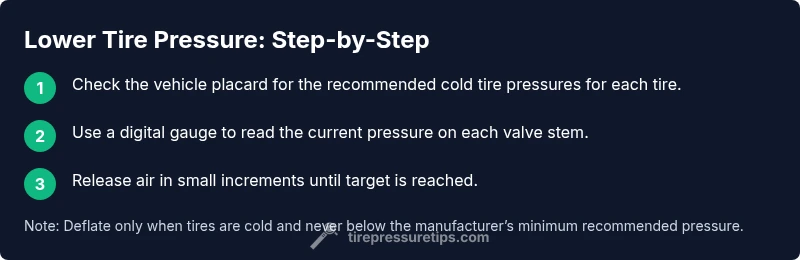
Check cold pressures against the placard to determine the target per tire. Attach your gauge to the valve stem, read the current pressure, and adjust by releasing air in small increments until you reach the target. After inflating or deflating, recheck all four tires to ensure consistency. For precision, recheck after tires have cooled for several minutes. If you use TPMS, verify that the sensor readings align with gauge measurements, and recalibrate if needed.
Practical Deflation Techniques and Best Practices
Use a gauge with a small release mechanism to release air in controlled steps. Do not chase a single number; margins matter because the road, weather, and driving style all influence what is safe. Deflate gradually, then drive a short distance and recheck to confirm stability. Keep your valve caps on to prevent dust and maintain seal integrity. When in doubt, err on the side of a slightly higher inflation, then monitor performance over time.
Maintenance Routine: Regular Checks and When to Reinflate
Tire pressure is not a one-time task. Make it part of a regular maintenance routine—especially when seasons change, temperatures shift dramatically, or you load the vehicle differently. Check pressures monthly and before long trips, and after any substantial tire service. A simple habit—check, adjust, and record—becomes a powerful tool for safety, fuel efficiency, and optimal handling. The Tire Pressure Tips approach emphasizes consistent checks and thoughtful adjustments rather than ad hoc deflation.
Tools & Materials
- Digital tire pressure gauge(Select a gauge with 0.5 psi (or better) resolution and a built-in release valve if possible.)
- Vehicle owner’s manual/placard(Use the recommended cold pressures for your vehicle.)
- Chalk or sticky notes(Mark target pressures or record per-tire readings for reference.)
- Tire deflation tool (built-in release)(Useful for precise 1–2 psi adjustments.)
Steps
Estimated time: 20-40 minutes
- 1
Check target pressures
Read the placard or owner's manual to confirm cold pressures for each tire and remember your baseline. This gives you reference points before you deflate.
Tip: Record the target psi per tire. - 2
Prepare the vehicle
Park on level ground, engage the parking brake, and ensure the vehicle is stationary with the tires cool before deflating.
Tip: Avoid inflating or deflating with the tires hot. - 3
Remove valve caps and attach gauge
Take off valve caps, place the gauge on the stem, and read the current pressure. If your gauge has a release valve, keep it ready for tiny adjustments.
Tip: If you hear air escaping, stop and verify the gauge is seated properly. - 4
Deflate in small increments
Release air in small steps (about 1–2 psi) and recheck after each increment to avoid overshooting the target.
Tip: Document each adjustment for accuracy. - 5
Recheck after tires cool
Recheck pressures after the tires have cooled for several minutes and compare with the target values.
Tip: If readings differ significantly, repeat the adjustment. - 6
Restore caps and final check
Replace valve caps, recheck all tires, and confirm consistent pressures. If TPMS exists, verify sensor readings align with gauges.
Tip: Keep records for future reference.
Frequently Asked Questions
Is it safe to lower tire pressure for better fuel economy?
Lowering tire pressure can reduce rolling resistance and slightly improve fuel economy in some cases, but it may also decrease grip and increase wear. Always stay within manufacturer-recommended ranges and test changes gradually.
Lowering tire pressure can affect fuel economy, but only within the manufacturer’s recommended range. Start small and monitor performance.
How do I know the minimum safe pressure for my tires?
The minimum safe pressure is set by the tire and vehicle manufacturer and is listed on the placard or in the owner's manual. Do not deflate below this value, even if you want a softer ride.
Check the placard or manual to find the minimum safe pressure and don’t go below it.
Can TPMS readings guide deflation?
TPMS can indicate under- or overinflation, but it is not a precise substitute for a gauge. Use TPMS as a check after adjusting with a reliable gauge.
Use TPMS as a backup check after measuring with a gauge.
Should I deflate when tires are hot or cold?
Deflate or inflate only when tires are cold for accuracy. Hot tires read higher and can mislead your target pressures.
Do adjustments when tires are cold to get accurate readings.
What’s the best way to verify accuracy after deflation?
Recheck pressures after tires cool and ensure each tire matches its target. If readings vary, adjust again in small increments.
Recheck after cooling and adjust in small increments as needed.
Watch Video
What to Remember
- Check manufacturer pressures before deflating.
- Deflate gradually and recheck after cooling.
- Avoid underinflation by staying within the recommended range.
- Use a reliable gauge for accurate readings.
- Record target pressures for future reference.