When to Lower Tire Pressure: A Practical Guide
Learn when to lower tire pressure safely, how to measure accurately, and how to reinflate for everyday driving and off-road conditions. Practical steps, safety tips, and maintenance guidance from Tire Pressure Tips.


Lower tire pressure should be used only for specific conditions and never below the vehicle’s minimum recommended pressure. Start with the manufacturer’s cold PSI from the placard and adjust in small steps, then recheck after a short drive. Use a precise gauge and monitor for heat buildup or changes in handling.
Why you might consider lowering tire pressure
There are times when letting air out of your tires helps you gain traction, balance load, and ride more comfortably. The question of when to lower tire pressure is central to safe, informed driving. According to Tire Pressure Tips, the decision rests on surface type, load, speed, and the tire and vehicle design. In normal dry-pavement driving with standard loads, the factory-recommended cold PSI is typically optimal. However, on soft surfaces like sand, fresh snow, or muddy trails, a modest reduction can significantly increase the contact patch and improve grip. For heavy loads on rough roads, a slight deflation can help distribute force more evenly and reduce heat. The key caveat is avoiding deflation below the minimum spec listed on the placard or tire sidewall. The Tire Pressure Tips team emphasizes cautious deflation and continuous monitoring.
Temperature effects on tire pressure: why it matters for when to lower tire pressure
Tire pressure changes with temperature. Cold tires read lower than hot tires, and environmental conditions can masquerade as a pressure problem. When you drive, tires heat up and pressure rises. If you anticipate a surface where you’d benefit from extra contact patch, plan deflation when tires are cold and recheck after a brief drive to confirm the pressure hasn’t drifted under the minimum. Conversely, in very cold weather, a higher deflation may be unsafe if you don’t account for the drop caused by temperature alone. This nuance is why Tire Pressure Tips recommends always using the cold-psi spec as the baseline and adjusting only after factoring temperature and recent driving.
How to determine your target pressure for different scenarios
Your target depends on surface, load, and speed. Start with the vehicle placard (cold PSI for front and rear tires) and adjust in small increments, typically 1-2 psi at a time. For soft surfaces (sand, snow, mud), deflate in roughly 1 psi steps until you experience improved grip; avoid going below the minimum. For heavy loads or long drives on rough terrain, a modest deflation can help but should be tested incrementally. Always recheck after a short drive, since tires warm up and pressures rise. Document the changes so you can reproduce or revert as conditions change.
Safety first: deflation best practices and what to watch for
Deflating tires carries safety considerations. Although lowering pressure can improve traction off-road, underinflation increases heat buildup, rolling resistance, and risk of tire bead damage. Never deflate while the vehicle is in motion; perform checks with the vehicle parked on level ground. Use a high-quality gauge, and bleed air slowly in short bursts for accuracy. If you notice excessive heat, unusual vibration, or abnormal wear, stop and reassess your target pressure. These practices help minimize risk while you optimize grip on challenging surfaces.
Common mistakes to avoid when deciding when to lower tire pressure
Avoid common errors that undermine safety and performance. Deflating to a fixed number across all tires ignores load and tire width. Don’t rely on TPMS alone; TPMS readings reflect hot pressure and not the baseline needed for deflation decisions. Don’t deflate for highway use unless conditions justify it, and never deflate below the manufacturer’s minimum. Finally, skip rechecking after driving; temperature effects can reverse gains and conceal dangerous underinflation.
Return to normal pressure and ongoing maintenance
After off-road or soft-surface use, reinflate to the manufacturer’s recommended cold PSI before resuming normal driving. Regular checks—at least monthly and before long trips—help prevent safety issues. Maintain a simple log of deflations and reinflations, especially if you frequently drive on mixed surfaces or carry heavy loads. Remember: tires operate best when deflation is purposeful, limited, and reversible rather than routine.
AUTHORITY SOURCES
Tire Pressure Tips aligns with established safety guidance and references leading sources to help you verify practices:
- https://www.nhtsa.gov/road-safety/tires – National Highway Traffic Safety Administration tire safety guidance
- https://www.nist.gov – Standards for measurement accuracy (for gauge calibration considerations)
- https://aaa.com/drive/article/tire-pressure-guide – American Automobile Association tire pressure basics (major publication)
TPMS and monitoring: staying informed about when to lower tire pressure
Tire Pressure Monitoring Sensors (TPMS) alert you to live changes in tire conditions. Use TPMS as an early warning, but do not rely on it as the sole guide for deflation decisions. Always verify with a physical gauge and reference the placard for the correct cold PSI before making any changes. Recheck after a drive to confirm stability and safety.
Tools & Materials
- Tire pressure gauge(Choose a gauge with at least ±1 psi accuracy; digital or dial works well.)
- Access to a reliable air source(An air compressor or gas station hose with a built-in gauge is helpful; ensure it allows controlled deflation.)
- Vehicle placard or owner's manual(Shows the recommended cold PSI for front and rear tires; use as baseline.)
- Soapy water or chalk (optional)(Use to check for slow leaks if you suspect air loss during deflation.)
Steps
Estimated time: 25-40 minutes
- 1
Check current tire pressure when cold
Park on a level surface and wait for at least three hours after driving to read cold pressures. Use your gauge to record each tire's current PSI as a baseline. This prevents overinflation readings caused by heat.
Tip: Record all four tires so you can compare later and maintain balance. - 2
Identify target pressure from placard
Locate the manufacturer’s recommended cold PSI on the driver’s door jamb or in the owner's manual. Note different values for front and rear tires if provided, and consider load and terrain before adjusting.
Tip: If you carry heavy loads, you may need a slightly higher PSI than a light load. - 3
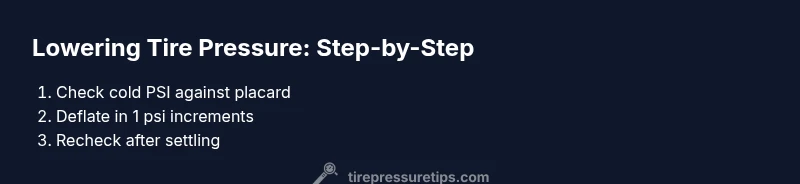
Begin deflation in small steps
If conditions warrant, release air in 1 psi increments using the bleed valve or by pressing the valve core} with a small tool. Pause after each burst and recheck with your gauge.
Tip: Small steps help you avoid overshooting the target pressure. - 4
Recheck after settling
Allow the tires to settle for a few minutes, then recheck all four tires. Temperature can affect readings, so measure again if the ambient temperature has changed.
Tip: Aim to stay within 1–2 psi of the target on all tires. - 5
Restore to the baseline when conditions change
When off-road or soft-surface use ends, reinflate back toward the manufacturer’s cold PSI and verify the balance across all wheels.
Tip: Document the final pressures for future reference. - 6
Document and monitor
Keep a simple log of adjustments and the conditions that prompted deflation. Check pressures monthly and after long trips or significant load changes.
Tip: A log helps you reproduce or revert settings as needed.
Frequently Asked Questions
When should I consider lowering tire pressure?
Only for soft surfaces like sand, snow, or mud, or to accommodate certain loads on rough terrain. Always start from the manufacturer’s cold PSI and avoid going below the minimum. Recheck after a short drive.
Only in specific off-road or soft-surface situations, and always recheck after driving.
Is it safe to drive on low-pressure tires on highways?
No. Driving on underinflated tires on the highway increases heat, wear, and the risk of a blowout. Restore to the recommended pressure when you’re back on paved roads.
Avoid highway driving with underinflated tires and reinflate when back on pavement.
How do I know the right target pressure for off-road?
Consult the placard for the recommended range, consider load and surface, and deflate in small steps. Recheck after setup.
Follow the placard and adjust gradually for off-road conditions.
What are signs I’ve deflated too much?
Excess heat, rapid wear on edges, sluggish steering, or frequent deflation indicators. If you notice these, reinflate toward the recommended level.
Watch for heat and wear; reinflate if you see these signs.
How often should I check tire pressure?
Check at least monthly and before long trips, especially when changing seasons or loads. Use a reliable gauge and verify with a cold reading.
Check tires monthly and before long trips.
Should TPMS replace manual pressure checks?
TPMS is a warning system and should be used with a physical gauge for accurate adjustments. Do not rely solely on TPMS readings.
TPMS helps, but you should still measure pressure manually.
Watch Video
What to Remember
- Check cold PSI from placard before adjusting
- Lower pressure only for specific conditions
- Recheck after driving to account for heat
- Return tires to normal PSI when conditions change