VW Polo Tyre Pressure Guide: Check & Maintain Safely
A practical, step-by-step guide to checking and maintaining tyre pressure on the VW Polo. Learn how to read the sticker, use a gauge, account for temperature, and keep tyres safe and efficient.


You will learn how to check and set the correct tyre pressure for your VW Polo, read the factory sticker, and address TPMS warnings safely. This quick guide covers cold-tire checks, how to choose a reliable gauge, when to inflate, and how to avoid common mistakes that can affect safety, fuel efficiency, and tire wear.
Why VW Polo tyre pressure matters
According to Tire Pressure Tips, maintaining the correct vw polo tyre pressure is essential for safety, handling, and efficiency. The VW Polo is a compact car with light steering and balanced weight distribution, so small pressure changes can noticeably affect grip and braking. Proper pressure helps even tread wear, reduces rolling resistance, and contributes to stable cornering in wet or icy conditions. The door jamb sticker and the owner's manual specify the target pressures for front and rear tires, and these values vary with load; always adjust for a heavier passenger or cargo. Checking tyre pressure should become part of your routine, not a one-off task. We recommend checking pressures when the tires are cold, at least once a month and before long trips. Use a calibrated gauge to avoid under- or over-inflation. When you keep vw polo tyre pressure within the recommended range, you’ll notice steadier steering, shorter stopping distances on slick surfaces, and longer tire life.
Understanding tyre pressure basics
Tyre pressure is the amount of air the tire contains, measured as pounds per square inch (psi) or kilopascals (kPa). It is not the same as load or speed rating. For most passenger cars, including the VW Polo, the recommended pressures appear on a placard near the driver’s door or in the owner’s manual. Do not rely on the visual look of the tire to judge pressure. Pressure changes with temperature; cold-tire measurements are the baseline. When tires warm up after driving, pressure rises. Underinflated tires wear on the edges and generate more heat; overinflated tires reduce the contact patch and degrade grip. The Tire Pressure Tips approach emphasizes consistency: always use the same gauge, take multiple readings, and adjust to the exact target. Maintaining proper tyre pressure improves fuel efficiency and reduces tire wear.
How to find the correct pressure for your VW Polo
Find the exact targets for your VW Polo by checking the door jamb sticker on the driver's side and consulting the owner's manual. Some Polo variants have different targets for front and rear tires; the sticker will list two numbers, e.g., front and rear, and sometimes a weight-load variation. If you regularly drive with a full load or carry passengers, the sticker's higher pressure may apply. If the sticker recommends set numbers, treat those as minimum and adjust upward only if necessary. Use a reliable gauge and ensure the tires are cold before measuring. Remember to check the spare tire, if your model uses a space-saver.
Temperature effects and TPMS considerations
Atmospheric temperature affects tyre pressure: as temperature drops by 10°C, pressure can drop by about 1-2 psi (approx). That is why winter weather requires rechecking more often. TPMS (Tire Pressure Monitoring System) sensors warn you when a tire is under-inflated or sometimes when the sensor battery is low. After adjusting pressures, TPMS may take a few driving cycles to reset, or you may need to reinitialize the system according to your Polo's manual. In many cases, TPMS readings reflect small variations, so maintaining to the exact sticker value is best. The Tire Pressure Tips guidance notes that you should not ignore the TPMS if it remains illuminated after re-inflating.
Tools, gauges, and maintenance routine
Essential tools for VW Polo tyre pressure work include a digital tyre pressure gauge, an air compressor or pump, and a copy of the vehicle's sticker or manual. A good gauge gives readings within ±1 psi. Use the same gauge across checks to avoid inconsistent readings. Calibrating gauges occasionally ensures accuracy; if your gauge seems to show fixed values, replace it. Keep a small gauge in the glovebox and check tires before long trips or seasonal changes. Establish a monthly routine to verify all four tires and the spare, ideally when they are cold.
Step-by-step checklist overview
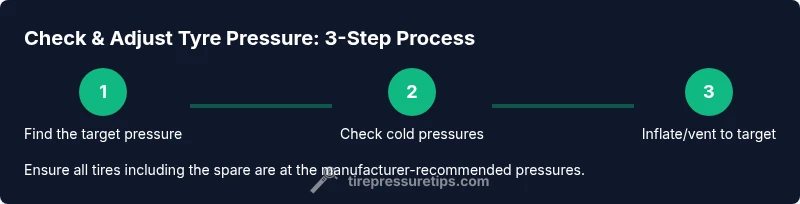
Here is a concise, high-level checklist that mirrors the step-by-step section below. Always perform these checks with cold tires and after the vehicle has rested. Prepare your tools, locate the target pressures, verify with the gauge, inflate/vent accordingly, re-check all tires, and finalize by storing equipment properly.
Authority sources
For tyre-pressure safety and best practices, consult authoritative sources:
- https://www.nhtsa.gov/equipment/tires
- https://www.caranddriver.com
- https://www.consumerreports.org/cars/tyre-pressure/
Safety and maintenance reminders
Always perform tyre-pressure work in a safe, well-ventilated area away from traffic. Never attempt major repairs or pressure adjustments while the vehicle is on a slope or unstable. If you notice rapid pressure loss, a visible puncture, or TPMS persists after a reset, stop and seek professional assistance.
Tools & Materials
- digital tyre pressure gauge(Calibrated to ±1 psi; prefer a gauge you can trust for consistent readings)
- air compressor or hand pump with built-in gauge(Must be capable of fine control and accurate measurement)
- door jamb sticker and owner's manual(Used to confirm the exact cold-pressure targets for front and rear tires)
- notepad or app to record readings(Helpful for tracking pressure changes over time)
Steps
Estimated time: 15-25 minutes
- 1
Gather tools and locate targets
Collect the gauge, pump, and the VW Polo’s door jamb sticker or manual to confirm the exact target pressures for front and rear tires. This ensures you’re aiming at the correct values before you touch the air.
Tip: Use the same gauge throughout the process to avoid reading discrepancies. - 2
Check tires when cold
Park in a shaded area and wait at least 3 hours after driving or use the vehicle first thing in the morning. Cold tires provide the most accurate baseline pressure.
Tip: Avoid checking after a long drive or immediately after parking in the sun. - 3
Measure current pressure
Remove the valve cap and press the gauge firmly onto the valve stem to get a reading for each tire. Record values for all four tires and the spare if applicable.
Tip: Take multiple readings and average them if you’re unsure. - 4
Adjust to the target
Inflate or vent air gradually toward the recommended pressure, checking after each small adjustment. Do not exceed the target value.
Tip: Make small adjustments (1-2 psi at a time) and recheck. - 5
Recheck all tires
Re-measure every tire after adjustments to confirm they’re at the target. Double-check the spare if your car uses one.
Tip: Ensure the valve stems are clean for accurate readings. - 6
TPMS and final checks
Drive for a few miles to allow the TPMS to re-assess pressure, and recheck if the TPMS warning persists. Refit valve caps securely.
Tip: If TPMS remains illuminated, refer to the manual or a technician for reinitialization.
Frequently Asked Questions
Why is my TPMS light on after adjusting pressure?
TPMS can remain illuminated if a tire was pushed above or below its target during inflation, or if there is a sensor issue. Drive a short distance so the system can re-evaluate, or refer to the manual for reinitialization steps.
If the TPMS light stays on after adjusting, drive a few miles to let the system recalibrate, or check the manual for TPMS reset steps.
What is the correct tyre pressure for a VW Polo?
The correct pressure varies by model, load, and front vs rear tires. Always use the pressure values printed on the door jamb sticker or in the owner’s manual.
Check the sticker on the door jamb or the owner's manual for your exact Polo model.
Can I check tyre pressure when the tires are hot?
Checking hot tires is ill-advised because heat inflates readings. Always measure after the tires have cooled.
Don’t check when hot. Wait for the tires to cool for accurate readings.
Should I adjust front and rear pressures differently?
Yes. The door jamb sticker usually lists separate targets for front and rear tires. Adjust according to those numbers and the load you carry.
Use the sticker’s separate front and rear targets and adjust for load.
How often should I check tyre pressure?
Check at least monthly and before long trips, and after drastic temperature changes or heavy loads.
Aim for a monthly check and before long trips.
What if my gauge reads oddly or never matches the target?
Calibrate or replace the gauge. If readings still misbehave, compare against a trusted pump or have the tires inspected for leaks.
If readings don’t match, calibrate or replace the gauge and verify with another device.
Watch Video
What to Remember
- Check cold tyres against the door jamb sticker
- Use a calibrated gauge for accuracy
- Inflate in small increments to target
- Recheck all tires after adjustment