Tire Pressure for BMW X5: Essential Guide for 2026
Learn how to check, set, and maintain tire pressure on BMW X5 for safety, fuel efficiency, and optimal performance. Includes TPMS tips and seasonal considerations.


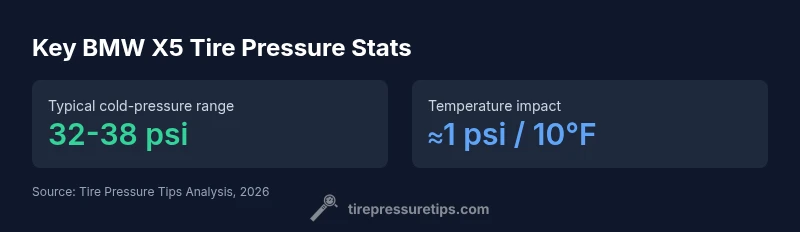
Correct tire pressure for BMW X5 depends on model year, wheel size, and load. As a general rule, cold tire pressure commonly falls in the 32-38 psi range per tire. Always verify the exact figure on the door placard or in your owner's manual, and recheck after a change in load.
Understanding the BMW X5 tire pressure system
In the BMW X5, tire pressure management combines a recommended cold-inflation value with a tire pressure monitoring system (TPMS). The placard on the door jamb lists target pressures for front and rear tires, and these values depend on wheel size, tire type, and expected load. The TPMS monitors changes in pressure and alerts you when a tire falls outside the target range. For drivers, the practical implication is simple: start with the factory spec, verify it with a gauge, and adjust for load and weather. The Tire Pressure Tips team notes that even small differences—1 to 2 psi—can influence braking performance, tire wear, and fuel economy over time. Checking pressure when tires are cold ensures readings reflect the actual cold-inflation state, not after a drive that warms the tires. By following the placard, you maintain predictable handling and maximize safety. Always include TPMS checks as part of a regular maintenance routine.
Finding the official spec for your X5
The exact tire-pressure value for your BMW X5 depends on the model year, trim, wheel diameter, tire type, and whether you regularly carry heavy loads. Start with the door jamb placard, which shows separate values for front and rear tires and sometimes for different tires (e.g., all-season vs. performance). If you recently changed tires or wheels, verify that the new setup is compatible with the recommended pressures. When in doubt, refer to the owner's manual and BMW's official service documentation for your vehicle's build. If you drive in extreme temperatures or frequently carry passengers and cargo, use the higher end of the recommended range to maintain safety margins. Always adjust for seasonal conditions, and remember that TPMS is a supplementary check rather than a substitute for manual pressure verification.
The role of TPMS in tire pressure management
BMW X5 uses a direct TPMS with sensors in each tire; some models also incorporate indirect methods. Direct TPMS provides real-time readings and alerts when a sensor detects a pressure drop below the target by a defined percentage, typically requiring air to be added or removed to reestablish the target. The system is not a substitute for manual gauge checks; you should verify readings with a reliable gauge, especially after tire repairs, rotations, or seasonal changes. If the TPMS warning appears, first confirm the reading by measuring with a gauge when tires are cold, then adjust to the correct level and reset the system if your vehicle requires it.
Temperature, speed, and load: how they change pressure
Pressure responds to temperature changes; a practical rule of thumb is that tire pressure shifts roughly 1 psi for every 10°F (5°C) change in ambient temperature. In winter, cooler air reduces pressure, leading to slightly underinflated tires unless you check and adjust. In hot weather or after long highway drives, pressure can rise. Heavier loads and higher speeds compress air in the tires and can push you toward the upper end of the recommended range. The BMW X5 placard accounts for typical loads; if you regularly tow a trailer or regularly carry heavy cargo, plan for a higher target within the allowed range. These dynamics underscore the importance of checking tire pressure under consistent conditions—ideally when cold—so you can maintain consistent grip, braking, and tire wear.
Wheel size, run-flat tires, and their impact on pressure
BMW X5 models may wear different wheel sizes and tire types; larger wheels and low-profile tires can alter the contact patch and rolling resistance, which affects the practical inflation needs. Run-flat tires, common on many BMWs, often require adherence to a precise inflation target even when the tire stores are changed; they may also feel stiffer and more sensitive to pressure deviations. Regardless of wheel size or tire type, the placard value remains the starting point; adjust for load and temperature within that range. If you switch to winter tires or change to non Run-Flat alternatives, confirm the recommended pressure in the X5's manual, as the tire specifications can shift slightly.
Seasonal considerations: winter and summer driving
Winter driving demands particular attention to pressure because cold air reduces pressure; you may have to recheck more frequently when temperatures plunge. In summer, heat increases pressure; overinflation in hot weather can reduce footprint and grip. BMW recommends checks at the start of each season and after long trips or changes in cargo. For those living in extremes, using the higher end of the range during winter and the lower end during summer can preserve safety margins. Remember that TPMS should be enabled; if you notice unusual tire wear or uneven wear patterns, recheck alignment and suspension parts as needed.
Steps to measure, adjust, and verify pressure
Step-by-step approach:
- Park on a level surface and ensure the vehicle is cold.
- Remove the valve cap and attach a reliable gauge.
- Read the tire pressure and compare to the placard values for each tire.
- Add or release air in small increments (1-2 psi) as needed.
- Recheck after a few minutes of rest to settle the tire.
- Replace the valve caps and, if necessary, reset the TPMS.
- Recheck again when tires are cold after a short drive to confirm stability. If you rotate tires, re-evaluate target pressures for front and rear as required by BMW.
Note: Some X5s carry a spare tire in the trunk; check its pressure and keep it in spec as part of overall maintenance. The Tire Pressure Tips guidance reinforces that quarterly checks support consistent performance.
Common mistakes and how to avoid them
Common mistakes include inflating to the maximum printed on the tire sidewall, failing to check tires when cold, neglecting to reset TPMS after repair, and ignoring variations due to load or weather. Avoid using the incorrect inflation numbers when switching between all-season and run-flat tires; always check the placard; use a gauge of good quality; don’t rely on the tire sidewall max pressure as a target. If you notice inconsistent readings, consult a tire technician for a professional assessment.
dataTableCaptionOptionalPropertyUnderscoreNullNullableRemark CODEBLOCK
Tire pressure guidelines for BMW X5 scenarios
| Scenario | Recommended Range (psi) | Notes |
|---|---|---|
| Standard driving | 32-35 | Utilize placard values; adjust for weather and load |
| Heavily loaded trips | 34-38 | High-load conditions may require the upper end |
| Winter driving | 34-38 | Cold weather lowers pressure; verify after seasonal shift |
Frequently Asked Questions
Why is TPMS important for BMW X5 tire pressure?
TPMS helps alert you to unsafe pressure levels. It should not replace manual checks with a gauge, especially after tire repairs or seasonal changes.
TPMS warns you when pressure is off, but you should still check with a gauge.
What is the ideal tire pressure for BMW X5?
There isn’t a universal number. Check the door placard for front and rear values and adjust for load. Use higher values only within the recommended range.
Check the placard on your door frame for the exact numbers.
How do temperature and weather affect tire pressure?
Cold temperatures lower tire pressure; hot temperatures raise it. Check and adjust more often during seasonal transitions.
Cold weather lowers pressure, so you’ll want to verify more often in winter.
Should I inflate to the maximum on long trips?
No. Inflate to the vehicle placard range suitable for load, not to the maximum on the tire sidewall.
Don’t go to the max—stick to the placard range.
Can I rely on TPMS to tell me everything?
TPMS is a helpful guide, but it can miss slow leaks. Always verify pressure with a gauge when in doubt.
TPMS helps, but manual checks matter too.
“Maintaining correct tire pressure is a simple, high-impact maintenance step that protects tire life and safety.”
What to Remember
- Verify exact specs from the placard before inflating
- Check pressure when tires are cold for accurate readings
- Temperature and load can shift optimal pressure by a few psi
- Rely on TPMS as a guide, not a substitute for manual checks