How to Check and Set Tire Pressure to 28 PSI
Learn to check and set tire pressure to 28 PSI safely. This step-by-step guide covers tools, measurement techniques, TPMS considerations, and maintenance tips for safer driving and better fuel efficiency.


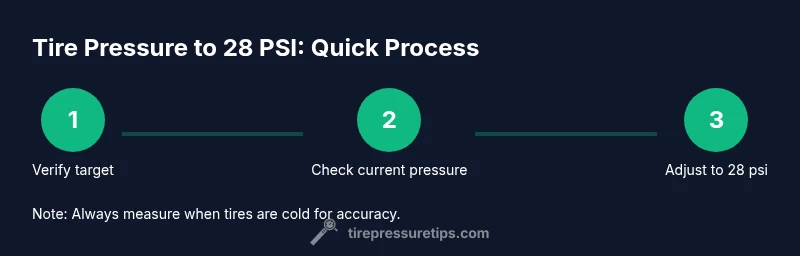
By following this guide, you will check and set your vehicle’s tire pressure to 28 psi safely and accurately. You’ll confirm the correct target using the placard or owner’s manual, measure cold tires with a reliable gauge, and adjust as needed. The steps cover TPMS considerations, seasonal effects, and maintenance tips to protect tire life and fuel efficiency.
Why tire pressure 28 matters
Tire pressure 28 is a practical starting point for many passenger cars, but the exact target should come from the vehicle’s placard or owner’s manual. According to Tire Pressure Tips, maintaining this pressure improves safety by preserving optimal road contact, boosts fuel efficiency, and reduces uneven wear. Temperature and load can shift readings, so measuring when tires are cold is essential. Tires that are under- or over-inflated affect steering feel, braking distance, and handling. The Tire Pressure Tips team found that while 28 psi works for many vehicles, always verify the official target and adjust for seasonal conditions and driving style. Keeping a regular check helps you catch slow leaks before they become emergencies.
How to locate your recommended tire pressure
The recommended tire pressure is typically listed on a sticker on the driver’s door jamb, often in pounds per square inch (psi). If you can’t locate the placard, consult the owner’s manual or the manufacturer’s online resources. Remember, some vehicles may have different targets for the front and rear tires, especially if the tires wear differently or the vehicle has a performance setup. For tire pressure 28, you should confirm whether this is a global target for all tires or just a specific axle. The goal is to follow the car’s official guidance rather than relying on a generic number. This step establishes a reliable baseline before you begin checks or adjustments.
Cold vs warm tire pressure: measuring accurately
Tire pressure readings are most accurate when tires are cold (not warmed by driving for at least three hours). Driving heats tires, increasing the air temperature and temporarily raising the psi. If you measure after a drive and then adjust, you’ll overshoot or undershoot the target. Tire Pressure Tips notes that many drivers have the best results by checking first thing in the morning or after the car has been stationary. For tire pressure 28, use cold tires to evaluate true pressure and avoid compensating for heat.
Using a tire pressure gauge: steps to measure and adjust to 28 psi
A reliable gauge is essential for precise adjustments. Start by removing the valve cap, firmly attach the gauge to the valve stem, and read the pressure. If the reading is below 28 psi, add air in small increments and recheck in between to avoid overinflation. If above 28 psi, release air until the target is reached. After achieving 28 psi, recheck all four tires and replace the valve caps. For consistency, don’t mix gauges or inflate using a dashboard readout alone; a real gauge provides a true measurement.
Effects of different tire types and load on 28 psi
Different tire types (summer, all-season, winter, run-flat) react differently to pressure changes. All-season tires generally tolerate a wider range, while winter tires can appear underinflated in cold weather if not adjusted, due to temperature effects. Vehicle load also influences the target pressure; heavier loads may require a higher psi on the placard. The key is to start from the official target and adjust only as the placard specifies, not merely by assuming 28 psi is always correct. This ensures optimal handling, tread wear, and fuel efficiency.
Seasonal temperature effects on tire pressure and 28 psi
Temperature swings have a measurable impact on tire pressure. As outdoor temperatures drop, psi tends to fall, sometimes by about 1 psi for every 5–10°F decrease, depending on tire type and volume. Conversely, hot weather can raise readings. If you monitor tire pressure regularly, you’ll notice these fluctuations and re-set to 28 psi as needed when seasons change. Tire Pressure Tips highlights that maintaining a consistent target helps prevent uneven wear and improves mileage.
Safety and maintenance considerations for sustaining 28 psi
Safety starts with consistent tire pressure. Under-inflation increases heat buildup and can lead to a blowout, while over-inflation reduces traction and can cause a harsher ride and increased wear in the center of the tread. Maintain 28 psi only if your placard supports it for your current load and speed. Rotate tires per the manufacturer’s schedule and inspect for cuts, punctures, or unusual wear that could affect pressure maintenance. If TPMS alerts, address the issue promptly to ensure continuous safety.
How to verify after inflation and track changes over time
After inflating to 28 psi, recheck with the gauge to confirm accuracy. Record the readings and date in a simple log to monitor shifts over time, especially across seasons. If you notice persistent drops in tire pressure, investigate possible slow leaks, valve stem issues, or bead leaks at the rim. Keeping a routine pressure-check cadence, such as monthly or before long trips, helps maintain optimal performance and safety.
Common mistakes and quick fixes when aiming for 28 psi
Common mistakes include measuring after a drive, using the wrong gauge, inflating to the tire’s maximum rating instead of the placard value, and neglecting the spare tire. Quick fixes involve rechecking with the same gauge, ensuring cold tires, and coordinating with a service center if leaks are suspected. By avoiding these mistakes, you’ll sustain proper tire pressure 28 and improve overall vehicle performance.
Tools & Materials
- Tire pressure gauge(Choose a dial or digital readout; ensure it’s calibrated and reads in psi)
- Air compressor or access to a pump(Home unit or gas station pump; ensure you can reach the target without overfilling)
- Vehicle door placard or owner's manual(Essential to confirm the exact target pressure per tire position)
- Marker and small notebook (optional)(To record readings and track changes over time)
Steps
Estimated time: 30-45 minutes
- 1
Find the official tire pressure target
Locate the placard or consult the owner's manual to confirm whether 28 psi is a global target or varies by axle. This establishes your baseline before adjustments.
Tip: Always start from the car’s official recommendation, not a generic guess. - 2
Gather tools and ensure tires are cold
Prepare your gauge, pump, and a log of readings. Measure when tires are cold (stationary for several hours) to avoid heat-related pressure increases.
Tip: Cold measurements yield the most accurate result. - 3
Attach the gauge and take the initial reading
Remove the valve cap, press the gauge onto the valve stem firmly, and read the pressure. Record the value before making any changes.
Tip: If readings vary by more than 1–2 psi between gauges, use a single gauge for consistency. - 4
Add air if below 28 psi
If the reading is under 28 psi, add air in small increments (about 1–2 psi at a time), then recheck after each increment.
Tip: Stop adding air as soon as you approach 28 psi to avoid overinflation. - 5
Release air if above 28 psi
If the tire reads above 28 psi, release air gradually by adjusting the valve core or using the pump's release function, then verify again.
Tip: Recheck after each small release to stay precise. - 6
Recheck all tires and reseal valve caps
Inflate or release as needed on each tire to reach 28 psi, then replace valve caps securely to prevent leaks from dirt or moisture.
Tip: Don’t forget the spare tire if it’s part of your routine. - 7
Document results and inspect tires
Log the final readings and visually inspect tires for wear, cuts, or damage that could affect pressure maintenance.
Tip: A quick photo log helps track changes across seasons. - 8
Recheck after a short drive
After driving, recheck pressure as heat can raise readings; rebalance to 28 psi if necessary.
Tip: Use the same gauge for consistency after any drive.
Frequently Asked Questions
What if my car's recommended pressure isn't 28 psi?
Always follow the placard or owner's manual; 28 psi is common but not universal. Adjust to the vehicle's specified target.
Always follow your car’s official target; 28 psi is common but not universal.
Can I check tire pressure when tires are warm?
Measuring when tires are warm can show higher readings and lead to over-inflation if used as the target. Cold measurements are recommended for accuracy.
Cold measurements are best for accuracy; avoid relying on warm readings.
How often should I check tire pressure?
Check at least once a month and before long trips. If you drive in temperature-heavy conditions, check more often.
Check monthly and before long trips.
What tools can help me maintain 28 psi?
Use a reliable gauge and an accessible air source. Calibrate or replace your gauge if readings seem inconsistent.
Have a good gauge and air source for accurate adjustments.
Why does my tire pressure drop after driving?
Heat expands air and increases pressure; once tires cool, pressure can drop slightly. Always verify after tires cool.
Pressure changes with temperature and driving; check when cold.
Should I fill to 28 psi in all tires including the spare?
Follow the placard for the spare as some spares use a different target or are not intended for regular driving.
Follow the placard for the spare; some spares differ.
Watch Video
What to Remember
- Verify the official target before adjusting.
- Check tires when cold for accuracy.
- Use a reliable gauge and be consistent.
- Adjust gradually and recheck to 28 psi.
- Record results and monitor changes over time.