Range Rover Evoque Tire Pressure Guide
Learn how to check, set, and maintain Range Rover Evoque tire pressure for safety, fuel efficiency, and tire longevity. Includes step-by-step guidance, TPMS tips, and maintenance best practices.


To properly check and maintain tire pressure on the Range Rover Evoque, locate the official cold-pressure specification on the door placard or in the owner's manual, use a reliable gauge, and inflate to that value. Adjust for load and temperature to optimize safety, fuel efficiency, and tire wear.
Why proper tire pressure matters for Range Rover Evoque
According to Tire Pressure Tips, maintaining correct tire pressure on an SUV like the Range Rover Evoque is essential for safety, handling, and tire longevity. Proper pressure ensures predictable steering response, balanced wear, and efficient fuel use. When pressures drift away from the manufacturer’s specification, you may notice softer turns, reduced grip, uneven wear, and higher fuel consumption. In the Evoque, precise inflation helps preserve the refined ride and safety performance that owners expect from a luxury compact SUV.
Finding the official Evoque tire pressure specification
The correct tire pressure for your Range Rover Evoque is not a single universal number; it varies by model year, wheel size, and load. Start with the door placard located on the driver's side jamb; it lists cold inflation targets for the front and rear tires. If the placard is missing or unreadable, consult the owner's manual or a dealership. For many Evoque configurations, the recommended cold pressures will be given in psi and may differ between front and rear axles. Note that the tire sidewall maximum pressure is not the target for daily driving; that maximum is a safety limit. Always inflate to the numbers on the placard when tires are cold, and adjust if you carry heavy loads or drive at high speeds.
Temperature, load, and tire pressure dynamics
Tire pressure changes with ambient temperature; a 10-degree Fahrenheit change can affect pressure by about 1 psi. When you drive, heat builds inside the tire and pressure rises; when you park in cold weather, pressure drops. For the Evoque, heavier loads or frequent highway driving can push pressures above the nominal target, especially in the front tires due to steering and weight distribution. Keep a simple log of seasonal pressure targets and check after long trips or temperature swings.
TPMS and its role (and limits)
The Evoque’s TPMS alerts you if a tire is underinflated or overinflated, but it does not tell you the exact current pressure. Treat TPMS as a warning, then verify with a gauge. Tire Pressure Tips Analysis, 2026 shows that relying on TPMS alone can miss gradual leaks or small underinflation until the warning threshold is crossed. Always cross-check with a physical gauge when you hear a warning or after a significant temperature change.
Quick, repeatable check workflow
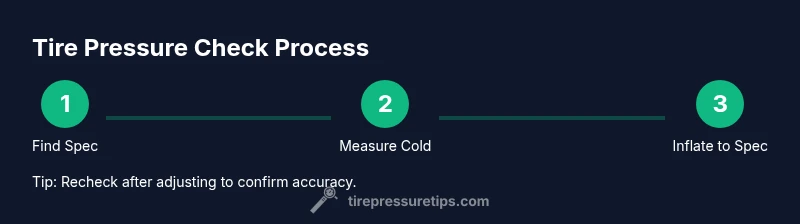
Before you start, ensure the vehicle is parked on a level surface, the engine is off, and tires are cold. Gather a reliable tire pressure gauge and an air source. Measure each tire’s pressure, compare with the placard, and inflate or deflate as needed. Recheck after adjustment to confirm accuracy. This sequence minimizes under- or over-inflation errors and promotes even wear.
Common mistakes and troubleshooting
Common mistakes include measuring right after a drive (tires are warm, readings are high), inflating to the maximum sidewall pressure instead of the placard value, ignoring differences between front and rear pressures, using a worn or inaccurate gauge, and neglecting the spare tire. To troubleshoot, re-measure after the tires cool and verify against the placard; replace a faulty gauge; and inspect for slow leaks that can throw readings off over weeks. Authority sources are cited below for further validation.
Authority Sources
For further validation and guidance, consult credible sources such as government and university publications. Useful references include: https://www.nhtsa.gov, https://www.fueleconomy.gov, and https://www.energy.gov.
Maintenance plan and next steps
Establish a simple maintenance routine that fits your driving pattern. Check tire pressures monthly, after long trips, and with significant temperature changes. Maintain a running log of each tire’s pressures and wheel, and adjust for seasonal load and speed. The Tire Pressure Tips team recommends scheduling a formal tire pressure review with your local dealer during seasonal maintenance or before long road trips to ensure the Evoque remains safe and efficient.
Tools & Materials
- Digital tire pressure gauge(Choose a gauge with a clear display and a range that covers typical psi values (e.g., 0–60 psi).)
- Air compressor or access to a station with an inflation system(Ensure the compressor is functioning correctly and set to a precise target pressure.)
- Owner's manual and door jamb placard(Always use the model-specific cold-pressure values listed by Range Rover for your Evoque.)
- Pen and notebook(Record tire pressures and any changes for tracking over time.)
- Tire thermometer or ambient temperature gauge(Helpful for correlating temperature changes with pressure changes.)
Steps
Estimated time: 25-45 minutes
- 1
Locate the official pressure spec
Find the cold tire pressure spec on the door jamb placard or in the Evoque’s owner’s manual. This value is model-year specific and may differ between front and rear tires.
Tip: Verify you’re reading the placard for the exact wheel size and trim of your Evoque. - 2
Park and ensure tires are cold
Park on a level surface, turn off the engine, and wait for at least 3 hours or after the car has been idle to ensure tires are cold.
Tip: Measuring cold tires prevents inflated readings that happen when tires warm up during driving. - 3
Clean valve stems and remove caps
Take off the valve caps and wipe the stems to remove dirt. Dirt can affect gauge accuracy.
Tip: Keep caps in a safe place to avoid losing them. - 4
Attach gauge and read the pressure
Push the gauge onto the valve stem firmly and squarely to get a stable reading. Record front and rear values.
Tip: If the reading seems off, re-check with a known-good gauge. - 5
Inflate or deflate to the spec
Add air or release air to reach the exact cold-spec pressure. Avoid overcorrection; make small adjustments and re-check.
Tip: If you’re near the limit of a tire’s capacity, avoid overinflation to protect sidewalls. - 6
Recheck all tires after adjustment
Measure all four tires again to confirm consistency and safety. Don’t forget the spare if applicable.
Tip: Inconsistent readings indicate gauge or valve issues that may require inspection. - 7
Reset or verify TPMS status
Drive normally to allow the system to recalibrate, or consult the manual if local resets are required.
Tip: TPMS is a warning tool—not a substitute for a manual pressure check. - 8
Log and schedule the next check
Record the pressures and plan the next check, especially after seasonal changes or long trips.
Tip: Consistency builds reliability and saves tire wear over time.
Frequently Asked Questions
What is the proper Range Rover Evoque tire pressure?
Pressures are model-specific and typically found on the door placard or owner's manual. Always inflate to those cold-tyre targets.
Check the door placard for your Evoque’s exact cold pressures and use a gauge to confirm.
Why does TPMS warn even if I think the pressure is correct?
TPMS alerts when a tire is underinflated or overinflated, but it doesn’t provide exact numbers. Verify with a gauge.
TPMS gives warnings, not exact pressures, so recheck with a gauge.
Should I inflate tires to the max sidewall pressure?
No. Do not exceed the placard’s target. The maximum on the sidewall is a safety limit, not a target.
Never inflate to the max; follow the placard values.
How often should I check Evoque tire pressure?
Check at least monthly, and after long trips or significant temperature changes.
Check monthly and after temperature shifts or long drives.
Do front and rear pressures differ on the Evoque?
Some Evoque models have different front and rear targets; always verify on the placard.
Yes, some models have separate front and rear pressures; check the placard.
What tools should I use to check tire pressure?
A reliable tire pressure gauge and access to an inflation device.
Use a good gauge and a pump or air compressor.
What about the spare tire pressure?
If you carry a spare, check its pressure as well and know its target pressure.
Don’t forget to check the spare tire.
Watch Video
What to Remember
- Check pressures when tires are cold.
- Inflate to the door placard values (front/rear if specified).
- Account for temperature and load changes.
- Use TPMS as a supplement, not a replacement for gauge readings.
- Record pressures to monitor changes over time.