Mazda CX-5 Tire Pressure: Check, Inflate & Maintain
Learn how to check, inflate, and maintain proper tire pressure for your Mazda CX-5. Practical steps, TPMS insights, and a maintenance plan from Tire Pressure Tips.


Get your Mazda CX-5 tires inflated to the vehicle’s recommended pressure and learn how to verify it accurately. This quick guide covers where to find the spec, how to measure cold tires, and how to adjust inflation for optimal safety and fuel efficiency. Expect durable tires and better handling.
Mazda CX-5 Tire Pressure Basics
Maintaining correct tire pressure on the Mazda CX-5 is a foundational aspect of safe driving, fuel efficiency, and tire longevity. Proper inflation affects how the vehicle handles cornering, braking, and straight-line stability, especially when the road surface is uneven or when carrying a full load. The Tire Pressure Tips team emphasizes that consistency matters: inflate to the manufacturer’s specification for each axle and tire size, and check pressure regularly as conditions change. Start by locating the official spec on the driver’s door jamb placard or in the owner’s manual, then compare it to the tire sidewall maximums to understand safety limits. Remember: every CX-5 model year and trim can have slightly different targets, so use the exact numbers for your vehicle. According to Tire Pressure Tips, maintaining correct pressure helps even tire wear and predictable handling across weather and road conditions.
Where to Find the Official Specs for Your Mazda CX-5
Your Mazda CX-5’s tire pressure specifications are not a guessing game. The placard on the driver’s door jamb typically lists the recommended front and rear tire pressures for standard load, and some models provide slightly different targets based on trim or seating. If the placard is missing or unclear, consult the owner’s manual or a Mazda dealership service sheet for the exact values. It’s important to note that the recommended PSI is a balance between comfort, efficiency, and tire wear, not the maximum tire pressure printed on the sidewall. By sticking to the official spec, you maintain stability during acceleration and braking and protect the tire’s internal structure over time.
How to Check Tire Pressure Accurately
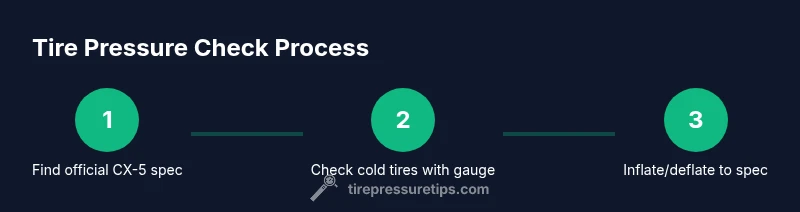
For the most accurate reading, measure tire pressure when the tires are cold (ideally before you’ve driven more than a mile). Remove the valve cap, press the gauge onto the valve stem firmly, and note the reading quickly. Compare the result to the CX-5’s door placard values; if you’re off, inflate or deflate in small increments and recheck. Use a reliable gauge (digital or analog) and avoid relying on visual checks alone, which can mislead you about actual pressure. If you’re at a service station, ensure the air compressor gauge is calibrated and set to the correct value before adding air.
The Role of TPMS in the Mazda CX-5
The Mazda CX-5 uses a tire pressure monitoring system (TPMS) to alert you when an individual tire drops below the recommended pressure. TPMS can be direct (measuring actual tire pressure) or indirect (using wheel speed sensors for relative changes). When the TPMS warning activates, you should check all tires for proper inflation and service any leaks or slow punctures. Even if one tire reads close to spec, slight variations among tires can affect handling, so balance pressures per the manufacturer’s guidance. Regular checks help you address stem leaks, damaged valves, and aging seals before they become unsafe.
Temperature, Seasons, and Tire Pressure
Temperature changes have a direct impact on tire pressure: as outdoor temperatures drop, tire pressure tends to decrease; rising temperatures can increase pressure. In Mazda CX-5s, pressure variation due to temperature is more noticeable in extremes and can lead to misreadings if you don’t check when tires are cold. Use the same calibration method across seasons and remember that the same tire may need a slight adjustment after a long highway drive or a trip loaded with gear. Consistency in measurement and adjustment is key to maintaining safe tire performance year-round.
Common Mistakes and Quick Fixes
Common mistakes include measuring hot tires, ignoring small pressure differences between front and rear tires, and inflating to the tire’s maximum sidewall pressure instead of the vehicle spec. Always verify the exact CX-5 target for your tires, and avoid overinflating, which can cause a harsh ride and uneven wear. If you notice frequent pressure losses, inspect for leaks around valves, rims, and punctures. Quick fixes include reseating the valve stem, replacing faulty caps, and using a quality gauge to verify readings after adjustments. These steps prevent misreads and ensure accurate maintenance.
A Practical Maintenance Routine for Your CX-5
Create a simple maintenance schedule: check tire pressure at least once a month and before long trips, especially when your CX-5 carries extra cargo or passengers. Use the official spec from the placard, adjust if necessary, and recheck within a few minutes to confirm stability. When seasons change, re-confirm the target pressures and adjust for temperature differences. Maintaining a routine will help you maximize fuel efficiency, improve safety, and extend tire life. The Tire Pressure Tips team recommends logging each reading in a notebook or smartphone to track trends over time.
How to Record and Monitor Tire Pressure Effectively
Keeping a record of your tire pressures helps you spot gradual leaks or slow punctures early. Note the date, ambient temperature, and tire pressure for each tire, especially after you rotate tires or replace wheels. Compare your readings against the CX-5’s official specs and note any consistent deviations. Over time, you’ll be able to identify patterns—such as tires that consistently lose pressure—that warrant service. If you notice persistent changes, consult a qualified technician to inspect valves, rims, and tires for structural issues.
Tools & Materials
- Tire pressure gauge (digital preferred)(Calibrated; use the same gauge across all checks)
- Mazda CX-5 door jamb placard or owner's manual(Source of official per-tire pressure specs)
- Air compressor or access to a service station(Needed to adjust pressure to spec)
- Notebook or mobile log(Record readings and changes for trend tracking)
- Valve caps and possibly a valve-core tool(Helps seal and adjust valves cleanly)
Steps
Estimated time: 15-25 minutes
- 1
Prepare and confirm cold tires
Park on a level surface and ensure the tires have not been driven recently. Wait at least three hours, or a minimum of 2 miles of driving, to allow the tires to cool before measuring.
Tip: Cold-tire readings yield the most accurate comparison to the spec. - 2
Find the correct CX-5 tire spec
Locate the door jamb placard or owner’s manual to confirm the exact front and rear tire pressures for your model. If your CX-5 uses a different tire size, use the numbers specified for that size rather than a generic value.
Tip: If mismatched tires were installed, follow the tire size-specific spec. - 3
Check each tire with a gauge
Remove the valve cap, press the gauge onto the valve stem firmly, and read the pressure. Do this for all four tires and compare to the official targets.
Tip: Take quick readings to avoid heat buildup from repeated checks. - 4
Adjust to the proper pressure
If a tire is underinflated, add air in small increments and recheck. If overinflated, release air until you reach the target. Repeat for all tires.
Tip: Make tiny adjustments and verify after each change. - 5
Recheck and verify TPMS status
After inflation, recheck all tires and ensure the TPMS light is not indicating a fault. If a light persists, there may be a sensor issue or valve problem.
Tip: If TPMS warns again, inspect valves and consider professional service. - 6
Document and schedule routine checks
Record your readings and plan monthly checks or before long trips. Regular checks help catch leaks early and maintain optimal performance.
Tip: Keeping a log makes trend analysis simple and effective.
Frequently Asked Questions
What is the recommended tire pressure for Mazda CX-5?
There isn’t a single universal value for all CX-5s. Check the door placard or owner’s manual for the exact front and rear tire pressures for your model and tire size. Use those numbers as the target for inflation.
Check the door placard or manual for your exact CX-5 tire pressures; use those numbers as your inflation target.
Where can I find the tire pressure specification for my CX-5?
Look on the driver’s door jamb placard or in the vehicle’s owner manual. If you have aftermarket wheels or tires, verify whether the spec differs for your setup.
Check the door placard or the owner’s manual for the exact spec; aftermarket tires may change targets.
Does TPMS always reflect exact PSI?
TPMS alerts you to underinflation or overinflation relative to the vehicle’s target. It doesn’t replace direct pressure measurements, so still verify with a gauge when needed.
TPMS warns of relative pressure but you should still measure with a gauge to confirm exact numbers.
Is it safe to drive with low tire pressure for a short distance?
Driving on underinflated tires can increase heat buildup and wear. If you notice a drop, inflate to the target as soon as possible or seek service if you can’t reach the proper pressure.
Avoid long drives on low pressure; inflate to the target or seek service if needed.
Should I inflate tires to the maximum sidewall PSI?
No. Use the vehicle’s recommended PSI from the placard, not the tire’s maximum sidewall pressure. Overinflation can reduce grip and ride quality.
Don’t inflate to the max rating; follow the vehicle’s recommended pressure.
How often should I check tire pressure?
Check at least monthly and before long trips. Temperature changes and seasonal shifts can affect pressure, so recheck after major weather changes.
Check monthly and before long trips, especially during weather changes.
Watch Video
What to Remember
- Check the CX-5 spec on the door placard before inflating.
- Use a reliable gauge for accurate measurements.
- Inflate to the official front/rear targets per axle.
- Recheck after adjustments and TPMS status.
- Log readings to spot leaks early and plan maintenance.