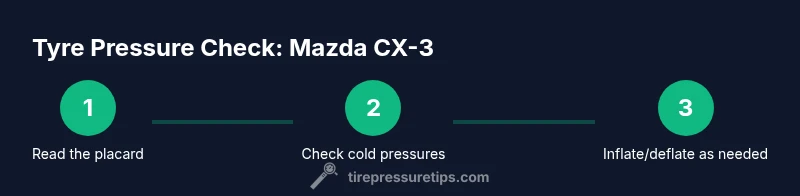
Mazda CX-3 Tyre Pressure Guide
A comprehensive, step-by-step guide to checking and maintaining tyre pressure on the Mazda CX-3. Learn how to read placards, use TPMS readings, and adjust safely for safety, fuel economy, and tire wear.


Learn how to check and adjust Mazda CX-3 tyre pressure safely using the door placard, TPMS readings, and a reliable gauge. We'll cover when to check, how to measure, how to adjust for load and speed, and how to troubleshoot common TPMS alerts. This quick guide is designed for drivers who want accurate readings and safe tire wear.
Why tyre pressure matters for Mazda CX-3
For Mazda CX-3 owners, correct tyre pressure isn’t just about avoiding a flat tire — it’s about safety, handling, fuel economy, and tire wear. According to Tire Pressure Tips, maintaining proper pressure helps prevent uneven contact with the road, reduces heat buildup, and preserves cold-weather grip and braking performance. Temperature naturally affects pressure: in cold weather, air contracts and pressure drops; in hot weather, it expands. The CX-3’s compact footprint and tire sizing are designed for responsive handling and efficiency, but underinflation or overinflation can undermine those advantages, increase wear, and alter steering feel. Regular checks are a lightweight habit that pays off in safer driving, better fuel economy, and more predictable tire wear across seasons.
Understanding the Mazda CX-3 tyre pressure specification
Your Mazda CX-3’s recommended tyre pressures are not arbitrary. They are printed on the vehicle placard located on the driver’s door jamb (and in the owner’s manual). The placard usually lists separate values for the front and rear tires and may include a separate recommendation for a fully loaded vehicle or for the spare. Differences between trim levels or optional wheels can shift the target pressures slightly, so always start with the exact numbers from your year and configuration. If you’re towing or carrying extra weight, some manufacturers specify a higher cold-pressure value, but never exceed the tire’s maximum inflation rating printed on the sidewall. In short: use the exact CX-3 spec from the placard or manual, and treat “load-based” adjustments as guidance rather than a free choice.
How to check tyre pressure on a Mazda CX-3
Checking tyre pressure correctly begins with using a reliable gauge and a cold tire. Start by locating the placard on the driver’s door frame and, if available, cross-check with the owner’s manual for model-year nuances. Remove the valve cap, press the gauge onto the valve stem squarely, and note the reading. Repeat for all four tires and the spare, if you’re maintaining full readiness. If readings differ from the recommended values by more than a few psi, plan to adjust. For a precise assessment, check after the car has sat for at least three hours or after the tires have cooled overnight. Write down each tire’s current pressure and target so you can log changes over time.
How to adjust tyre pressure safely
Inflate or deflate each tire to reach the CX-3’s cold-inflation specification. Use a pump with a built-in gauge or a separate gauge to verify the final pressure. Make small adjustments (1–2 psi at a time) and re-check after a few minutes because the gauge and valve can add minor variance. Never inflate beyond the tire’s maximum pressure rating. After adjusting all tires, recheck all readings to ensure consistency and symmetry across the axle. If TPMS alerts persist after inflation, compare readings with the TPMS display and physically verify with a gauge.
Common pitfalls and TPMS tips for the CX-3
Tire pressure monitoring systems (TPMS) are helpful, but they’re not a substitute for manual checks. If a TPMS warning appears, verify the readings with a gauge and compare against the placard. Remember that TPMS sensors can be slow to update after you inflate or deflate; a short drive may be required for the system to reflect the new values. If the warning persists after inflation to spec, inspect the tires for leaks, valve stems, and possible curb damage. Battery or sensor faults can trigger TPMS issues; in that case, visit a tire or automotive service shop for a sensor test.
Seasonal and load-based pressure changes
Seasonal temperature shifts can cause noticeable changes in tyre pressure. In colder months, you may see a drop in readings; in hot weather, readings can rise. When carrying heavier loads, the front or rear pressures might need to be adjusted to accommodate the extra weight. The goal is to keep all four tires within a similar pressure band that aligns with the CX-3 placard, ensuring even contact with the road and balanced handling.
Maintenance routine and when to seek help
Make tyre pressure checks part of a monthly routine or before long trips, especially when replacing wheels or changing seasonal tires. Keep a small gauge in the glovebox or use a digital gauge for quick checks. If you notice persistent pressure loss, slow leaks, or erratic TPMS behavior, seek professional inspection to rule out valve leaks, wheel damage, or sensor faults. Regular checks also support safer braking performance and fuel efficiency over the life of your CX-3.
Tools & Materials
- Tire pressure gauge(Choose a gauge with at least 0.5 psi precision; digital gauges reduce reading ambiguity.)
- Air source (compressor or pump)(A unit with a built-in gauge helps ensure accuracy; if using a gas station pump, verify its gauge against your own.)
- Mazda CX-3 owner’s manual or door placard(Location: driver’s door jamb; verify model-year-specific pressures, including load recommendations.)
- Notebook or digital log(Record readings, target pressures, and date for trend tracking.)
Steps
Estimated time: 20-25 minutes
- 1
Find the correct tyre pressure spec
Locate the CX-3’s recommended cold tire pressures on the door placard or owner’s manual. Note any front vs rear differences and special guidance for loaded driving. Ensure tires are cold before reading.
Tip: Always verify while tires are cold for accurate readings. - 2
Gather your tools
Assemble a reliable gauge, a suitable inflator/pump, and a way to record results. Having everything ready saves time and minimizes repeated trips to the trunk or garage.
Tip: Use a gauge with high accuracy and calibration if possible. - 3
Check each tire’s current pressure
Remove the valve caps and measure each tire’s pressure when cold. Record the numbers for all four tires and the spare if you’re maintaining full readiness.
Tip: Take multiple readings to reduce random variation. - 4
Adjust to spec
Inflate or deflate in small increments to match the CX-3’s cold-pressure spec. Recheck after a brief settling period and correct any remaining variance.
Tip: Don’t over-inflate; adjust in small steps and re-check. - 5
Check spare tire pressure
Spare tires sometimes have different pressure targets. Verify its spec on the placard and ensure the spare is pressurized appropriately.
Tip: Don’t neglect the spare—it's your backup on the road. - 6
Re-test with TPMS
Drive a short distance to allow the TPMS to refresh, then verify with your gauge. If the TPMS remains off, inspect for leaks or sensor issues.
Tip: If TPMS readings disagree with your gauge, trust the manual/placard and re-check.
Frequently Asked Questions
Where is the Mazda CX-3 tyre pressure placard located?
The placard is typically on the driver’s door jamb and may also be listed in the owner's manual. It shows the recommended cold pressures for front and rear tires and sometimes a separate loading specification.
Look for the door jamb placard on the driver’s side; it shows the recommended cold tire pressures for front and rear tires.
Can I drive with underinflated tyres on a Mazda CX-3?
Driving with underinflated tires can reduce handling, increase stopping distance, and cause uneven tread wear. Always aim to bring tires to the recommended cold pressures before highway use.
Driving on underinflated tires can compromise safety. Inflate to the recommended cold pressure before long trips.
Should I use the same tyre pressure for all four tyres on CX-3?
In most cases, the CX-3 specifies the same pressure for all four tires, but some configurations may differ by wheel position or load. Always start with the placard numbers and adjust for load as needed.
Often the CX-3 uses the same pressure for all tires, but check the placard for your exact setup.
What should I do if the TPMS light stays on after inflating to spec?
If TPMS stays on, recheck each tire with a gauge to confirm accuracy. Inspect for slow leaks, damaged valves, or sensor issues. If the light persists, have the sensor system inspected by a professional.
If the TPMS light won’t go off after inflation, recheck with a gauge and check for leaks or sensor problems.
How often should I check tyre pressure on a Mazda CX-3?
Check tyre pressure at least once a month and before long trips. Temperature changes and load can shift pressure, so periodic checks help maintain safety and efficiency.
Check your tyres at least monthly and before long trips due to temperature and load changes.
Is it okay to use nitrogen for CX-3 tyres?
Using nitrogen is not required for normal driving. Regular air with a good gauge is sufficient if you maintain the pressures accurately and regularly.
Nitrogen isn’t required for CX-3 tyres; air with proper maintenance works well.
Watch Video
What to Remember
- Check tires when cold before driving
- Follow the CX-3 placard for the correct pressures
- Maintain equal pressure across all four tires
- Use a reliable gauge and re-check after inflation