Kia Sportage Tyre Pressure Guide: Check, Adjust, and Maintain
Learn how to check and maintain tyre pressure for your Kia Sportage. Follow step-by-step guidance to ensure safe driving, fuel efficiency, and optimal handling across temperatures and loads.


To optimize kia sportage tyre pressure, check the cold-psi values on the driver’s door placard and measure with a reliable gauge. Maintain those targets for all tires, recalibrate after driving or temperature shifts, and adjust when you change tires or load. This quick guide shows how to measure, adjust, and monitor tyre pressure safely.
Understanding Kia Sportage Tyre Pressure Basics
Tire pressure is the amount of air in your tires, typically measured in psi or kPa. For the Kia Sportage, the official recommended values are found on the door placard. These numbers cover both front and rear tires and can differ between models or trim levels depending on load. When you read tire pressure, you are measuring the cold pressure, which is the pressure when the tires are at ambient temperature and not warmed by driving. Driving heats tires and can temporarily raise the reading, leading to overestimation if you measure after a drive. Maintaining the correct tyre pressure improves safety, handling, fuel efficiency, and tire wear. In practice, treat the recommended pressure as a guide to keep all tires within the intended contact patch and load-bearing capability. Always verify both front and rear values if your Kia Sportage has a different spec. Regular checks, especially with seasonal temperature shifts, help protect wheels and suspension while maximizing fuel economy.
Locate Your Kia Sportage's Recommended Tire Pressure
The recommended tire pressure for your Kia Sportage is printed on a placard located on the driver’s door jamb. This placard lists separate pressures for the front and rear tires and may include a different value for the spare tire if your model provides one. If you drive with heavier loads or frequent towing, your manufacturer may recommend a higher pressure range; always start from the placard values and adjust based on load. If you cannot find the placard, consult the owner’s manual or your dealer’s service documentation. Remember: the placard shows cold pressure; do not inflate based on a hot reading. The goal is consistent tire performance, even wear, and reliable handling across scenarios including highway trips and city driving.
How to Check Tire Pressure Correctly
Before checking, ensure the tires are cold (the car has not driven more than a mile in the last 3 hours). Remove the valve cap from one tire, place the gauge on the valve stem, and press firmly to get a reading. Record the value for that tire and compare it to the placard specification. Repeat for all tires, including the spare if you have one. If a tire reads below the recommended level, add air in small increments and recheck after each adjustment. If a tire is above the target, release air until you reach the target. Replace the valve cap securely after each measurement and keep gauge readings in a notebook or app for progress tracking.
How to Adjust and Maintain Consistent Pressure
After you determine the cold pressure targets from the placard, inflate or deflate each tire to match. Use the same gauge model for all measurements to reduce discrepancy between devices. Recheck all tires after completing adjustments, since small changes can affect others. Temperature shifts (cooling in winter or heating in summer) can cause pressure changes, so check periodically and adjust as needed. If you rotate or replace tires, verify that the new tires have the same pressure targets as the original set. Document dates and readings to build a maintenance habit and prevent underinflation or overinflation.
Special Considerations for Kia Sportage
Tire pressure maintenance also involves the vehicle's Tire Pressure Monitoring System (TPMS). If a tire is under or overinflated beyond the placard's range, TPMS will warn you. When inflating after a flat repair or tire rotation, ensure consistency with front and rear pressures and reset TPMS if required by the manual. If the TPMS warning persists after adjustments, consult the owner’s manual or an authorized service center to rule out sensor issues or slow leaks. Seasonal temperature changes, loading patterns, and tire wear all influence the ideal pressure, so periodic checks are essential for continued performance and safety.
Troubleshooting Common Issues
A slow leak, damaged valve stem, or a cracked wheel can cause gradual pressure loss even when readings seem normal. Always inspect tires visually for embedded objects and signs of wear or damage. If you notice frequent pressure loss, perform a leak test with soapy water around the valve stems and bead seats to identify the source. Replace damaged components promptly. Avoid overinflating to compensate for leaks, as this can reduce traction and lead to uneven wear. Regular checks help you catch issues early before they affect handling or fuel efficiency.
Tools & Materials
- Tire pressure gauge(Digital gauge preferred for accuracy; test before use and calibrate if needed)
- Air compressor or tire inflator( Able to reach the target pressure on all tires; portable unit is convenient)
- Door jamb placard or owner’s manual(Locate the exact cold pressure values for front, rear, and spare tires)
- Valve stem caps(Keep caps on to prevent leaks and protect valve cores)
- Notebook or mobile app for logging pressures(Helpful for tracking changes over time and scheduling checks)
Steps
Estimated time: 15-20 minutes
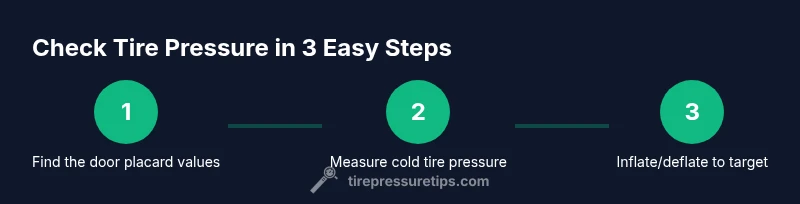
- 1
Find the official pressure targets
Locate the placard on the driver’s door jamb and note the cold tire pressure values for front, rear, and spare if provided. Record separate targets for different conditions if the model specifies. This step sets the baseline for safe inflation.
Tip: Double-check if load or trim changes alter the recommended pressures; always start from the placard. - 2
Measure cold tire pressure
Before driving, remove the valve cap and press the gauge onto the valve stem firmly. Take the reading quickly to avoid heat buildup from contact with the stem. Repeat for each tire and the spare if relevant.
Tip: Use the same gauge model for consistency across all measurements. - 3
Inflate or deflate to target
If a tire is below target, add air in small increments and recheck after each addition. If above target, release small amounts until you reach the recommended pressure. Do not overfill in a single step.
Tip: After adjusting, wait a moment for the pressure to stabilize and recheck again. - 4
Check all tires together
Repeat measurement for all tires, including the spare if you plan to use it. Make sure the readings align with the placard values. Consistent pressures improve handling and even wear.
Tip: Tires wear evenly only when all four (and the spare if used) are within the target range. - 5
Replace valve caps and log readings
Screw the valve caps back on securely. Record the final readings and date to monitor trends and plan future checks. Keeping a log helps catch gradual leaks early.
Tip: Consider noting the external temperature as it can influence readings. - 6
Recheck after a short drive
Take a quick measurement after driving a few miles to ensure the tires have returned to normal pressure if they were adjusted recently. TPMS may also trigger if a change is significant.
Tip: If the TPMS reports a deviation after adjustment, re-assess all tires and sensor status.
Frequently Asked Questions
Where can I find the recommended tire pressure for my Kia Sportage?
The recommended pressure is printed on the door jamb placard of the Kia Sportage. It shows front and rear values and sometimes a spare. If you can't locate it, consult the owner's manual or a dealer for the exact figures.
Check the door jamb placard for the exact tire pressures. If you can't find it, refer to the manual or contact a dealer.
Should I check tire pressure when tires are hot or cold?
Always check when tires are cold for an accurate reading. Heating from driving raises pressure temporarily and can mislead the gauge.
Always measure when cold. Hot tires give higher readings and can mask underinflation.
What if the TPMS light stays on after I inflate?
If the TPMS stays on after inflating, recheck all tires and ensure valves are sealing properly. A persistent warning may indicate a sensor fault or a slow leak that requires inspection.
If the light remains on after inflation, recheck tires and consider sensor or leak issues with a service visit.
Is it okay to mix different tire pressures on front and rear?
It’s best to match the pressures to the manufacturer’s recommended values for each axle. Deviating from the recommended front/rear pressures can affect handling and wear.
Stick to the manufacturer’s front and rear targets. Mixing can change handling.
How often should I check tire pressure?
Check at least once a month and before long trips. Temperature changes seasonally can affect pressure, so more frequent checks are prudent.
Check monthly and before trips, especially with weather changes.
Watch Video
What to Remember
- Check the door placard values before inflating
- Measure cold pressure for accuracy
- Inflate/deflate to the target value
- Recheck all tires after adjustments