i10 Tyre Pressure Guide: Check, Set & Maintain
Master i10 tyre pressure with a practical, step-by-step guide. Learn where to find official values, how to measure cold tires, adjust for load and temperature, and troubleshoot TPMS alerts for safer, more efficient driving.


Learn how to check and maintain i10 tyre pressure for safety, fuel efficiency, and even tire wear. This guide shows where to find the official numbers for the Hyundai i10, how to measure accurately, how to adjust for load and temperature, and when to recalibrate after changes in weather or tire type. You’ll also discover how TPMS alerts fit into the process and common mistakes to avoid.
Why i10 tyre pressure matters for safety and efficiency
Maintaining the correct tyre pressure on your i10 is a foundational safety habit and a practical way to improve fuel efficiency and tire longevity. Under-inflated tires reduce cornering stiffness, increase stopping distances, and can lead to excessive heat buildup that damages the tire structure over time. Over-inflation, on the other hand, makes the ride harsher, reduces grip on rough roads, and can cause uneven wear along the center of the tread. For i10 owners, the key is consistency: check pressures regularly, especially when the seasons shift or you carry heavier loads.
Understanding official values for i10 tyre pressure
The official pressure specification for your i10 is typically found on the driver’s door jamb placard or in the owner’s manual. That number is chosen by the manufacturer to balance comfort, handling, and fuel economy for standard loading. If you drive with a full trunk or luggage rack, the recommended pressure may change slightly to maintain safe handling. When in doubt, start with the standard value and adjust in small increments, checking the tires when they’re cold for an accurate reading.
Reading TPMS alerts and how they relate to i10 tyre pressure
Many modern Hyundai i10s feature a Tire Pressure Monitoring System (TPMS) that illuminates a warning light when a tire drops below or rises above the recommended range. TPMS readings reflect gauge pressure inside the tire but are influenced by ambient temperature, vehicle load, and tire wear. If you see a TPMS warning, don’t assume it’s a single tire issue—check all four tires with a gauge, verify readings against the placard, and address any leaks or valve issues promptly. The Tire Pressure Tips team emphasizes using TPMS as a quick alert, then confirming with a physical gauge for accuracy.
A practical, step-by-step approach to vouch for correct i10 tyre pressure
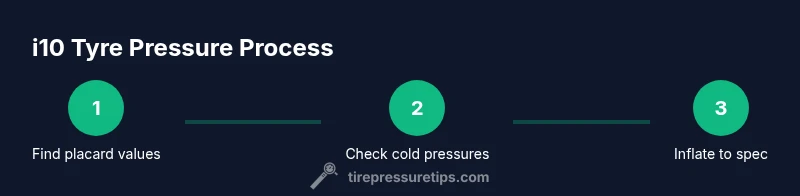
This section expands on the quick answer with a structured method you can follow on your next maintenance day. Start by locating the correct pressure values, then check all tires when they’re cold, adjust as needed, and recheck after inflation. Remember to reseal valve stems and replace valve caps after you’re finished to prevent slow leaks. For best results, perform checks in a consistent environment (same time of day, same pump) to minimize variables.
Common scenarios: heat, cold, and loaded driving with i10 tyres
Temperature changes cause air to expand or contract inside tires. In cold weather, pressures drop, sometimes by a few psi, which makes it more likely you’ll be under-inflated if you don’t check. In hot weather or after long highway drives, tire pressure can rise, risking over-inflation. If you routinely carry heavy loads or travel with a roof rack, you may need to adjust pressures upward a notch from the standard specification. Always verify with a gauge when tires are cold for consistent readings.
How to troubleshoot uneven wear related to pressure on an i10
Uneven wear can indicate chronic under- or over-inflation, misalignment, or improper load distribution. If you notice one tire wearing out faster than the others, start with a pressure check on all four tires and confirm you’re using the correct values for your load. If the wear pattern persists after correcting pressure, have the alignment and suspension inspected by a professional. Regularly rotating tires also helps even out wear and preserve performance.
Tools & Materials
- Tire pressure gauge (digital or analog)(Calibrated and readable; check accuracy with a known reference if possible)
- Owner's manual and door placard(Primary sources for i10 tyre pressure values)
- Portable air compressor or access to a reliable air station(Useful for topping up, not strictly required if you have a hand pump)
- Soapy water and a small brush(To check for slow leaks around valve stems and punctures)
- Notebook or smartphone notes(Record readings and dates for maintenance history)
Steps
Estimated time: 15-25 minutes
- 1
Find the correct tyre pressure values
Locate the official i10 tyre pressure on the door placard or in the owner’s manual. Note both the standard front and rear values, as some configurations vary by axle. If you drive with a heavier load or a roof rack, you may need a different target pressure.
Tip: Start with the base value and adjust in small increments of 1–2 psi, checking after each adjustment. - 2
Check tires when cold
Park the car for at least three hours or drive less than 1 mile before measurement. Warm tires inflate the numbers and give an inaccurate reading. Remove the valve caps before inserting the gauge.
Tip: Check all four tires to catch imbalances that could affect handling. - 3
Measure current pressures
Using the gauge, measure each tire’s pressure in psi. Compare readings to the placard values. Note any significant deviations that may indicate leaks or slow leaks from the valve stem or bead.
Tip: If readings are hard to read, gently shake the tire to settle the air and recheck. - 4
Adjust pressure to target
If a tire is low, add air in short bursts until you reach the target. If a tire is high, release air until the gauge reads the correct pressure. Recheck after adjustments to confirm accuracy.
Tip: Do not exceed the recommended value; small overinflation can be corrected by letting air out gradually. - 5
Seal and verify
Reinstall the valve caps and wipe away any signs of leakage or dirt around the valve stem. Recheck pressures one hour later to confirm they hold after the seating process.
Tip: Keep a log of readings for future reference and seasonality changes.
Frequently Asked Questions
What should the i10 tyre pressure be for most daily driving?
Most daily driving for an i10 uses the standard door placard values provided by the manufacturer. If you frequently carry heavy loads or travel with roof racks, you may need to adjust slightly according to the placard guidance. Always verify with a gauge when tires are cold.
For typical daily driving, use the standard door placard value. If you regularly carry extra load, adjust per the placard and recheck with a gauge when tires are cold.
Is TPMS a replacement for manual tire pressure checks?
TPMS provides a warning when pressure deviates from the target range, but it isn’t a precise reading. Always verify with a physical gauge to confirm actual pressure, especially after inflating or changing tires.
TPMS warns you when pressure is off, but use a gauge to confirm exact numbers before driving long distances.
Can weather affect i10 tyre pressure?
Yes. Cold weather lowers tire pressure, while hot weather raises it. Temperature shifts can make readings look normal at one time of day and underinflate or overinflate later. Check pressures when tires are cold for consistency.
Weather changes can skew readings, so check pressures when tires are cold for accuracy.
What should I do if one tire is consistently low?
A consistently low tire could indicate a slow leak, a faulty valve stem, or wheel damage. Inspect for leaks, check valve stems, and consider professional assessment if the problem persists.
If a tire stays low, inspect for leaks or valve issues and seek a professional check if it continues.
How often should I check i10 tyre pressure?
Check at least once a month and before long trips. If you drive in extreme temperatures or switch tire types, check more often.
Check monthly, and more often when temperatures shift or you change tires.
What tools do I need for accurate i10 tyre pressure checks?
A reliable tire pressure gauge, access to the door placard or owner's manual, and a source of air for adjustments. Keep valve caps tight and inspect for leaks during checks.
Use a good tire gauge, the placard values, and air to adjust; inspect for leaks when checking.
Watch Video
What to Remember
- Check i10 tyre pressure when tires are cold before driving.
- Follow the door placard values for safe, efficient performance.
- Use a gauge to verify TPMS readings with a manual measurement.
- Adjust for load and temperature to avoid under- or over-inflation.