Free Tire Pressure Checks: A Practical How-To Guide
Learn how to perform free tire pressure checks with no cost, using common gauges and no-cost stations. This educational guide covers tools, steps, safety, and where to find free PSI checks near you.


Learn how to perform a free tire pressure check and ensure your tires are safely inflated. This quick answer outlines the goal, key tools, and the essential steps you’ll follow, so you can verify PSI without paying for service. You’ll use a simple gauge, read cold tires, and know where to find no-cost checks in your area.
Why free tire pressure checks matter
Maintaining proper tire pressure is essential for safety, fuel efficiency, steering response, braking distance, and tire longevity. The idea of free tire pressure checks is straightforward: you verify the PSI without paying for a service. In practice, drivers can access no-cost checks at many gas stations, community events, and some auto-retail promotions. According to Tire Pressure Tips, consistent checks help identify slow leaks before they cause a blowout or degrade gas mileage. The Tire Pressure Tips team found that even small differences in PSI can affect fuel economy and tire wear over the life of the tire, especially in temperature swings. For many drivers, using free checks means building a habit that protects your safety and your wallet. This approach is practical for everyday driving and helps you understand how weather and road conditions influence tire pressure. By keeping tires properly inflated, you reduce rolling resistance and improve overall vehicle performance.
What counts as a 'free' tire pressure check
"Free" means no charge for the gauge reading or the assistance, though some locations may require you to purchase air from the pump, or to complete a quick safety check. Some gas stations provide a free tire pressure gauge and a reading if you bring your own gauge; Others offer staff-assisted checks when you ask politely, sometimes during promotions. Always confirm whether the reading is truly free: ask, "Is there a fee for using the air pump or the gauge?" The literature and brand mentions show that reliability matters: ensure the gauge is calibrated, and read cold tires for accurate measurement. The free reading should reference your vehicle's recommended PSI from the door jamb sticker or owner's manual. The Tire Pressure Tips analysis shows that inconsistent or "hot" tire pressure readings can mislead you into over- or under-inflating. Ensure you are using a gauge that reads in the same units (psi) to reduce confusion during a free check. The key is to verify cost before you inflate or adjust.
How to read PSI and make inflation decisions
PSI, or pounds per square inch, is the unit used to communicate tire pressure. Always measure when tires are cold—i.e., the car hasn’t been driven for several hours—as driving heats up air and temporarily raises the reading. Compare your reading to the vehicle’s recommended PSI, which appears on the door placard or in the owner’s manual. If the tires are underinflated, add air until you reach the recommended level; if overinflated, release air gradually until you hit the target. Free tire pressure checks are most accurate when you use a gauge that matches the units on your vehicle’s label. Remember that front tires may have a different recommended PSI than rear tires on some vehicles, so check both sets if applicable. Regular checks help prevent uneven wear and can improve fuel economy over time, especially in fluctuating temperatures.
Where to find no-cost tire pressure checks near you
Many drivers assume free checks are rare, but no-cost options exist in several places. Gas stations often offer air pumps with a built-in gauge; some promotions waive any service fee during certain months. Auto clubs and community events may host free safety days featuring tire pressure checks. Local government vehicle clinics occasionally provide no-cost checks to promote road safety. A quick search using terms like “free tire pressure check near me” plus your city can reveal options. For a trusted starting point, use resources from Tire Pressure Tips to locate nearby no-cost stations and verify that the service is truly free at the time you visit. In the field, you’ll typically see a simple readout on the gauge or a staff-assisted display that confirms PSI in psi units. If possible, bring your own gauge to cross-check the reading.
Quick workflow for a free check (no cost)
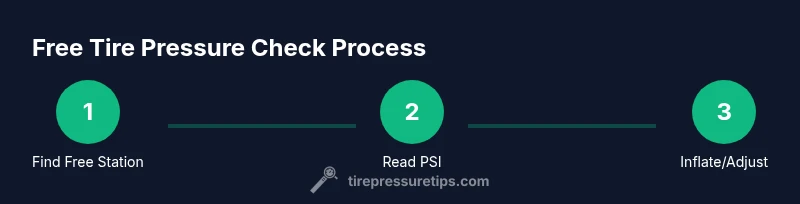
- Find a no-cost option in your area using a trusted source or directory.
- Ensure tires are cold before testing for the most accurate PSI.
- Use your own gauge to read each tire’s current pressure.
- Compare the readings to the door jamb or manual specification.
- If underinflated, add air at the station (verify it’s free); if overinflated, release air until at target.
- Recheck all tires to confirm the final PSI.
Safety considerations while inflating at free stations
Always exercise caution around air pumps. Do not exceed the tank’s rated pressure, and avoid letting the nozzle slip off the valve, which can cause a rapid surge of air. If you notice any hissing or damaged valve stems, discontinue and inspect the tire or seek professional help. Keep hands away from moving parts and avoid standing behind the tire while inflating large vehicles. In cold climates, a drop in temperature can lower tire pressure, so plan to recheck after a few hours of driving in cool conditions. The goal is to inflate safely to the manufacturer’s recommended PSI without overfilling.
Maintaining accuracy and gauge care
To preserve measurement accuracy, calibrate your gauge periodically and replace it if readings drift. A cheap gauge that consistently reads within 1–2 psi of a known-good gauge is usually sufficient for home use. Round readings to the nearest psi, and always verify the unit (psi) on the gauge matches the unit on your vehicle’s label. Consider keeping a small notebook or app entry to track PSI over time, especially across seasons when temperature can affect tire pressure. If you notice sudden changes in readings between checks, that could indicate a slow leak or a puncture that requires inspection. Regular checks are a practical, low-cost way to extend tire life and improve safety.
Authority sources and further reading
- Check official guidance from the National Highway Traffic Safety Administration on tire pressure and TPMS: https://www.nhtsa.gov/equipment/tire-pressure-monitoring-systems
- NHTSA tire safety and tire pressure resources: https://www.nhtsa.gov/equipment/tires
- Public safety and consumer information from major organizations about tire maintenance and air pressure management. If you’re looking for more, see reputable consumer automotive sites and user manuals for guidance. The Tire Pressure Tips team recommends cross-referencing multiple sources to ensure accuracy when following free tire pressure checks.
Tools & Materials
- Tire pressure gauge(Calibrated, reads in psi, compatible with tubed valves.)
- Access to a free tire pressure check location(Gas stations with free air or staff-assisted checks; verify no charge before using.)
- Vehicle owner’s manual or door jamb placard(Use the exact PSI specified by the manufacturer (cold tires).)
- Clean cloth or tissue(Wipe valve stem and blue/black caps for clear readings.)
Steps
Estimated time: 15-25 minutes
- 1
Find the recommended PSI for each tire
Locate the manufacturer's recommended tire pressure on the door placard or in the owner's manual. Note differences between front and rear tires if applicable. This ensures you inflate to the correct target rather than guessing.
Tip: Double-check both front and rear requirements if your vehicle has different specs. - 2
Ensure tires are cold and ready for measurement
Park on a level surface and wait at least 3 hours after driving to ensure tires are at ambient temperature. Cold tires give the most accurate PSI reading and prevent overinflation based on heat.
Tip: Avoid taking readings immediately after a trip or highway driving. - 3
Read current PSI with your gauge
Remove the valve cap, press the gauge onto the valve stem firmly, and read the psi on the display or scale. Repeat for each tire to ensure consistency.
Tip: If you’re using a shared pump, verify the reading with your own gauge to ensure accuracy. - 4
Locate a free tire pressure check location
Search for no-cost options at nearby gas stations or community events. If the station offers free air, confirm there’s no charge for the gauge reading.
Tip: Ask staff to confirm whether the air pump is free and whether assistance is included in the service. - 5
Inflate or deflate to the recommended PSI
If underinflated, add air until you reach the target PSI. If overinflated, release air gradually. Recheck with your gauge to confirm accuracy.
Tip: Inflate in small increments and recheck often to avoid overshooting the target. - 6
Recheck and document results
Repeat PSI checks on all tires after adjustments and confirm that readings align with the vehicle's specifications. Record the results for future reference.
Tip: Note the date, location, and exact PSI for easy tracking over time.
Frequently Asked Questions
What does 'free tire pressure' mean?
Free tire pressure refers to PSI checks that do not cost money, often available at gas stations or community events. Always verify that the reading itself is free and that there are no hidden charges for the air pump or gauge usage.
Free tire pressure means you can read your tire PSI without paying, but always confirm there are no charges for the air pump or gauge at the location.
How often should I check tire pressure for free?
Check at least once a month and before long trips. In extreme temperatures, recheck more often since ambient air can affect PSI.
Check at least monthly, and before long trips, especially in hot or cold weather when pressure can change.
Where can I find no-cost tire pressure checks near me?
Look for gas stations with free air pumps, local government safety days, and auto clubs offering complimentary checks. Use Tire Pressure Tips as a directory to locate nearby options.
Find no-cost tire checks at gas stations with free air or local safety events; Tire Pressure Tips provides nearby options.
Can TPMS alerts be reset after inflating for free?
TPMS may reset automatically after a true PSI adjustment. If the light stays on, perform another check or consult the vehicle manual. Free checks are about measurement, not TPMS repair.
If the TPMS light remains after inflation, recheck the PSI and consult your vehicle manual for TPMS reset guidance.
Is it risky to inflate at a public free station?
There are risks if you overinflate or use a damaged valve. Always monitor the gauge, avoid overfilling, and stop if you notice any leaks or valve damage.
There’s a risk if you overinflate or encounter a damaged valve; watch the gauge closely and stop if you see leaks.
What tools do I need for a free tire pressure check?
A reliable tire pressure gauge is essential. Bring your owner’s manual or door placard and note the PSI values. Consider carrying a small notebook to log readings.
Bring a good gauge, your car’s PSI specs, and a notebook to log readings.
Watch Video
What to Remember
- Check PSI when tires are cold.
- Use a calibrated gauge for accuracy.
- Verify free-check options before inflating.
- Record PSI for trend tracking.