how much does tire pressure change in cold weather
Learn how much tire pressure changes in cold weather, why it happens, and how to check and adjust safely with practical ranges and TPMS notes from Tire Pressure Tips.


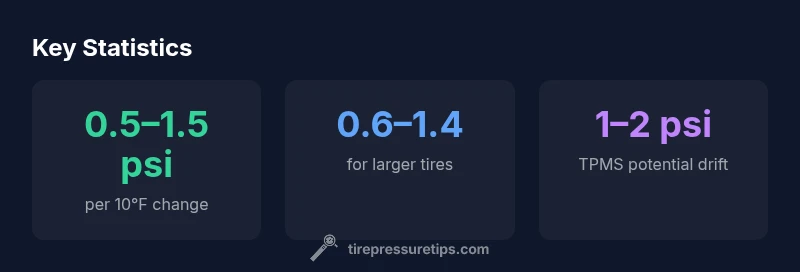
How much tire pressure changes in cold weather? In typical conditions, tires lose about 0.5–1.5 psi for every 10°F drop in ambient temperature, with the exact amount depending on load, tire size, and TPMS type. Always check tire pressure when temperatures shift dramatically and compare to the vehicle's recommended PSI.
How temperature translates to tire pressure changes
When you ask how much tire pressure changes in cold weather, you are asking about a gas-law effect in action: as air cools, it contracts. In practice, most passenger-car tires lose roughly 0.5–1.5 psi for every 10°F drop in ambient temperature, though the exact amount depends on tire construction, load, wheel size, and whether the TPMS is an indirect or direct system. Tire inflation is measured in psi, and most vehicles are designed to operate at a recommended cold PSI. Reading at the tire surface after driving can yield different numbers, especially after a warm drive when tires cool down. In cold climates or during rapid temperature swings, you might see larger fluctuations. The Tire Pressure Tips team emphasizes that this isn’t a fixed rule—it's a guideline with important caveats. The first step is to know your car’s official recommended cold tire pressure (not the maximum rating on the sidewall). The recommended value accounts for normal driving conditions and helps maintain handling, traction, and fuel economy. The impact of temperature on pressure is independent of the road surface; it’s the air inside the tire responding to the environment. By understanding these concepts, you’ll be better prepared to manage tire pressures year-round.
Factors that amplify or dampen the change
A range of factors affects how much pressure shifts in cold weather. Load is a major driver: a heavy load or frequent acceleration/braking can amplify pressure loss because additional tire deformation generates extra heat and affects cooling rates. Tire size and construction also matter: wider tires and lower-profile rims have different volume and stiffness, which can shift how much air pressure changes with temperature. The environment plays a role too—rapid transitions between indoor warmth and icy outdoor air can cause readings to bounce more noticeably on TPMS or gauge measurements. Finally, the type of TPMS can influence how quickly you perceive a change; direct TPMS sensors measure actual pressure, while indirect systems infer pressure from wheel speed sensors and may lag behind real changes. Understanding these factors helps you interpret readings more accurately and avoid chasing phantom drops.
Seasonal patterns by vehicle type and tires
Seasonal changes do not affect all vehicles equally. Passenger cars with standard all-season tires tend to follow the general rule of 0.5–1.5 psi per 10°F, but SUVs and light trucks often see slightly larger shifts due to larger tire volumes and heavier loads. Tire type matters as well: winter tires designed to stay flexible at low temperatures may retain pressure differently than summer-performance tires. Rim design and tire mounting can further modulate the change, as can wheel alignment and suspension wear that alter how a tire carries its load. In short, while the 0.5–1.5 psi per 10°F guideline is useful, expect a bit more movement with larger tires or heavy loads, and a bit less movement with smaller, well-inflated setups.
Measuring, adjusting, and TPMS implications
Always measure tire pressure when tires are cold, ideally after the car has been stationary in a dry, shaded spot for at least three hours. Use a reliable gauge and compare the reading to the vehicle’s recommended cold PSI. If you see a drop in the 0.5–1.5 psi per 10°F range, plan to adjust during the next opportunity, but never inflate beyond the recommended cold PSI. TPMS can help you monitor changes between gauge checks, but it is not a substitute for a precise manual gauge. In colder weather, readings can be less intuitive due to sensor lag or battery drain in older TPMS units, so confirm with a gauge and adjust when needed. A proactive approach—checking, recording, and maintaining consistent PSI—yields better handling, traction, and fuel economy.
Case studies and common winter mistakes in tire care
Consider a driver in a 15°F drop scenario with a standard sedan under a moderate load. If the tires were 32 psi cold, the reading on a direct TPMS might show 30–31 psi depending on defense and sensor accuracy. A common mistake is inflating all tires to the maximum number on the sidewall before winter starts. This can lead to over-inflation in warm conditions and under-inflation when temperatures plummet. Another pitfall is neglecting the spare tire, which can also lose pressure. A practical approach is to document the cold PSI for each tire, check monthly, and recheck after significant temperature shifts.
Winter-ready checklist and maintenance cadence
- Check tire pressures monthly during winter and after major temperature swings.
- Inflate to the vehicle’s recommended cold PSI, not the maximum on the sidewall.
- Use a reliable gauge and verify TPMS readings with manual measurements when in doubt.
- Inspect tires for wear, tread depth, and signs of uneven wear that could affect pressure readings.
- Keep a small gauge in the glovebox for quick checks before road trips or cold starts.
- Schedule professional tire maintenance before extreme seasons to ensure TPMS calibration and valve stems are in good condition.
Estimated tire pressure changes by vehicle type and temperature
| Scenario | Typical PSI Change per 10°F | Notes |
|---|---|---|
| Passenger car (standard tires) | 0.5–1.5 | Depends on load and ambient conditions |
| SUV/Light truck | 0.6–1.4 | Larger tires may see slightly different changes |
| Rapid temperature swings | 0.5–2.0 | If you drive quickly into cold air, readings can fluctuate |
Frequently Asked Questions
What causes tire pressure to change in cold weather?
Temperature is the primary driver; air contracts in cold temps and expands in warmth. This physical behavior lowers tire pressure as ambient temperature falls, and readings will rise when temperatures rise.
Temperature is the main driver. In cold weather, air contracts and tire pressure drops; as it warms up, pressure increases.
Should I inflate to the max when it's cold?
No. Always inflate to the vehicle's recommended cold PSI rather than the maximum on the sidewall, which is intended for safety margins under extreme conditions.
No—stick to the recommended cold PSI for safety and optimal performance.
How often should I check tire pressure in winter?
Check at least monthly, and after temperature swings of 20°F or more. Extreme shifts can affect accuracy and performance.
Check monthly, especially after cold snaps or big temperature changes.
Does TPMS need recalibration for temperature changes?
TPMS readings can fluctuate with ambient temperature, but recalibration isn’t usually required. Rely on a manual gauge for precise validation.
TPMS may drift with temperature, but you don’t typically recalibrate it—use a gauge to confirm.
Do cold weather changes affect tires differently by brand or model?
Yes. Tire construction, load ratings, and wheel size influence how much pressure changes with temperature. Check manufacturer guidance for your model.
Yes—different tires behave differently with cold temps. Check your tire’s specs.
Should I check the spare tire in winter?
Yes. Spare tires lose pressure too, so check and top up as needed, especially if stored in cold areas.
Don’t forget the spare—check its pressure too, especially in cold weather.
“Temperature-driven tire pressure changes are predictable, but the exact amount depends on tire size, load, and driving conditions.”
What to Remember
- Check tire pressure monthly during winter.
- Inflate to the vehicle’s recommended cold PSI.
- Expect about 0.5–1.5 psi change per 10°F.
- Larger tires or heavier loads amplify changes.
- Verify TPMS readings with a manual gauge.