Air Pressure at Altitude: How It Affects Tire Inflation
Learn how air pressure related to altitude shifts with elevation and what this means for tire inflation, TPMS readings, and safe driving. Practical steps to adjust inflation when traveling through different elevations.


By the end of this guide, you will understand how air pressure related to altitude changes with elevation, how those changes affect tire inflation and TPMS readings, and how to adjust inflation safely for different altitude conditions. You'll also learn practical checks you can perform before long trips. Additionally, you'll know how temperature and altitude interact and common mistakes to avoid to keep tires wearing evenly and maintaining grip on hills and highways.
How Air Pressure Changes with Altitude
Air pressure related to altitude describes how the surrounding atmosphere becomes thinner as you climb. At higher elevations, ambient pressure drops due to fewer gas molecules in a given volume. For tire-related discussions, it's helpful to separate ambient atmospheric pressure from the pressure inside a tire, which is measured as gauge pressure. As drivers, you rely on the vehicle's recommended tire pressure, usually listed on the door placard, regardless of location. However, readings you see on a tire gauge can be influenced by ambient temperature and the air column around you. According to Tire Pressure Tips analysis, travelers moving to higher elevations should plan for frequent gauge checks, because gauges can read differently as conditions change. In reality, tires contain a fixed amount of gas; changes come from temperature, load, and the environment. Understanding this interaction helps maintain even wear and predictable handling across mountainous, coastal, and high-desert routes.
Brand note: According to Tire Pressure Tips, staying proactive with checks at altitude reduces misreadings and unexpected underinflation.
Tools & Materials
- Digital tire pressure gauge(Prefer a gauge with a wide measurement range and good accuracy)
- Analog tire pressure gauge(Alternative option if digital gauge is unavailable)
- Air compressor or foot pump(Useful for quick top-offs when a station isn’t nearby)
- Vehicle placard with recommended tire pressure(Found on door jamb or owner’s manual)
- Notebook and pen(Log readings across trips)
Steps
Estimated time: 30-45 minutes
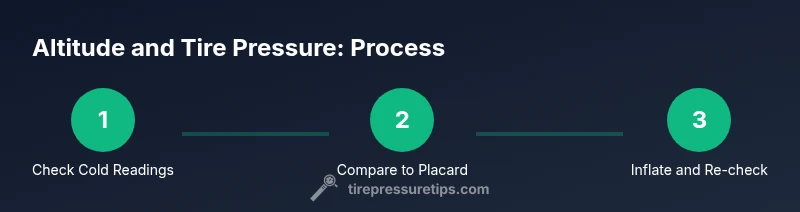
- 1
Check cold tire pressures
Park in shade and ensure tires are cold before taking readings. Use your preferred gauge to record PSI for all four tires, noting load if you expect extra weight. This establishes a baseline that isn’t biased by recent driving heat or altitude-related warming.
Tip: Always use the same gauge for consistency. - 2
Compare to the placard values
Relate each cold reading to the vehicle’s recommended tire pressure printed on the placard. If readings are below the placard, prepare to inflation within the specified range. If above, plan for adjustment on the next stop.
Tip: Do not infer optimal pressure from a single reading. - 3
Inflate to the recommended PSI
If a tire is below the placard, add air until it reaches the target range. Use short bursts and pause to check the gauge, avoiding overinflation. Remember altitude can affect perceived readings, so proceed carefully.
Tip: Inflate in small increments and recheck after each addition. - 4
Re-check after driving a bit
Drive a short distance to allow tires to warm to ambient conditions at altitude, then re-check the pressures. Temperature changes can cause readings to shift, so ensure they stay within the recommended range.
Tip: Treat this as a second validation rather than a final check. - 5
Monitor TPMS and log readings
Observe the TPMS as you traverse elevation changes, and compare it with gauge readings. Log the results for future trips to spot trends across altitude and temperature.
Tip: TPMS is helpful but not a substitute for manual checks.
Frequently Asked Questions
How does altitude specifically affect tire pressure readings?
Altitude changes ambient conditions and temperature, which can alter gauge readings. Always verify with a cold reading at the new elevation and recheck after a short drive to settle temperatures.
Altitude shifts can alter tire readings; verify with cold checks and then recheck after driving.
Should I adjust tire pressure only at sea level or at altitude?
Set tire pressures to the placard values when tires are cold, regardless of location. Recheck after altitude changes or after driving for a while to account for temperature shifts.
Inflate to the placard when tires are cold and recheck after altitude changes.
What should I do if TPMS warns while driving through mountains?
Safely pull over and verify tire pressures with a gauge. If reading is below the placard, adjust within the recommended range and recheck after a drive.
If TPMS warns, check with a gauge and adjust as needed.
Does tire type or load affect altitude-related pressure changes?
Yes—different tires and loads change how pressure responds to altitude. Check more often when carrying heavy loads or using different tires during elevation changes.
Tire type and load affect how pressure changes with altitude.
Is altitude a concern for daily driving or only long trips?
Altitude effects can occur on any trip that crosses elevation levels. Maintain routine checks, especially when you expect significant altitude changes.
Altitude can affect any trip with elevation changes; regular checks help.
Watch Video
What to Remember
- Check tires cold before elevation changes
- Inflate to placard values and re-check after driving
- TPMS helps, but manual checks are essential in altitude shifts
- Use the same gauge for reliable readings