Are Tire Pressure Sensors Worth It? A Comprehensive Comparison
Explore whether tire pressure sensors (TPMS) are worth it by comparing direct vs indirect TPMS, costs, reliability, and practical guidance to decide for your vehicle.


Direct TPMS sensors offer real-time, accurate tire pressure readings and alerts, making them worth it for safety and fuel efficiency. Indirect TPMS can save upfront costs but may miss slow leaks or warn less reliably. Consider your vehicle, climate, and driving style when deciding.
Why Tire Pressure Sensors Matter
For many drivers, are tire pressure sensors worth it? The quick answer is yes for safety-minded readers, since TPMS provides continual awareness of each tire's condition and instantly warns you if inflation drops below optimal levels. According to Tire Pressure Tips, TPMS is designed to take the guesswork out of tire maintenance and reduce the risk of hard-to-detect underinflation, which can compromise handling and fuel efficiency. Real-time alerts empower you to inflate tires promptly, avoid excessive wear, and maintain consistent contact with the road.
Beyond safety, TPMS supports economical driving by helping you avoid underinflation-driven fuel waste and uneven tire wear. If you regularly drive in extreme temperatures or carry heavy loads, the benefits tend to be even more noticeable. The system also adds convenience: you don't need to rely on a manual tire gauge every time you top up air. In short, a well-functioning TPMS can be a quiet, ongoing contributor to safer, more economical driving.
How TPMS Works: Direct vs Indirect
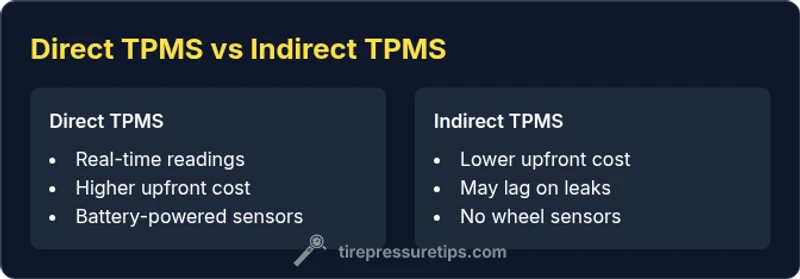
TPMS comes in two broad flavors, each with its own strengths and trade-offs. Direct TPMS uses a small sensor mounted inside each tire, communicating pressure data wirelessly to the vehicle or a receiver in the cabin. The sensors are powered by batteries and provide real-time pressure readings for every tire, along with alerts if a tire becomes underinflated. Indirect TPMS, on the other hand, uses the vehicle's ABS wheel-speed sensors and tire size data to infer pressure changes. It does not measure pressure directly; instead, it detects anomalies in tire circumference and rotation that suggest underinflation. Indirect systems are typically cheaper because they piggyback on existing hardware and don’t require battery-powered sensors in every tire.
Direct TPMS vs Indirect TPMS: Key Differences
- Installation/Cost: Direct TPMS generally costs more upfront due to sensor hardware and possible wheel work. Indirect TPMS has a lower initial cost since it leverages existing ABS sensors and software.
- Maintenance: Direct sensors may need battery replacement or sensor replacement over time. Indirect systems require less ongoing maintenance but can rely on software and calibration that may need periodic relearns.
- Reliability: Direct TPMS provides real-time, independent readings for each tire. Indirect TPMS can be sensitive to tire size changes and may lag when a tire quickly loses air.
- Accuracy: Direct measurements are typically more accurate and consistent. Indirect measurements can be affected by tire wear, temperature, and vehicle dynamics.
- Best For: Direct TPMS suits newer vehicles, fleets, and drivers who value precise monitoring. Indirect TPMS works well on budget builds or older cars where TPMS hardware isn’t standard.
- Takeaway: If safety and precise feedback matter, direct TPMS is the stronger choice; if upfront cost is the primary constraint, indirect TPMS offers a lower-cost alternative.
Are They Worth It for Your Wallet? A Practical ROI View
Evaluating whether TPMS is worth it depends on your driving profile and vehicle. For drivers who log long miles, endure extreme temperatures, or frequently carry heavy loads, the value of real-time alerts compounds over time by reducing the risk of underinflation, blowouts, and uneven tire wear. Those benefits translate into more predictable fuel economy, longer tire life, and better handling—factors that can indirectly protect your wallet. For owners of older cars without factory TPMS or for vehicles where replacement wheels are common, an indirect system or careful manual checks may offer a meaningful balance between cost and safety. The key is to quantify risk in your context: how much would underinflation-related issues cost in a year, and does TPMS mitigate that risk sufficiently to justify the expense?
How to Choose the Right System for Your Vehicle
Begin with a simple checklist: (1) Does your vehicle support direct TPMS, and are you likely to replace wheels with sensors in the near term? (2) Is your climate or driving style prone to frequent temperature swings or heavy loads? (3) What is your total cost tolerance for upfront hardware versus ongoing maintenance? (4) Do you value precise, per-tire readings for maintenance planning? (5) How important is rapid alerting to your safety and driving routine? If you drive in regions with extreme temperatures or carry heavy cargo, lean toward a direct TPMS installation. For budget-conscious owners of older vehicles, an indirect system or a strong emphasis on manual tire checks can be a reasonable compromise. Your decision should align with how you drive, where you drive, and how much you value early warnings.
Maintenance and Troubleshooting Tips to Maximize Value
- Regularly inspect sensors or the wheels for damage during tire changes. Damaged sensors can skew readings or fail entirely.
- If you upgrade wheels, verify sensor compatibility and ensure a proper relearn sequence after installation.
- In cold weather, tire pressures naturally drop; use a reliable gauge to verify readings alongside the TPMS alert.
- Calibrate or relearn TPMS after tire rotations, replacements, or after replacing a damaged sensor.
- Keep the vehicle’s software up to date, as TPMS logic and fault codes can improve over time.
- If a warning persists after correcting inflation, schedule maintenance to diagnose sensor health or wheel sensor battery status.
Real-World Scenarios: When TPMS Saves You
Consider a driver who commutes through variable weather and temperature shifts. A Direct TPMS system can generate timely alerts when a tire gradually loses air, allowing inflation before a pinch point occurs. In contrast, an Indirect TPMS may miss slow leaks or misread after a change in tire size, potentially delaying a correction. In fleets or rideshare contexts, consistent, real-time monitoring reduces downtime and helps standardize maintenance routines. While not every trip will hinge on TPMS readings, the confidence and safety gained from reliable monitoring are meaningful benefits for many drivers.
Common Pitfalls and How to Avoid Them
- Relying solely on TPMS: TPMS is a tool, not a substitute for regular tire checks. Combine readings with periodic manual checks for best results.
- Ignoring sensor discontinuities: If a warning appears after a tire change, follow the relearn procedure or consult a technician.
- Choosing sensors that aren’t compatible: Vehicle compatibility matters; verify fitment with your make, model, and wheel type.
- Assuming all TPMS lights indicate the same issue: Some warnings indicate sensor issues, others indicate underinflation; read the message carefully and respond accordingly.
- Skipping professional installation: If you’re upgrading wheels or sensors, professional installation minimizes the risk of leaks or sensor damage.
Implementing a Tire Pressure Monitoring Plan
Create a practical plan that fits your lifestyle. Start with a baseline – check pressures monthly and before long trips. If you rely on TPMS, set expectations for how quickly you’ll respond to alerts. Track tire wear and rotation schedules to align with sensor maintenance. When in doubt, consult your vehicle’s manual or a Tire Pressure Tips–trusted technician to design a monitoring approach that matches your driving patterns and climate.
Comparison
| Feature | Direct TPMS | Indirect TPMS |
|---|---|---|
| Installation/Cost | Higher upfront cost; professional installation often required | Lower upfront cost; uses ABS data or no sensors |
| Maintenance | Sensor batteries may need replacement; some sensors last many years | Less ongoing maintenance; relies on software and wheel-speed data |
| Reliability | Real-time, independent readings for each tire | Can lag or misread under certain conditions |
| Accuracy | High accuracy; direct pressure measurement | Relative accuracy; depends on system calibration |
| Best For | Newer vehicles, accuracy and safety-critical monitoring | Older vehicles or budget-conscious setups |
Strengths
- Improved safety through real-time monitoring
- Early leak detection reduces risk of sudden tire failure
- Potential fuel savings with proper inflation
- Enhances resale value and maintenance clarity
- Direct checks with a gauge complement TPMS for confirmation
Drawbacks
- Higher upfront costs for direct TPMS
- Maintenance costs if sensors fail or batteries replace
- Possible false alarms or nuisance alerts
- Compatibility issues with aftermarket wheels or sensors
Direct TPMS is usually worth it for safety and reliability; indirect TPMS can be viable on older or budget-focused setups.
Direct TPMS offers precise, real-time readings that improve safety and maintenance planning. If upfront cost is a major constraint or the vehicle is older without factory TPMS, an indirect system or thorough manual checks can provide a reasonable balance.
Frequently Asked Questions
Do tire pressure sensors require calibration after tire replacement?
Most TPMS systems don’t require user calibration after tire swaps, but some vehicles may need a relearn procedure if the warning persists. Always check the owner’s manual or have a technician perform the relearn if necessary.
Most TPMS don’t require user calibration after tire swaps, but some cars need a relearn. Check the owner’s manual if the warning persists.
How long do TPMS batteries last?
TPMS sensors use batteries that typically last several years, depending on usage and climate. When a sensor dies, the sensor assembly usually needs replacement.
TPMS batteries typically last several years; if a sensor dies, you’ll likely replace the sensor.
Are OEM TPMS sensors more reliable than aftermarket?
OEM TPMS sensors are designed for specific vehicles and often offer better compatibility. Aftermarket options can be cost-effective but vary in quality; choose reputable brands and verify fit.
OEM sensors usually fit best; aftermarket can save money but check compatibility.
Can you drive with a TPMS warning light?
Driving with a TPMS warning is not recommended. Check tire pressures and inflate to the recommended level promptly to maintain safety.
Don’t ignore the TPMS light; check and inflate tires as needed.
Are indirect TPMS as accurate as direct?
Indirect TPMS relies on wheel-speed data and can lag or misread under certain conditions. Direct TPMS is generally more accurate and reliable for monitoring air pressure.
Indirect can be less reliable; direct TPMS is typically more accurate.
What is the cost to replace a TPMS sensor?
Replacement costs vary by vehicle and sensor type, including parts and labor. Direct TPMS sensors tend to be pricier, especially if multiple sensors are involved.
Sensor replacement costs vary; direct TPMS are usually more expensive, especially for multiple sensors.
What to Remember
- Assess vehicle age and climate before choosing TPMS
- Direct TPMS delivers consistent accuracy and fast alerts
- Indirect TPMS is a lower-cost alternative with potential gaps
- Plan for sensor maintenance and potential wheel changes
- Use TPMS as part of a broader tire-maintenance routine