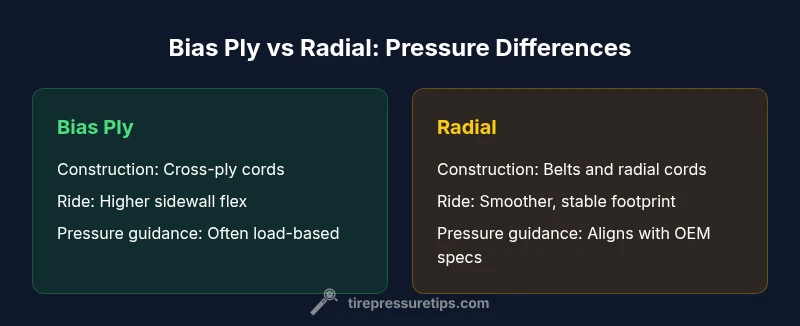
Bias Ply vs Radial Tire Pressure: A Practical Comparison
Understand how bias ply and radial tires differ in pressure guidance, wear patterns, and performance. A data-informed guide to inflation practices for bias ply vs radial tires with TPMS considerations and maintenance tips.


Bias ply vs radial tire pressure is not a one-size-fits-all choice. In practice, inflation targets depend on tire construction, vehicle load, and speed demands. Radial tires typically follow OEM pressure specs with stable wear and heat behavior, while bias-ply tires can require load-based adjustments. Always verify the exact pressure from the tire and vehicle manufacturer.
Tire construction: bias ply vs radial and how it shapes pressure needs
According to Tire Pressure Tips, bias ply tires use criss-cross cords that run at angles to the circumference, while radial tires employ belts that run under the tread in a radial direction. This fundamental difference affects how the tire deforms under load, how heat dissipates, and how pressure translates into contact patch shape. Because of this, the recommended cold inflation pressure is not universal across both families; instead, it is tied to the tire size, vehicle weight, speed rating, and intended use. For an owner of a mid-sized sedan, the OEM spec is calibrated for the particular construction of the factory-installed tires. In classic or off-road applications where bias ply may still be used, the load distribution and flex characteristics require careful pressure targeting to avoid shoulder wear or uneven wear across the tread. The Tire Pressure Tips team analysis shows that misaligned pressures can exacerbate wear patterns and accelerate heat buildup, especially if the tire is pushed beyond its designed speed and load envelope.
How inflation pressure is determined for bias ply and radial tires
Inflation pressure is not a single target; it is a balance between load index, speed rating, tire size, and vehicle dynamics. Radial tires tend to benefit from uniform inflation that respects OEM guidance because their belts and plies respond predictably to heat and load. Bias ply tires, by contrast, can show different deflection and wear when pressure is not tuned to the specific load distribution. Vehicle manufacturers calibrate inflation targets at the factory to account for suspension geometry, axle loads, and expected operating conditions. When you replace tires, check the label on the door jamb or in the owner's manual for the exact cold pressure. If you are restoring a classic or using off-road bias ply tires, work with load-based charts from the tire maker and follow incremental pressure changes while monitoring wear patterns and heat signs. Tire Pressure Tips analysis shows that the right pressure is critical to even tread wear and safe handling, particularly under heavy loads or high-speed operation.
Performance implications: ride, handling, and wear
Tire pressure affects the tire's footprint on the road, which in turn influences grip, steering response, and stability. Radial tires typically provide a more consistent footprint due to their belt structure, which translates to smoother ride quality and steadier braking in a wide range of temperatures. Bias ply tires, with their higher sidewall flex, can feel more forgiving on rough roads but may demonstrate more pronounced changes in handling as pressure shifts. Underinflation increases heat buildup and accelerates shoulder wear, while overinflation reduces the contact patch size and can lead to harsher ride and uneven wear. The construction differences also mean bias ply tires can be more sensitive to abrupt load changes, whereas radial tires resist heat-related degradation more effectively at typical highway speeds. These dynamics highlight why following the proper pressure for your tire type remains essential for safety and performance.
Practical inflation guidance and checks
Start with the vehicle manufacturer’s recommended cold pressure as your baseline. Use a high-quality gauge and measure when the tires are cold, ideally before a drive begins. If you are mounting bias ply tires on an older vehicle or using them in off-road conditions, you may need to consult the tire maker’s load-based charts and consider revised pressures for different terrains and speeds. When tires run hot, pressures rise; this should be accounted for by rechecking after a short cool-down period. Regular checks are a simple habit that pays dividends in even wear, safer cornering, and fuel efficiency. Integrate TPMS alerts into your routine by checking for sensor faults and confirming that the tire pressure readings align with the actual inflation, especially after temperature shifts or wheel changes.
TPMS and maintenance considerations
Tire Pressure Monitoring Systems (TPMS) are designed to warn you when pressures diverge from the target. While TPMS can help catch underinflation, it is not a substitute for regular manual checks. Ensure TPMS sensors are calibrated and that a tire change uses sensors compatible with your vehicle. If you switch from bias ply to radial tires, recheck the pressure recommendations and update the load indices if necessary. In some cases, older TPMS sensors may drift, so periodic diagnostic checks are prudent. Aligning your inflation strategy with both tire construction and TPMS feedback minimizes wear and improves road stability, traction, and braking performance.
Applying the lessons to your vehicle
The core takeaway for drivers is that tire type matters for pressure targets. If your vehicle currently uses bias ply tires, verify any load-based adjustment charts from the tire manufacturer when upgrading or changing tire types. For modern vehicles running radial tires, the OEM specification remains the anchor, with adjustments only as indicated by load and speed. The distinction matters most in high-load or high-speed scenarios, where heat management and footprint stability drive safety and performance. By respecting construction-specific pressures and keeping TPMS in good health, you can optimize ride quality, wear patterns, and fuel efficiency. The Tire Pressure Tips team emphasizes aligning practice with manufacturer data and validating every change with wear and heat observations, especially after switching tire types or making seasonal adjustments.
Authority references
- Authority references to official sources help validate guidance. Consider consulting:
- https://www.nhtsa.gov for tire safety basics and inflation guidance.
- https://www.sae.org for engineering context on tire construction and performance.
- https://www.michelinman.com/auto/tire-pressure.html for practical inflation charts and application notes.
Authority references (continued)
- Tire Pressure Tips Analysis, 2026 summarizes the construction-driven differences in inflation response and the importance of adhering to manufacturer guidance to minimize wear and maximize safety.
Comparison
| Feature | Bias Ply | Radial |
|---|---|---|
| Construction and cord layout | Cross-ply cords with diagonal plies | Belts under tread with radial cords |
| Ride quality | Higher sidewall flex; may feel softer on rough roads | Smoother ride and more stable feel |
| Heat handling | Can tolerate lower heat buildup with proper pressures in limited scenarios | Generally better heat dissipation and stability at speed |
| Wear patterns | Shoulder wear common if pressures are not tuned to load | Tread wear more even with OEM pressure and load alignment |
| Inflation guidance | Pressure targets are more load-sensitive and vary with use | Pressure targets align closely with OEM specs for most vehicles |
| Best for | Classic cars or off-road where bias ply remains recommended | Modern highway driving and performance-focused use |
Strengths
- Radial tires offer smoother ride and predictable behavior under load
- Bias ply tires can be suitable for classics or specialized off-road use
- OEM pressure guidance applies to both types when manufacturer data exists
- TPMS alerts work with both constructions when sensors are functional
Drawbacks
- Bias ply tires may exhibit variable wear if pressures aren’t load-appropriate
- Radial tires can be more expensive and may require careful matching to vehicle specs
- Pressure changes due to temperature require regular checks for both types
Radial tires are generally the safer, more versatile choice for modern driving; bias ply remains viable for specific classic or off-road applications
Choose radial tires for most drivers seeking stability, wear consistency, and heat management. Reserve bias ply for vintage vehicles or off-road scenarios where the manufacturer supports this construction. Always verify inflation against the vehicle’s published spec and monitor wear patterns closely.
Frequently Asked Questions
What is the main difference between bias ply and radial tires in terms of construction?
Bias ply tires use criss-cross plies that create a distinct footprint and higher sidewall deflection, while radial tires use belts and radial cords to create a more stable footprint. The construction affects how pressure translates to wear, heat, and handling.
Bias ply uses criss-cross plies; radial uses belts and radial cords for stability. This changes how pressure affects wear and handling.
Do inflation pressures differ for bias ply vs radial tires?
Yes. Pressure targets are tied to tire construction, load, and vehicle specifications. Radial tires often align with OEM pressure, while bias ply may require load-based adjustments in certain applications.
Pressure depends on tire type and load; radial usually follows OEM specs, bias ply may need load-based adjustments.
How do I know the correct inflation pressure for my tires?
Consult the vehicle door-jamb label and tire manufacturer charts for the exact cold pressure. If upgrading tires, verify the new load index and speed rating and adjust accordingly.
Check the door label and tire charts for the exact cold pressure, especially after tire upgrades.
Can TPMS misread bias ply tires?
TPMS measures actual pressure and should react regardless of tire construction. However, sensor performance and calibration affect accuracy, so regular checks are still important.
TPMS reads pressure no matter the tire type, but sensors can drift; verify with a manual gauge.
Is bias ply suitable for modern highway driving?
Bias ply can be acceptable in some contexts, such as classic or off-road setups, but most modern highway driving benefits from radial tires due to stability and wear patterns.
Bias ply can work in specific contexts, but radial tires suit modern highway driving better.
Should I switch to radial tires for better fuel economy?
Radial tires often provide lower rolling resistance and better wear characteristics, which can improve efficiency. Always verify compatibility with your vehicle and the tires you plan to use.
Radial tires may improve efficiency, but check compatibility with your vehicle first.
What to Remember
- Follow the vehicle’s inflation spec for your tire type
- Understand that bias ply and radial tires respond differently to load and heat
- Regularly check tire pressure when temperatures shift or tires are changed
- Use TPMS as a supplement, not a substitute for manual checks
- Review OEM charts when upgrading tire construction on an existing vehicle