Tire Pressure 50 psi: Meaning, Safety, and How to Check
Deep dive into tire pressure 50 psi: what it means, when it’s appropriate, and how to safely measure and adjust to your vehicle’s recommended specs with practical steps and tips.


Tire pressure 50 psi is unusually high for most passenger cars and usually applies to specialized tires or heavy loads. Check the vehicle placard or owner’s manual for the exact target range. When adjusting, verify cold tires and use a precise gauge before driving.
What tire pressure 50 psi means in practice
In everyday driving, tire pressure 50 psi is on the high side for most passenger cars. Tires designed for heavy loads, performance applications, or off-road use sometimes run at higher targets, especially when they carry substantial cargo or are inflated for highway efficiency. The key is to compare to the vehicle's specified range on the door placard, owner's manual, or tire sidewall. Remember that tire pressure 50 psi is not a universal target; it's a setting you may encounter on specific tires or applications, and it should be validated before driving. According to Tire Pressure Tips, always verify cold tire pressure and check after a few miles of driving, since heat can temporarily raise the reading. For a typical sedan, you might see 32-35 psi as a normal range; for light trucks or some performance tires, the range can be higher, but 50 psi is rare for stock configurations.
Why your vehicle might show 50 psi on some tires
There are several scenarios where a reading around 50 psi can occur. A heavy cargo load can push the relative pressure higher, while highway driving with higher speed and low rolling resistance can contribute to a higher reading on a gauge. Temperature also plays a role: colder tires read lower, and after a hot drive the air expands and reads higher. The vehicle maker’s target is not the maximum PSI printed on the sidewall; it’s the recommended operating pressure listed on the placard or manual. If a TPMS warning accompanies a 50 psi reading, recheck all tires while they are cold to confirm accuracy. The Tire Pressure Tips team notes that gauge discrepancies are common, so use a reliable gauge and log readings for trend monitoring.
Measuring and interpreting tire pressures: a practical guide
To interpret a reading like 50 psi, first confirm it’s taken when the tire is cold (before a drive of more than a mile). Remove the valve cap, press the gauge onto the valve stem, and read the pressure. If the reading is notably higher than the target, you will need to release air in small increments and remeasure until you reach the recommended level. If it is lower, you will need to add air gradually. Always check both front and rear tires, as staggered pressures are common on some vehicles. Remember that a reading of 50 psi doesn’t automatically mean danger, but it does demand verification against manufacturer guidance.
Practical scenarios where 50 psi is used and how to respond
In some real-world situations, 50 psi can be appropriate for certain tires or loads. Heavy cargo on light trucks, or tires designed for rugged terrain, may be tuned toward higher pressures to improve stability and load distribution. If you encounter 50 psi as a target, ensure the load and tire type justify it, and revert to the vehicle’s stated range when the load changes. If guidance is unclear, aim toward the middle of the published range and never exceed the maximum printed on the sidewall. Always recheck after adjusting to ensure all four tires are balanced to the same spec when required by the setup.
Safety and maintenance reminders
Regular tire-pressure checks are a core safety habit. Temperature shifts, seasonal changes, and driving patterns all influence readings. Keep a digital gauge calibrated, monitor TPMS alerts, and log readings to spot trends over time. The Tire Pressure Tips team emphasizes cold-tire checks and prompt adjustments after long trips or heavy loads. Remember to inspect tires for wear or damage as part of a routine maintenance routine.
Tools & Materials
- Digital tire pressure gauge(Calibrated; use on cold tires for accuracy)
- Air compressor or service-station pump(Prefer a gauge on the pump; allow precise adjustments)
- Owner's manual or door placard for the exact PSI target(Never rely on the tire sidewall max psi as operating pressure)
- Notebook or mobile log app(Record readings and target pressures for trend tracking)
- Tire tread depth gauge(Check overall tire health during pressure checks)
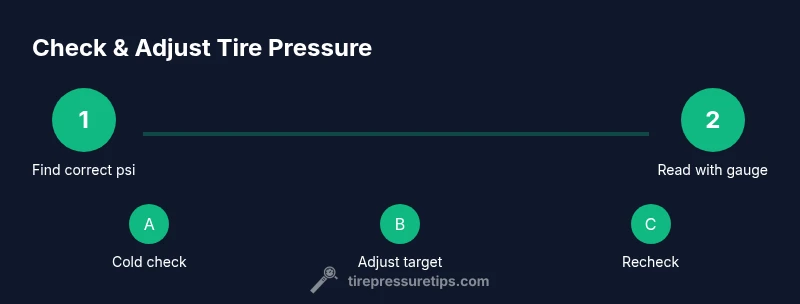
Steps
Estimated time: 30-40 minutes
- 1
Locate the correct tire-pressure spec
Find the exact recommended pressure for your tires from the door placard or owner’s manual. Note whether the front and rear tires have the same target or different values, especially on performance or heavy-load vehicles.
Tip: Use the placard as the primary source; the sidewall max is not the operating target. - 2
Prepare and verify your tools
Gather a digital gauge and an air source. Ensure tires are cold before measuring, and remove the valve caps to access the stems.
Tip: A cold start ensures readings reflect ambient pressure rather than recent driving heat. - 3
Read current pressure
Attach the gauge securely to the valve stem and note the reading. Record this value, especially if it’s far from the target range.
Tip: If the gauge wiggles or misreads, re-seat and take a second reading. - 4
Adjust to target pressure
If underinflated, add air in small increments (about 1-2 psi at a time) and recheck after each increment. If overinflated, release air gradually and recheck.
Tip: Small changes are safer; large adjustments can overshoot the target. - 5
Recheck all tires
Repeat the measurement on all four tires. Ensure consistency with the target pressures and verify TPMS consistency.
Tip: Tires can wear differently; ensure all four readings are aligned with the vehicle’s spec. - 6
Finish and log
Replace valve caps, tidy tools, and log the final readings. Note the date, ambient temperature, and any special loads for future reference.
Tip: Keep a simple record so you can compare seasonal changes over time.
Frequently Asked Questions
What does tire pressure 50 psi mean for my car?
50 psi usually indicates high inflation or a specialized tire setup. Always verify against the vehicle’s specified range in the owner’s manual or placard.
Fifty psi typically means high inflation or a special tire setup; check the manual or placard for your exact range.
Is it safe to drive with 50 psi?
Only if the manufacturer’s spec allows it for your particular tires and load. If in doubt, reduce to the recommended range and recheck.
Only drive with that pressure if your specs allow it; otherwise, reduce to the recommended range.
How does temperature affect tire pressure?
Tire pressure changes with temperature. Cold weather lowers pressure and warm weather can raise it; measure when tires are cold for consistency.
Temperature changes affect pressure—check when cold for accuracy.
How often should I check tire pressure?
Check at least once a month and before long trips. Always measure tires when cold to get accurate readings.
Check monthly and before trips, and always when tires are cold.
What should I do if TPMS shows a warning at high psi?
Treat it as a signal to inspect all tires promptly. Recheck pressures on all tires and fix any leaks. If unsure, consult a technician.
If TPMS warns, inspect all tires and verify with a gauge; fix leaks or service as needed.
How do I determine the correct pressure for heavy loads?
Refer to the vehicle manual or door placard for the heavy-load setting. Do not rely on the tire’s max psi on the sidewall as operating pressure.
For heavy loads, check the placard and follow the manual; do not use the sidewall max as a guide.
Watch Video
What to Remember
- Verify the target pressure before driving
- Use a reliable gauge and check cold tires
- 50 psi is uncommon for most cars; confirm why it’s specified
- Temperature and load influence readings