Tire Pressure 16: Check, Adjust & Maintain Proper PSI
Learn how to check and maintain tire pressure for 16-inch tires, interpret TPMS alerts, and prevent under- or over-inflation with practical steps, tools, and seasonal guidance.


Goal: learn to check, adjust, and troubleshoot tire pressure for a 16-inch tire setup. You’ll learn the exact PSI ranges for common vehicles, how to interpret TPMS alerts, and how to correct under- or over-inflation safely. This guide also covers seasonal changes, tools you’ll need, and best maintenance practices to protect tire life and fuel efficiency.
What the phrase tire pressure 16 means for you
In everyday driving, 'tire pressure 16' refers to tires mounted on 16-inch wheels. The size alone does not determine the correct PSI; the manufacturer’s specification for your vehicle does. Checking and maintaining the correct pressure helps with safety, handling, tire wear, and fuel efficiency. According to Tire Pressure Tips, vehicle owners who routinely verify cold tire pressure and keep it within the recommended range experience more consistent handling and reduced risk of blowouts. The Tire Pressure Tips team emphasizes that the exact PSI depends on the axle load and driving conditions, so always start with the door placard or owner’s manual. This foundational step is crucial for tires on 16 inch wheels, as they respond differently to load and temperature than larger or smaller rims. Throughout this guide you will learn where to find the spec, how to measure accurately, and how to address common pitfalls. TPMS warnings are useful cues but do not replace actual measurements.
How to locate the correct PSI for your 16-inch tires
The first step is to locate the official recommended tire pressure for your specific vehicle. Most cars list a PSI value on a rider door placard mounted inside the driver’s door jamb. Some vehicles also show the spec on the edge of the driver’s door, in the glove compartment, or in the owner manual. In many trucks and SUVs the front and rear tires may have different specs, so check both axles. If you cannot find a placard, use the vehicle manufacturer’s online spec sheet or contact a dealer. Remember that the 16 inch wheel size is separate from the PSI spec; you must use the published PSI for your model regardless of wheel diameter. Record the front and rear values for future reference.
Tools and gauge types: choosing accuracy
To measure tire pressure accurately, you will need a reliable gauge and the means to inflate if necessary. Common options include a dial gauge, a digital gauge, or a built in gauge at a service station. Digital gauges are easy to read, but ensure calibration against a known standard from time to time. A quality gauge should read within plus or minus 1 psi of the true value. Also have access to a portable air pump or compressor so you can adjust pressure quickly. Keep a note of the gauge type you use and its last calibration date.
Practical tips for measuring without bias
Always measure when tires are cold, meaning the vehicle hasn’t been driven more than a mile since the last measurement. Remove the valve cap, place the gauge on the valve stem squarely, and take a reading. If the result differs from the spec by more than a few psi, recheck with the same gauge to confirm accuracy. A leaky valve stem or a damaged core can skew readings, so inspect the stem for corrosion or wear and replace as needed. Record readings and note any unusual changes in front vs rear pressures to catch gradual leaks early.
Interpreting TPMS alerts vs actual PSI
TPMS is a helpful warning system but it is not a substitute for direct measurement. A TPMS warning indicates that pressure has deviated from the recommended range, but it does not reveal the exact PSI. After a TPMS alert, manually verify each tire with a gauge and adjust to the vehicle spec. If a tire repeatedly triggers TPMS while your gauge shows correct pressure, you may have a faulty sensor or a slow leak that warrants inspection by a tire professional.
Temperature effects and seasonal changes
Tire pressure is sensitive to temperature. Colder ambient temperatures can lower PSI, while hot road surfaces and braking can influence readings shortly after driving. In cold climates, check tires more frequently during fall and winter, especially after cold snaps or storms. Temperature-related changes can be a few psi, which is enough to move you out of the recommended range even if the tires were correct a day earlier. Keeping a simple log helps you notice patterns and maintain consistent pressure year-round.
Common mistakes and how to fix
Mistakes like inflating to a target number without referencing the vehicle placard, using worn or inaccurate gauges, or measuring after driving can lead to inconsistent results. Always verify with a reliable gauge and adjust while tires are cold. Never mix front and rear pressures unless the placard specifies separate values for each axle. If you notice uneven wear, a slow leak, or a TPMS warning that won’t resolve after adjusting, seek help from a tire professional.
Vehicle-specific considerations and tire types
Different vehicle categories and wheel configurations affect optimal PSI. Sports cars with firmer suspensions and higher cornering loads may use a different range than sedans. All-season, winter, and performance tires also have distinct pressure tolerances. Always start from the manufacturer spec rather than personal preference, then consider load, speed, and typical driving conditions. For 16-inch wheels, the overall approach remains the same: verify cold PSI with a reliable gauge and adjust to the recommended range.
Maintenance routines and logging readings
Create a simple routine: check cold tire pressure monthly, before long trips, and after tire rotations or air-pressure changes. Keep a log with date, tire, front/rear, measured psi, and the target psi. This habit helps you identify gradual leaks and ensures you stay within safe operating limits across all tires. Pair this with periodic TPMS checks and valve stem inspections to catch issues early.
Safety and when to seek professional help
If you notice persistent air loss, a damaged valve stem, bulges, or cracks in the sidewall, stop driving and seek a tire professional immediately. Do not rely on TPMS alone when addressing a suspected leak or damaged tire. Routine maintenance between trips reduces the risk of blowouts and improves handling, tire longevity, and fuel efficiency.
Tools & Materials
- Tire pressure gauge (dial or digital)(Calibrate or verify accuracy against a known standard; read in psi.)
- Portable air pump or compressor(Prefer a unit with a built-in gauge; maintain control to avoid overinflation.)
- Vehicle owner’s manual or door placard(Used to locate the exact PSI spec for front and rear tires.)
- Valve cap remover or replacement valve stems(Useful if valve caps are missing or stems show wear.)
- Notebook or digital log(Track readings and maintenance history for future reference.)
Steps
Estimated time: 15-25 minutes
- 1
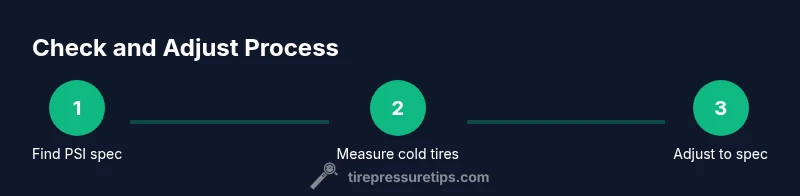
Find the correct PSI spec for your vehicle
Consult the door placard or owner’s manual to identify front and rear tire PSI targets. Note if there are separate values for axle pairs or varying by load. This is the foundation for every tire pressure adjustment.
Tip: If the placard lists pressures in both kg/cm2 and psi, convert if needed and record the psi values clearly. - 2
Check that tires are cold
Measure before driving or after at least three hours of no driving to avoid heat-related pressure increases from recent movement.
Tip: If you must drive, plan to recheck again after a short drive and allow tires to cool before final adjustment. - 3
Remove valve caps and attach gauge
Place the gauge on the valve stem squarely and press straight down. Read the PSI promptly to avoid air loss from prolonged contact.
Tip: Keep the valve stem clean; a dirty stem can skew readings or contaminate the gauge. - 4
Compare reading to spec
If the reading is below or above the target, plan the adjustment accordingly. Do not rely on a single gauge if readings seem off; re-check with a different gauge if possible.
Tip: Small adjustments in increments of 1–2 psi reduce the risk of overinflation. - 5
Adjust to target PSI
If underinflated, add air until you reach the recommended PSI. If overinflated, release air gradually to the exact value.
Tip: Use the edge of the valve stem to release air with a steady touch—don’t rush the process. - 6
Recheck and recap
Recheck all tires after adjustment to confirm accuracy. Replace valve caps and tidy up any equipment.
Tip: Record the final PSI for each tire to maintain a baseline for future checks. - 7
Address TPMS reminders
If TPMS remains lit after adjustment, consider sensor issues, slow leaks, or the need for a reset service.
Tip: Do not ignore persistent TPMS warnings; consult a professional if the light stays on.
Frequently Asked Questions
What is the recommended tire pressure for 16-inch tires?
The recommended PSI for 16-inch tires depends on the vehicle model and axle. Always start with the door placard or owner's manual for the exact front and rear values. If you cannot locate the spec, contact the dealer or manufacturer for the official numbers.
Check the door placard or owner's manual for your exact PSI values. If in doubt, contact the dealer for the official numbers.
How often should I check tire pressure?
Check tire pressure at least monthly and before long trips. Do so when tires are cold to get an accurate reading and adjust if needed.
Check at least once a month and before long trips, when tires are cold to get an accurate reading.
Can TPMS replace tire pressure gauges?
TPMS alerts you to pressure deviations but does not provide an exact PSI. Always verify with a reliable gauge and adjust to the spec.
TPMS warns you of low or high pressure, but you should still measure with a gauge to know the exact value.
What tools do I need to measure tire pressure?
A reliable tire pressure gauge and access to an air source. A logbook or app to track readings helps maintain consistency over time.
Use a good gauge and an air source; keep a log of readings for reference.
What risks come from underinflation?
Underinflation can cause poor handling, uneven wear, and reduced fuel efficiency. It also increases the likelihood of tire failure under load or at high speeds.
Underinflation reduces handling, wears tires faster, and lowers fuel efficiency. It can be dangerous under load.
Should I adjust tire pressure for cold weather?
Yes, cold weather lowers PSI. Check and adjust more frequently in fall and winter to maintain safe pressure levels.
Yes, in cold weather your tires lose pressure. Check more often during the cold season.
Watch Video
What to Remember
- Verify cold PSI against manufacturer spec before driving.
- Use a reliable gauge and recheck after adjustments.
- Account for temperature and season when checking pressure.
- Treat TPMS as a warning cue, not a measurement substitute.
- Maintain a simple log of tire readings for consistency.