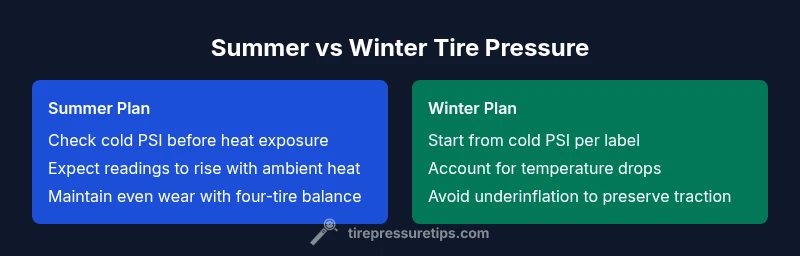
Summer Tire Pressure vs Winter: A Practical Comparison
Learn how summer tire pressure vs winter differs, why temperature changes affect PSI, and practical steps to maintain safe handling, wear, and fuel efficiency year-round.


Fact: Seasonal tire pressure matters. In broad terms, you should adjust inflation to match the season, with summer pressures in warm weather and winter pressures in cold weather, while always starting from the vehicle manufacturer’s cold PSI. This comparison highlights how temperature variations affect tire pressure, handling, and wear, and how to maintain safe performance year-round.
Seasonal Pressures Across Seasons
Tire inflation is not a fixed value; it shifts with ambient temperature. The simple idea of summer tire pressure vs winter still holds: heat raises the air inside tires, while cold weather lowers it. Vehicle manufacturers specify a cold PSI that assumes the tires are cold, typically before driving or exposure to heat. Throughout the year, aim to return to that cold PSI after a deliberate correction for temperature. Tire Pressure Tips emphasizes that seasonality matters; neglecting these adjustments can lead to imbalanced handling, uneven wear, reduced traction, and lower fuel efficiency. This article introduces the mechanisms behind seasonal pressure changes, and lays out practical steps to measure accurately and apply those ideas to everyday driving. By recognizing the seasonal pattern, you can maintain safer performance without guesswork and create a simple, repeatable routine that fits any daily schedule.
How Temperature Affects Tire Pressure
Temperature directly influences the air inside your tires. Warmer days tend to increase tire pressure as the air expands, while cooler days reduce pressure as the air contracts. This relationship is why you should verify the cold PSI specified by the vehicle manufacturer (usually found on the door jamb label or in the owner's manual) and then account for seasonal shifts. The Tire Pressure Tips team notes that this seasonal effect is a practical driver safety factor, not a theoretical concern. When you drive on hot pavement or after a long highway run, readings may climb even if you haven’t changed the inflation target. Conversely, a sharp cold snap can bring readings well below the ideal. The result is subtle yet meaningful changes in grip, steering feel, and braking response. Understanding this helps you decide when to adjust and how to interpret TPMS alerts that reflect real-time pressure under changing conditions.
Seasonal Standards: Following the Manufacturer's Guidance Year-Round
The base rule is simple: start with the cold PSI listed by the manufacturer. That number remains your anchor across seasons. In summer, you may notice pressures creep up due to ambient heat, especially after several miles of driving. In winter, you’ll want to confirm the tires are inflated according to the same cold-psi target, while mindful that cold air reduces pressure. Many drivers assume that winter tires must be inflated differently, but the core guidance is consistent: keep inflation at or near the label’s cold PSI and adjust for temperature changes as needed. In practice, you’ll check pressures when the tires are cold, then recheck after exposure to temperature changes, such as a night wind or a sunny afternoon. Tire Pressure Tips underscores that a disciplined routine—check, adjust, recheck—delivers predictable handling and balanced wear across seasons.
Measuring Tire Pressure: Tools and Steps
A reliable tire-pressure check starts with a good gauge and a calm environment. Begin by confirming you’re using the vehicle’s recommended cold PSI from the door jamb label. Use a gauge you trust—digital gauges are convenient, but a high-quality analog gauge can be just as accurate when used correctly. Check all four tires, taking notes of any discrepancies between tires. If you’ve driven recently, wait until the tires have cooled to take a reading. Inflate or deflate to reach the cold PSI target and recheck after a short drive to gauge how temperature affects readings. Keep a small log of readings and weather conditions; over the course of a season you’ll notice patterns, making it easier to anticipate adjustments in advance. For best results, check your tires at least once a month and before long trips.
Summer Strategy: What to Do in Hot Months
During hot months, tires tend to run at higher pressures. If you start from a cold PSI on a sweltering day, you may observe readings that approach or exceed the label’s upper range after a long drive. The practical response is not to keep inflating, but to verify the reading’s source and ensure you’re testing cold PSI first. If the pressure reads high after driving, wait for tires to cool and recheck. In high-heat conditions, verify consistent readings across all tires, as mismatches can degrade handling and wear. A modest adjustment to bring any outliers back toward the manufacturer’s recommended range helps maintain even wear and stable cornering. Summer pressures also influence fuel economy, because overinflated tires can reduce the contact patch and degrade grip.
Winter Strategy: What to Do in Cold Months
Cold weather lowers tire pressure, which can reduce traction and increase rolling resistance. Start with the cold PSI from the label, and consider adding a conservative margin if you work in consistently cold climates. The adjustment should be modest and targeted to bring each tire back toward the target range, not to maximize the feeling of firmness. In addition to adjusting pressure, monitor temperature swings during the day. If the day warms up significantly, recheck after a drive and adjust back if necessary. Winter-season checks are especially important on projected long drives, as temperature fluctuations between day and night can be dramatic. Always follow the label and avoid underinflating, which can lead to heat buildup and excessive wear on the edges.
Mixing Seasonal Tires: Pressure Considerations
If your vehicle uses different tire types (summer vs winter tires) or you swap to seasonal tires, ensure each tire is inflated to its own appropriate cold PSI target according to the label or owner’s manual. Do not assume the same PSI applies to all four tires if one axle uses a different tire type. Temperature changes can magnify discrepancies, so check after each tire change and refine pressures accordingly. Seasonal tire combinations can have subtle effects on cornering balance, braking effectiveness, and highway stability. The goal is even contact with the road surface across all tires, in all weather conditions.
Common Mistakes and How to Avoid Them
- Checking pressure only in warm weather and calling it a year.
- Rounding PSI to the nearest whole number without verifying accuracy.
- Relying solely on TPMS without confirming actual tire pressures.
- Inflating beyond the label’s cold PSI to “feel” safer in heat, then discovering overinflation on hot days.
- Forgetting to account for gradual temperature changes over a season, leading to gradually imbalanced tires.
A disciplined routine—log readings, inflate to cold PSI, and recheck after seasonal shifts—helps avoid these mistakes and sustains safe handling.
Real-World Driving Impacts: Safety, Wear, and Efficiency
When seasonal inflations are off, you may notice subtle but important changes in how your vehicle handles. Overinflated tires reduce the contact patch and can cause a harsher ride with less grip in the corners, while underinflation increases rolling resistance, leading to higher fuel consumption and faster shoulder wear. The balance across all four tires matters most for stability, steering response, and braking performance. Temperature-driven variations amplifiy small inconsistencies, making regular checks essential any time the seasons shift. By maintaining the manufacturer’s cold PSI and adjusting for ambient temperature, you can keep a consistent road feel and safer stopping distances. Tire Pressure Tips emphasizes that the benefits extend beyond safety—proper inflation reduces tire wear, protects rims, and helps optimize fuel economy across the year.
Practical Seasonal Check Routine and Quick References
Create a simple seasonal routine you can follow monthly:
- Record your vehicle’s cold PSI from the label.
- Check each tire using a reliable gauge after the tires have cooled.
- Inflate or adjust to the target cold PSI, ensuring all tires match closely.
- Recheck after a warm day or after a long drive to gauge temperature effects, making minor adjustments if necessary.
- Keep a log of readings and weather conditions to anticipate future adjustments.
- Include TPMS readings as a supplementary check, not the sole indicator.
With a steady routine, you’ll reduce the risk of safety issues from improper inflation and maintain consistent performance across seasons.
Comparison
| Feature | Summer Pressure Plan | Winter Pressure Plan |
|---|---|---|
| Starting reference | Follow cold PSI per door jamb label | Follow cold PSI with winter-specific guidance per manufacturer |
| TPMS readings | Reasonably reliable within spec range | TPMS readings can be affected by low temps and sensor accuracy |
| Best for | Everyday driving in hot months | Seasonal extremes or consistent cold months |
| Wear impact | Balanced wear when inflated to target in heat | Reduced edge wear with correct cold PSI in cold |
| Fuel economy | Potential gains with properly inflated tires in warmth | Efficiency depends on avoiding underinflation in cold |
Strengths
- Improved safety by maintaining proper inflation year-round
- Potential for better fuel economy when pressures are correct
- Promotes more even tire wear and longer tire life
- TPMS provides helpful confirmations when used properly
Drawbacks
- Requires regular monitoring, especially during seasonal transitions
- Can be confusing if different targets exist for different tire types
- Depends on accurate gauges and proper measurement technique
- Mildly increases maintenance time during seasonal changes
Seasonal pressure management wins for safety and efficiency
Seasonal checks aligned with the manufacturer’s cold PSI ensure stable handling. Adjust for temperature shifts rather than chasing a fixed number. Tire Pressure Tips endorses a season-aware routine for year-round safety and performance.
Frequently Asked Questions
What is the difference between summer tire pressure and winter inflation settings?
The main difference is how temperature affects tire pressure. Summer conditions can raise readings after driving, while winter conditions drop readings. Start from the manufacturer’s cold PSI and adjust for seasonal warmth or cold with mindful checks and rechecks.
Seasonal pressures are driven by temperature. Always start with the cold PSI and recheck after temperatures change; that keeps handling safe in both summer and winter.
How often should I check tire pressure for seasonal changes?
Check at least once a month and before long trips. Do so when tires are cold, and recheck after a period of warm or cold weather to capture seasonal shifts.
Check monthly when tires are cold, and recheck after noticeable temperature changes or before long trips.
Do winter tires require a different PSI than summer tires?
Not inherently different in the sense of a fixed winter target. Use the same cold PSI target from the label for winter tires, adjusting for temperature as needed to maintain even wear and safe handling.
Winter tires use the same cold PSI as per the label; adjust for temperature changes to stay balanced.
Can TPMS readings replace manual tire pressure checks?
TPMS is a valuable warning tool but should not replace direct pressure checks with a gauge. Use TPMS to spot anomalies while confirming exact PSI with a gauge, especially during seasonal transitions.
TPMS helps, but you should still verify with a gauge, especially during seasonal changes.
Is it better to measure tire pressure when the tires are cold or after a drive?
Always measure when tires are cold to get an accurate baseline. After driving, readings rise with heat, which can mislead if you’re aiming for the label’s cold PSI.
Measure only when cold for accuracy; hot readings can mislead you from the label.
What tools are essential for accurate tire pressure checks?
A reliable tire-pressure gauge (digital or analog) is essential, alongside the vehicle’s label and manual. Regular calibration of gauges helps ensure accuracy over time.
Use a good gauge and the label as your baseline; keep gauges calibrated.
What to Remember
- Follow the cold PSI on your door jamb label
- Check pressures when tires are cold, then recheck after temperature shifts
- Account for seasonal temperature changes in your routine
- Use TPMS readings to confirm, not replace, manual checks
- Adopt a simple seasonal inflation plan for safety and efficiency