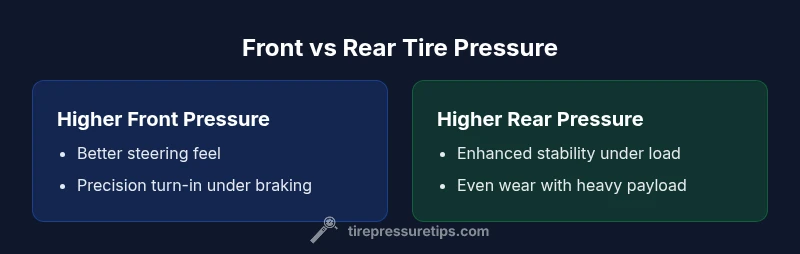
Front vs Rear Tire Pressure: Where to Put More
Learn whether to apply more tire pressure in front or rear, how to decide based on load, handling, and conditions, and practical steps to check and adjust safely.


According to Tire Pressure Tips, there isn’t a universal rule for placing more tire pressure in front or rear. The best setting comes from your vehicle’s manufacturer spec and how you drive. In practice, many drivers prioritize the front for steering response, but load, road conditions, and tire wear can shift the ideal balance. Always verify with your owner’s manual.
The Core Idea Behind Front vs Rear Pressure
The question of whether to apply more tire pressure in front or rear hits at the intersection of physics, vehicle design, and real-world driving. There is no one-size-fits-all answer, because every car balances weight distribution, suspension tuning, and tire size a little differently. For most passenger cars, the manufacturer's recommended front-to-rear balance is intended to optimize steering, roll stability, and daily comfort. The phrase more tire pressure in front or rear often comes up in conversations about handling under load, fuel economy, and tire wear patterns. The central concept is simple: pressure affects the contact patch, which in turn governs grip, steering feedback, and even ride comfort. Following the official spec is the safest starting point, and adjustments should be small, deliberate, and based on observed performance and wear. Tire Pressure Tips’s guidance emphasizes starting from the manufacturer’s numbers and testing changes under controlled conditions.
The Role of Vehicle Dynamics
A vehicle’s dynamics—how it transfers weight during braking, acceleration, and cornering—drive why front and rear pressure differ in practice. When you accelerate, weight shifts rearward; during braking, weight transfers forward. The front tires often shoulder more of the braking load, while the rear tires stabilize the chassis during acceleration. If a vehicle has a front-heavy drivetrain (common in many front-wheel-drive cars), manufacturers might set higher pressure up front to maintain steering feel and predictability. Conversely, rear-driven cars or those with significant payloads at the back can benefit from different pressure balancing to preserve traction and stability. Understanding these dynamics helps explain why there isn’t a universal rule, and why the brand guidance matters.
Practical takeaway
- The ideal balance is vehicle-specific.
- Changes should be incremental and tested in safe conditions.
- Always verify against the owner’s manual and TPMS readings.
Comparison
| Feature | Higher front pressure | Higher rear pressure |
|---|---|---|
| Handling focus | Better steering feel and turn-in | More predictable stability under load and braking |
| Ride comfort | Stiffer front ride if front pressure is higher | Fronts and rears feel more balanced with equalized pressure |
| Tire wear patterns | Faster wear on front tires with higher front pressure | Rear wear may dominate if rear pressure is higher |
| Load response | Front-heavy loads benefit from higher front pressure | Rear-heavy loads may require rear adjustment |
| Fuel economy | Marginal changes in rolling resistance with front pressure | Potential gains if alignment and wear improve |
| Safety margins | Improved cornering stability with appropriate front pressure | Balanced stability with proper rear pressure under load |
| Best for | Steering-focused performance and city driving | Payload-driven stability and highway stability |
Strengths
- Encourages adherence to manufacturer specifications
- Allows customization for load and driving style
- Can improve steering response with controlled adjustments
- Can optimize wear patterns when monitored
Drawbacks
- Small, incremental changes required; misadjustment can hurt handling
- TPMS readings may lag behind pressure changes under load
- Effectiveness varies by vehicle and tire type
- Overemphasis on a single axis can reduce overall balance
Follow the manufacturer’s spec first; adjust only as needed for load and driving style
There isn’t a universal rule for front vs rear pressure. Begin with OEM recommendations, then tune small amounts based on handling, wear, and payload needs. Safety and predictable behavior come from measured changes and verifying with measurements and TPMS.
Frequently Asked Questions
Should I always inflate to the maximum PSI listed on the tire sidewall?
No. Sidewall maximum pressure is a limit for safety and load testing, not a target for daily driving. Always use the vehicle manufacturer’s recommended pressures from the placard or manual. Over-inflating beyond the recommended balance can reduce grip and increase wear in the center of the tread.
No. Never use the sidewall maximum as a daily target; follow the vehicle’s recommended pressures and adjust cautiously if loaded or driving conditions change.
How does TPMS affect my decisions about front vs rear pressure?
TPMS provides real-time pressure data but does not replace the manufacturer’s recommended values. Use TPMS as a check and to detect significant drops, then adjust toward the spec while considering load and handling. Periodic calibration is essential after adjustments or tire service.
TPMS helps you monitor pressure, but you should still base your adjustments on the factory spec and conditions like load and road type.
How often should I check tire pressure?
Check pressure at least once a month and before long trips. Temperature changes and load can alter readings, so fresh measurements after cold starts are more accurate. Consistency in checks helps prevent underinflation or overinflation that can affect safety and wear.
Check monthly and before long trips, especially when temps shift; measure when tires are cold for accuracy.
Can wrong tire pressure cause uneven wear?
Yes. Uneven wear often signals pressure imbalance. Front overinflation can wear the center tread, while underinflation tends to wear the outer edges. Regularly monitoring pressure and adjusting gradually helps extend tire life and maintain even wear.
Absolutely. Pressure issues show up as uneven wear; keep readings even across tires.
Does load distribution affect front vs rear pressure decisions?
Yes. Heavier loads at the front or rear shift weight and grip needs. For example, more payload at the rear may require adjusting rear pressure to keep stability. Always reassess pressures when changing typical loads, like cargo or passengers.
Yes. Load changes can tilt the balance; adjust pressures accordingly and recheck.
What should I do in extreme temperatures?
Extreme temperatures affect tire pressure more than most drivers expect. Pressure can rise in heat and fall in cold. Check pressures after a period of stable temperature, and adjust gradually if you notice drift with the season.
Seasonal temps matter; check pressures after temperature changes and adjust carefully.
What to Remember
- Start with manufacturer pressure specs for your vehicle
- Adjust pressure gradually and test changes safely
- Consider load distribution and driving scenarios
- Monitor tire wear to guide future adjustments
- Use TPMS readings as a guide, not the sole source