Adding Air to Tires: A Practical Step-by-Step Guide
Learn to add air to tires safely and accurately. This Tire Pressure Tips guide covers finding the correct PSI, using a gauge, inflating properly, and verifying tire pressures for your vehicle.


Goal: You will successfully add air to your tires to bring them to the vehicle’s recommended PSI. You’ll need a reliable pressure gauge, access to an air source, and the correct pressure specification from your door jamb sticker. According to Tire Pressure Tips, adding air to tires to the recommended PSI improves safety, tire wear, and fuel efficiency. This quick guide covers checking, adjusting, and verifying pressures.
Why adding air to tires matters
Tire pressure is a simple, powerful factor in how your car behaves on the road. Properly inflated tires provide better grip, more even wear, improved fuel efficiency, and more predictable handling in rain or snow. When tires are underinflated, the tread area gets more flex, leading to overheating, faster wear on the outer edges, and higher rolling resistance that saps mileage. Overinflated tires ride firmer and can reduce the contact patch, causing harsher steering and reduced grip in certain conditions.
According to Tire Pressure Tips, the most reliable way to maintain correct pressure is to use the vehicle’s recommended PSI, which is usually listed on the door jamb sticker or in the owner’s manual, rather than relying on the tire sidewall maximum. Pressure should be checked when tires are cold, because heat from driving increases PSI and can give a false reading. For most passenger cars, maintaining proper tire pressure across all four tires helps ensure even tread wear, balanced steering, and a safer stop distance. In this guide we’ll cover how to locate the right numbers, how to measure accurately, and how to adjust with an air compressor or inflator.
How to find the correct tire pressure
The correct pressure is not a single value; it's per tire and per axle. Start with the door jamb sticker on the driver's side or consult the owner's manual. Note the 'cold tire' PSI numbers. If you can't locate them, check a dealer service bulletin or contact the vehicle manufacturer. Front tires are often set differently from rear tires. Then consider the load and speed: heavy loads or high-speed driving may require slightly higher inflation, sometimes up to a few psi more. Use a quality gauge and check each tire individually. Remember that TPMS alerts do not tell you the exact PSI; they indicate there's an under- or overinflation problem.
Tools and safety reminders
To add air to tires correctly, you’ll need a few reliable tools and a safe workspace. Start with a calibrated tire pressure gauge (digital or analog) and a quality inflator or air compressor. Have the vehicle’s PSI label handy and a notebook to record readings. Park on a level surface, engage the parking brake, and chock the wheels to prevent movement. Never inflate a tire that shows obvious tread damage or a puncture beyond repair. Never exceed the maximum PSI printed on the tire sidewall. If you are inflating a tire that has recently run hot, wait until it cools before taking a final reading. These precautions help prevent overinflation and ensure accurate measurements.
Preparing to add air (before inflating)
Before touching the valve, gather your tools and inspect the tire for damage. Remove the valve cap and check for cracks or objects in the stem. Confirm the target PSI from the door jamb label, then set your inflator to read in psi. If your gauge lacks a zero setting, reset it by briefly pressing the trigger with the nozzle attached to a known calm surface. This preparation reduces measurement error and makes the inflation process smoother.
Step-by-step inflation process
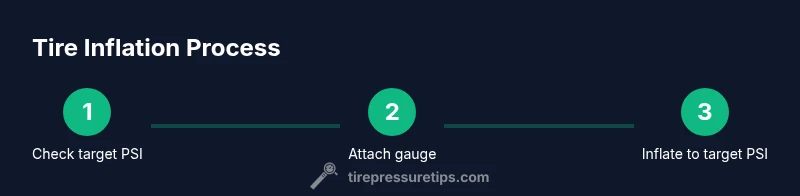
Attach the gauge to the valve stem and note the current reading. If under target, attach the inflator and add air in small increments, 1–2 psi at a time. Pause to read the gauge and let the tire settle for a moment before the next adjustment. Repeat until the tire is within 1 psi of the recommended value. Replace the valve cap and wipe away any dust from the stem. Repeat for the other tires, respecting different front/rear specifications if applicable.
Verifying pressures and final checks
After you finish inflating, recheck all four tires when they are cold and have rested for at least 3 hours, or before a long trip. Revisit the numbers and adjust as needed. If you plan to drive long distances, consider re-checking after the first 10–20 miles as the tires heat up and pressures rise. Keep a record of the values for future reference and for periodic maintenance. Check the spare tire as well, since it is often overlooked but essential in emergencies.
Common mistakes and troubleshooting
Common mistakes include inflating while tires are hot, relying on the tire sidewall maximum instead of the door label, and using mismatched gauges. A too-low reading may be caused by a slow leak or a damaged valve stem. Overinflation can reduce the contact patch and worsen ride quality. If your TPMS warns after inflating, verify the readings again with a separate gauge and ensure you inflated all tires to the correct numbers. If a tire refuses to hold pressure or shows unusual wear, seek professional inspection.
Authority sources
For verified guidance, refer to reputable safety and standards resources:
- https://www.nhtsa.gov/road-safety/tires
- https://www.consumerreports.org/cars/how-to-check-tire-pressure/
- https://www.nist.gov/pml/metrology
Tools & Materials
- Tire pressure gauge(Digital preferred for accuracy; ensure it is calibrated and reads in psi.)
- Air compressor or portable inflator(Prefer a unit with a built-in gauge; if using public air, verify accuracy.)
- Vehicle door jamb PSI label or owner's manual(Needed to know the target PSI per tire.)
- Valve caps(Keep caps on to prevent dust and leaks.)
- Wheel chocks or blocks(Use to prevent wheel movement on level ground.)
- Notebook and pen(Record pressures for tracking over time.)
Steps
Estimated time: 15-25 minutes
- 1
Find the correct tire pressure
Locate the target PSI per tire on the door jamb sticker or owner's manual. Note that front and rear tires can have different values and that cold readings are essential for accuracy.
Tip: Double-check both axles if your vehicle has different per-tire specs. - 2
Park on level ground and ensure tires are cold
Move to a level surface, engage the parking brake, and wait for tires to cool if they were driven recently. Hot tires rise in pressure, skewing readings.
Tip: If you must drive before inflating, drive gently and re-check after the tires cool. - 3
Attach gauge and prepare inflator
Remove the valve caps and place the gauge on the valve stem to read the current pressure. Connect the inflator and ensure a good seal with no leaks.
Tip: Make sure the valve stem is clean before connection to avoid false readings. - 4
Inflate in small increments
Add air in small increments of 1–2 psi, pause, and re-check. This prevents overinflation and lets the tire settle before another adjustment.
Tip: If you overshoot, use the release valve or back off air gradually. - 5
Re-check and adjust to target PSI
Continue until the gauge reads within 1 psi of the target value for each tire. Do not rely on gut feel; use the gauge every time.
Tip: Mark down the final readings for future reference. - 6
Finalize and document
Replace valve caps, reset any TPMS after inflation, and record the final pressures. Check all four tires and the spare if present.
Tip: Store the gauge and maintain a simple log for routine checks.
Frequently Asked Questions
Why did my TPMS light stay on after inflating to the target PSI?
TPMS alerts can stay on if the system detected a previous underinflation or if the tire just heated up after driving. Recheck all tires with a gauge, and if readings are correct, you may need to reset the TPMS or seek service if the light remains. Always consult your vehicle’s manual for TPMS reset procedures.
If the light stays on, recheck with a gauge and reset the TPMS per your manual. If it won’t reset, have a technician check the system.
Can I inflate a hot tire safely?
Inflating a hot tire can give a higher reading than the true cold PSI, leading to underinflation once the tire cools. It’s best to wait until the tire is cold before inflating and use the label’s cold-psi value for accuracy.
No—wait until the tire is cold to read the correct PSI and inflate accordingly.
Is it okay to mix different tire pressures on the same axle?
For most vehicles, all tires on the same axle should be inflated to the same value as specified for that axle. Mixing pressures can affect handling and wear. If the manufacturer specifies different values, follow those per tire position.
No, keep the same spec per axle unless the manual says otherwise.
How often should I check tire pressure?
Check tire pressure at least once a month and before long trips. Temperature changes and load can affect pressure, so regular checks help prevent issues.
Check monthly and before long trips.
What should I do about a slow leak?
If you notice repeated pressure loss, inspect for punctures, damaged valves, or rim leaks. A slow leak may require repair or tire replacement – seek professional help if you cannot locate or fix the spot.
A slow leak may need a professional look to repair or replace the tire.
Should I use nitrogen in tires?
Nitrogen can reduce pressure loss slightly and is often used in fleets, but it isn’t necessary for personal vehicles. If you use it, ensure the same pressure as your standard PSI is maintained and checked regularly.
Nitrogen isn’t required for most cars; regular pressure checks are enough.
Watch Video
What to Remember
- Check tires cold before inflating.
- Inflate in small increments and verify with a gauge.
- Maintain axle-balanced pressures per tire specs.
- Record final pressures for future maintenance.
- Inspect tires for damage during the process.