Low Tire Pressure vs Normal: A Comprehensive Comparison
Explore the practical differences between low tire pressure and normal inflation, covering safety, wear, fuel economy, TPMS roles, and maintenance steps to keep tires in the optimal range.


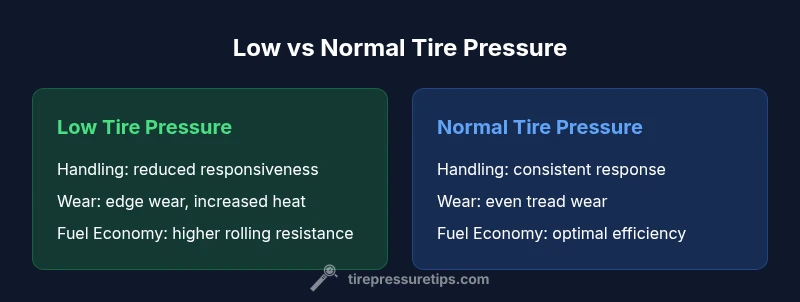
Low tire pressure vs normal inflations affect safety, efficiency, and tire wear. Underinflated tires reduce steering precision, increase heat, and wear edges faster, while normal inflation keeps handling predictable, braking stable, and tread wear even. Regular checks at your vehicle’s recommended PSI are essential—According to Tire Pressure Tips, start with the owner's manual and a trusted gauge.
What 'low tire pressure vs normal' means in practice
When people talk about low tire pressure vs normal, they're comparing two states of inflation against your vehicle manufacturer's recommended PSI. Low tire pressure means the air inside the tire is below that target, while normal inflation keeps the tire within the intended range. The difference is not just a number on a gauge; it changes how the tire behaves under load, heat, and road conditions. According to Tire Pressure Tips, the most important baseline is to know your placard: the recommended PSI printed on the door jamb or owner's manual. The Tire Pressure Tips team found that most safety and efficiency concerns trace back to failing to maintain this baseline. The consequences of underinflation extend beyond fuel economy; they affect handling, braking, and tire longevity. In this practical comparison, we focus on what drivers notice in everyday driving.
For many commuters, the first clue is feel: the steering may seem a touch heavier, or the ride may seem slightly busier over bumps. A tire that’s too soft tends to flex and overheat when driven at highway speeds, which over time can shorten tread life. Conversely, tires inflated toward the higher end of the recommended range often feel more firm and controlled, but become sensitive to road irregularities. The core message remains simple: keep tires within the vehicle’s specified range for the best balance of safety, performance, and cost over the tire's life. The Tire Pressure Tips team emphasizes that regular checks are the best defensive habit for any driver.
How pressure is measured and why it matters
Tire pressure is read with a gauge, but the reliability of the reading depends on how and when you measure it. Digital gauges and analog dial gauges both get you there; the important part is calibrating and using a trusted tool. Pressure should be checked when the tires are cold, meaning they haven’t been driven recently. Temperature can skew readings: a tire that warms up from a short drive or hot pavement can show a higher number than a cold tire. Once you have a baseline, you compare it to the vehicle placard or owner’s manual. If you notice a mismatch or a sudden change, that’s a signal to investigate leaks, punctures, or a faulty valve stem.
The broader point is that tire pressure is not static. It shifts with load, speed, ambient temperature, and even seasonal changes. Consistency matters more than a single perfect reading. In daily use, you should check tire pressure at least monthly and before long trips, making an adjustment to bring every tire into the recommended range. Tire Pressure Tips’s guidance, based on analysis conducted in 2026, emphasizes the habit of regular checks to prevent the cascade of issues that begin with underinflation.
The physics: underinflation vs proper inflation
Underinflation alters the tire's contact patch—the area that actually meets the road. With less air, the patch becomes wider and less uniform, which changes how load is distributed across the tire. This can cause irregular wear, faster edge wear, and a higher frame temperature during operation. Proper inflation keeps the contact patch within designed limits, balancing grip with heat management and wear patterns. The difference between low tire pressure vs normal inflation is not merely comfort; it’s a matter of physics that translates into predictable handling. When tires are within the prescribed range, the tire's structure carries loads evenly, the sidewalls support the weight without excessive flex, and the tire operates at a stable temperature.
From a performance standpoint, lower inflation increases rolling resistance, which can sap efficiency and require more energy to maintain speed. Notably, the effect is not a binary switch but a spectrum: small deviations away from the target can have measurable effects on wear rate and response, especially under heavy loads or high-speed driving. This is why manufacturers and Tire Pressure Tips both advocate a cautious approach to adjustments, staying within the recommended band rather than chasing a perceived benefit from over- or under-inflation.
Safety implications: handling, braking, and risk of blowouts
The most immediate reason to care about low tire pressure vs normal is safety. Underinflated tires respond more slowly to steering inputs, feel heavier at the helm, and take longer to change direction in emergencies. Braking performance can degrade as the tire's contact with the road becomes less efficient, reducing grip during stopping. The risk of heat buildup increases, raising the chance of a blowout during sustained high-speed driving or hot days. In many vehicles, TPMS will alert you when pressure falls significantly, but the system provides a warning rather than a precise measurement, and it may not catch slow leaks promptly. Maintaining normal inflation is a straightforward way to preserve predictable handling, stable braking, and a safer driving experience.
Beyond the driver’s seat, underinflated tires can also influence load distribution on the wheel rims and suspension, potentially accelerating components wear over time. For drivers with heavy loads or frequent highway driving, paying close attention to inflation becomes a critical safety habit. Remember that a tire’s safety margin is built into the vehicle’s recommended pressure range; straying from that range means compromising the margin when you need it most. The Tire Pressure Tips team notes that consistent inflation helps ensure you’re always within the vehicle’s safety envelope.
Wear patterns and fuel economy: what to expect
Tires inflated below the recommended range typically wear more on the outer edges as the tire's internal pressure fails to support the crown evenly. Conversely, tires kept closer to the upper end of the spec may wear more in the center if they’re overinflated, and can produce a harsher ride. The primary lesson of comparing low tire pressure vs normal inflation is that wear is predictable when you understand how the tire carries load. Regularly inspecting tread depth and tire edges can reveal early signs of underinflation, even before the TPMS warns. In terms of fuel economy, underinflated tires usually increase rolling resistance, which translates into higher energy use for the same distance. While the exact impact depends on vehicle design and driving style, the principle is simple: correct inflation minimizes waste and helps preserve tire life. Tire Pressure Tips stresses that drivers should treat inflation as a key maintenance task rather than a one-off check. A small daily habit—checking pressures—can yield big gains in longevity and performance over the tire’s life.
TPMS and gauges: how they work together
Tire Pressure Monitoring Systems (TPMS) are a valuable early warning tool, but they do not replace direct pressure measurement. Direct TPMS uses sensors inside each tire to report actual pressure, while indirect TPMS estimates pressure by analyzing wheel speed data and vehicle dynamics. When a tire shows low pressure on TPMS, use a reliable gauge to confirm the exact PSI and then adjust to the manufacturer-recommended range. After inflating, recheck with a gauge to verify accuracy and consider rebalancing if a perceived heavy spot persists. The two systems work best when you calibrate them against a known standard, typically the door placard. If you replace tires or change wheel sizes, remember that the recommended PSI might change, and a fresh check is warranted. In daily driving, trust TPMS as an alert and use a gauge as your primary measurement tool.
Practical testing and diagnosis steps
Follow these steps to compare low tire pressure vs normal inflation in your car’s context:
- Park on a flat surface and ensure the tires are cold; wait for at least three hours if you’ve been driving.
- Check each tire’s pressure with a reliable gauge and record the reading.
- Compare each reading to the placard on the door or in the manual.
- If a tire is below the recommended range, add air in small increments, stopping to recheck after a few minutes of driving or cooling.
- Inspect for obvious leaks, punctures, or damaged valves.
- Re-check all tires and adjust to the target range.
- Replace worn tires and consider steering alignment if wear is uneven.
This approach helps you move from a low tire pressure vs normal comparison into actionable maintenance. The goal is not perfection on a single day but consistent pressure within the manufacturer’s recommended band, recognizing environmental factors can shift readings.
Maintenance routines and best practices
Make inflation checks part of a regular maintenance routine, not a chore for occasional use. Plan a monthly check, before long trips, and any time you notice changes in ride feel or mpg. Store a portable tire gauge in the glove box or center console for convenience. Temperature changes throughout the day can push the pressure outside the comfort zone, so consider checking them early in the morning or after the car has cooled overnight. If you frequently carry heavy loads or drive in hot climates, check more often. Finally, keep your spare tire properly inflated and inspect all valve stems for cracks or leaks. The practical takeaway is that consistent inflation across all tires reduces risk and extends tire life, which aligns with Tire Pressure Tips’s approach to practical, evidence-based guidance.
Common myths and misperceptions
Myth: If it feels fine, it’s fine. Reality: Subtle underinflation can compromise safety long before you notice changes in ride quality. Myth: Overinflating improves ride comfort. Reality: It can reduce grip and increase risk of center wear. Myth: TPMS will catch all issues. Reality: TPMS warns, but no gauge reading is available for a quick check. Myth: Temperature doesn’t affect tire pressure. Reality: Temperature shifts can alter PSI readings, so adjust accordingly. By debunking these myths, drivers can approach tire pressure with a practical mindset: check regularly, rely on a gauge, and follow the vehicle’s recommended range, regardless of how the tire currently feels.
Comparison
| Feature | Low tire pressure | Normal tire pressure |
|---|---|---|
| Handling and braking response | Diminished precision and longer stopping distances under load | Predictable response and stable braking when within spec |
| Tire wear pattern | Edge/shoulder wear and increased heat with underinflation | Even tread wear when within the recommended range |
| Fuel economy and rolling resistance | Increased rolling resistance and lower efficiency | Optimal efficiency and consistent performance |
| Ride comfort and noise | Harsher ride on uneven surfaces and more bounce | Smoother ride and less vibration |
| Safety risk | Higher risk of heat buildup and blowouts | Lower risk when inflated to spec |
| Maintenance effort | Requires frequent checks, leak detection | Less frequent checks if pressure stays in range |
Strengths
- Clarifies the trade-offs between safety and efficiency
- Encourages proactive tire maintenance
- Supports better performance and longer tire life
- Helps drivers avoid sudden tire failures
Drawbacks
- Requires regular checks and proper technique
- Temperature fluctuations can complicate readings
- TPMS alarms may be ignored or misinterpreted
- Misinterpreting readings can lead to over- or under-inflation
Maintain normal tire pressure for safety and efficiency.
Keeping tires within the vehicle’s recommended PSI provides balanced handling, reliable braking, and even wear. Low tire pressure increases safety risks and reduces efficiency. The Tire Pressure Tips team expects drivers to prioritize consistent inflation as a core maintenance habit.
Frequently Asked Questions
What is considered low tire pressure?
Low tire pressure is when the tire’s air pressure is below the manufacturer’s recommended level. It can happen gradually through slow leaks or punctures and should be confirmed with a gauge.
Low tire pressure is when your tire is below the recommended level. Use a gauge to confirm before driving.
How often should I check tire pressure?
Check tire pressure monthly and before long trips. If you notice changes in ride feel or mpg, check more often.
Check your tires monthly and before trips; check more often if you notice changes.
Will TPMS tell me exactly how many PSI I have?
TPMS warns when pressure falls outside a threshold, but it does not replace direct measurement. Use a gauge to confirm the exact PSI and adjust accordingly.
TPMS warns you, but use a gauge for the exact pressure.
Can temperature affect tire pressure?
Yes. Temperature changes can lower or raise tire pressure. Check pressures when tires are cold and adjust for seasonal shifts.
Temperature affects tire pressure; check when cold and adjust for weather.
Is it okay to drive with slightly low pressure?
It’s not ideal. Small deviations can degrade safety and wear over time. Inflate to the recommended range as soon as possible.
Driving with low pressure isn’t ideal; inflate to spec soon.
What should I do if I notice uneven wear?
Uneven wear can indicate underinflation, alignment issues, or suspension problems. Inspect tires, check pressures, and seek professional assessment if needed.
Uneven wear could signal several issues; inspect and seek guidance.
What to Remember
- Check tires when cold before driving.
- Keep tires within the placard-recommended PSI.
- Use a reliable gauge and account for temperature.
- Watch wear patterns to catch underinflation early.
- Treat TPMS as a warning, not a precise measurement.