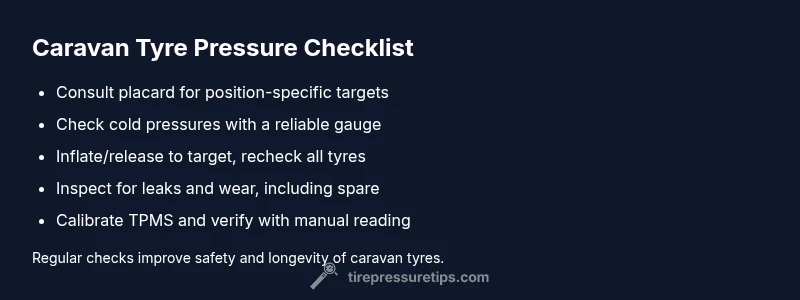
Why Are Caravan Tyre Pressures So High? A Practical Guide
Learn why caravan tyre pressures stay high, how to verify them safely, and step-by-step maintenance tips to prevent blowouts and maximize stability on the road.


Step 1: Caravan tyres typically require higher inflation than passenger tyres to carry heavy loads and maintain stability across multiple axles. Step 2: Always start with the caravan placard and tyre sidewall for the correct cold-pressure range, and check pressures when tyres are cold. Step 3: Recheck after loading and after a short drive, then adjust if needed.
Why caravan tyre pressures are high
If you’re asking why are caravan tyre pressures so high, the simple answer is that caravans carry far more weight than a typical car and must stay stable over longer distances. According to Tire Pressure Tips, the fundamental reason is load and weight distribution across multiple wheels. The combination of a heavy, unbalanced load and a longer wheelbase means tyres operate under higher demands during cornering, braking, and highway travel. This requires higher initial inflation to maintain the tire’s footprint, prevent overheating, and reduce heat buildup during long drives. Understanding this principle helps explain why caravan tyres are set to higher inflation than standard passenger tyres and why it’s essential to follow the manufacturer placard and tyre sidewall specifications exactly. The Tire Pressure Tips team emphasizes that correct pressure is a safety factor for steering response and load-carrying performance, especially in windy conditions and uneven road surfaces.
The physics behind high caravan tyre pressures
Tyres act like a dynamic cushion under load; they deform with every mile, transferring energy and heat. For caravans, the load is distributed over more wheels, and the tyres must maintain grip without excessive rolling resistance. This means the average tyre contact patch must remain stable under weight, camber, and suspension movements. When pressures are too low, sidewalls flex too much, increasing heat and wear; when too high, contact patch area shrinks, reducing traction and increasing the risk of a harsh ride. The practical takeaway is that the high baseline pressure helps keep the footprint predictable, improves steering precision, and mitigates pinch-flat risks during loading and unloading. Maintaining consistent pressure aligned with the placard promotes even tread wear and prolongs tyre life over the journey.
How weight, distribution and multi-axle setups drive pressure
A caravan’s weight isn’t just on the axle closest to the hitch; it is distributed across the entire setup, including the axle near the trailer tongue and the rear axle. This distribution affects the internal heat generation and tyre load at every contact point. Multi-axle configurations also introduce differences between front and rear tyres, so a single fixed pressure often isn’t appropriate for all positions. In practice, you’ll see higher pressures recommended for caravans when laden, and adjustments may be published for single-axle versus twin-axle configurations. Always use the placard for the exact load-based targets, and verify that the tyres are all within a safe band under current conditions.
Checking pressure correctly: cold readings and tools
Before you move, measure tyre pressure when the tyres are cold and the caravan hasn’t been driven for several hours. Temperature affects readings, and a cold check gives a stable baseline. Use a high-quality gauge, ideally a digital or dial gauge, to minimize reading error. Don’t rely on a visual estimation or a pocket gauge that’s worn or uncalibrated. Remember to check all tyres, including the spare, since under-inflated spares can fail when needed. If you’re towing in hot weather or after a long drive, wait until tyres cool down before rechecking for safety accuracy. The little steps here prevent mismatches that could compromise handling.
TPMS and caravan tires: monitoring safety
Many caravans are equipped with TPMS that alert you to rapid pressure changes. While TPMS is valuable, it should not replace a physical pressure check with a gauge—TPMS readings can lag or be affected by temperature or sensor faults. Regularly calibrate sensors if your system allows, and verify sensor readings by cross-checking with a gauge. For caravans, TPMS can help you detect leaks and pinch-flat risks before they become dangerous at highway speeds. Use TPMS as a supplement to direct measurement, and always confirm any alert with a manual reading.
Common myths and missteps that raise risk
There are several misconceptions about caravan tyre pressures that can create danger. Some owners assume higher pressures automatically improve stability; others believe the same pressure works for every tyre position. Neither is true. Each caravan model and tyre combination has a specific pressure range on the placard that corresponds to load and speed ratings. Another common error is inflating to ‘maximum’ on the sidewall, which does not account for load distribution or heat. Stay aligned with the placard, use a consistent gauge, and avoid over- or under-inflation regardless of weather or road type.
Practical guidelines for different loads and climates
If you regularly tow heavy loads or travel in fluctuating climates, you’ll need to adapt your pressure strategy to account for temperature shifts and load changes. As ambient temperature drops, tyre pressure can fall; as it rises, pressure can increase. In practice, check pressures when the caravan is cold and at a consistent ambient temperature before trips. If you add extra cargo or cargo boxes, recalculate pressure using the caravan’s guidance. When travelling in hot sun or on long climbs, plan for minor adjustments, keeping you within the placard’s safe range. Consistency is key to predictable handling and even wear.
Safe maintenance and proactive checks to prevent issues
Make tyre pressure checks a routine part of caravan maintenance, not a rescue step before trips. Schedule monthly checks, after loading changes, and after long drives to re-confirm correct pressures. Replace damaged valves, monitor for slow leaks, and inspect tread for unusual wear patterns that can signal pressure issues. Always keep a reliable gauge on hand and a small air compressor if you travel away from service stations. Regular calibration of your gauges and a quick pre-trip pressure check can prevent unsafe conditions and improve fuel efficiency and handling stability.
Steps
Estimated time: 60-90 minutes
- 1
Gather tools and locate placard
Collect a reliable tyre gauge, a portable inflator, and a copy of the caravan's load placard. Locate the placard on the caravan door or near the hitch to confirm the correct pressure targets for each tyre position.
Tip: Double-check that you’re reading the correct table for your caravan’s model. - 2
Find a cold baseline
Park on level ground and ensure the tyres are cold. A cold baseline provides the most accurate reading and helps prevent heat-related over or under-inflation during the test.
Tip: If you’ve just arrived, wait for the tyres to cool for at least two hours. - 3
Check each tyre
Using the gauge, measure the pressure on all tyres including the spare. Note readings and compare to the placard values for each position (drive, trailer, or spare).
Tip: Use the same gauge for consistency across all readings. - 4
Inflate to target range
If a tyre is below or above the target range, add or release air to reach the specified cold pressure. Recheck after adjustments to confirm accuracy.
Tip: Avoid inflating beyond the upper limit on the placard. - 5
Recheck after loading
Load the caravan as you would for travel and recheck pressures after the items settle. A small shift in weight can change the pressure slightly.
Tip: During long trips, recheck at least once per day or after significant fuel stops. - 6
Inspect for damage and wear
Look for cuts, bulges, or unusual wear that could indicate pressure issues or a slow leak. Address any damage before continuing the journey.
Tip: Do not ignore a cracked or blistered bead area. - 7
Verify TPMS readings
If your caravan uses TPMS, ensure sensors are functioning and cross-check with a manual gauge to confirm accuracy.
Tip: Reset TPMS after adjusting pressures so alerts reflect current values. - 8
Document and schedule checks
Keep a log of tested pressures and known changes with loads. Schedule periodic checks, especially before long trips or seasonal storage.
Tip: A simple notebook keeps pattern tracking handy.
Diagnosis: Caravan tyre pressures change noticeably after loading or during travel
Possible Causes
- highUneven or excessive load distribution
- highInaccurate gauge or readings due to hot tyres
- mediumWrong placard pressure or mismatched tyres
Fixes
- easyMeasure cold tyres with a reliable gauge and compare to placard
- mediumRebalance load or adjust axle configuration if permitted by manufacturer
- easyInspect for leaks and replace damaged valves or tyres
Frequently Asked Questions
Why do caravan tyres require higher pressure than regular car tyres?
Caravan tyres must support heavier loads and sustain stability over longer distances. The higher pressure helps maintain a consistent footprint, reduces heat buildup, and improves steering response under load. Always follow the placard for the exact targets.
Caravan tyres need higher pressure to safely carry heavier loads and stay stable. Follow the placard and check cold pressures for accuracy.
Should I inflate to the same pressure on all wheels?
Not necessarily. Use the caravan’s placard, which provides per-position targets for front, rear, and spare tyres. Differences between positions are common and safe when followed correctly.
No—follow the placard for each tyre position, which may differ between wheels.
How often should I recheck caravan tyre pressure?
Check pressures before every trip when tyres are cold, and recheck after loading or long drives. Regular checks help catch slow leaks and slow down wear.
Check cold pressures before you go, and recheck after loading or long drives.
Can TPMS replace manual pressure checks?
TPMS is a safety aid, not a replacement for a manual gauge. Use TPMS to alert you of changes, then verify with a physical reading for accuracy.
TPMS helps, but you should still check pressures with a gauge.
What should I do if a tyre leaks while driving?
If you notice a sudden pressure drop or audible hissing, slow gradually, pull safely off the road, and inspect the tyre. If the leak is slow, refill and head to a service station as soon as possible. Do not drive on a damaged tyre.
If you notice a leak while driving, pull over safely and check the tyre.
Watch Video
What to Remember
- Check cold pressures against the placard before every trip
- Use a reliable gauge and recheck after loading
- TPMS supplements manual checks, don’t replace them
- Distribute weight evenly and adjust per axle guidance
- Maintain regular maintenance and inspections