Tire Pressure Yaris: A Practical Guide
Learn how to check, set, and maintain tire pressure on a Toyota Yaris with practical steps, TPMS tips, and safety reminders from Tire Pressure Tips.


In this guide you will learn how to check, adjust, and maintain tire pressure on the Toyota Yaris, including TPMS basics, safe pressure ranges, and how temperature affects readings. By following these steps, you can improve fuel efficiency, tire wear, and safety. According to Tire Pressure Tips, starting with the correct cold PSI is essential.
Why Tire Pressure Yaris Matters
Maintaining proper tire pressure on your Yaris isn't just about avoiding a flat tire. It affects handling, braking distance, tire wear, fuel efficiency, and overall safety. For the Toyota Yaris, the compact size and specific tire setup mean that even small pressure changes can noticeably influence ride quality and the car's responsiveness. The Tire Pressure Tips team emphasizes that regularly checking pressure helps prevent uneven wear on the shoulders of the tires, reduces heat buildup, and can prevent tire failure on the highway. By establishing a routine, you will notice smoother acceleration, more precise steering, and improved mileage. Remember to always refer to the official spec label on the door jamb or your owner's manual for the exact figure. This ensures you're operating within the manufacturer's intended performance envelope. According to Tire Pressure Tips, cold tire pressures are the baseline for any adjustment, and consistency across all four tires yields the best overall balance and safety.
Finding the Official Yaris Tire Pressure Specification
Finding the correct tire pressure for your Yaris starts with two trusted sources: the door jamb placard and the owner's manual. The placard shows the cold PSI targets for front and rear tires, and it may also indicate different numbers if the car is commonly loaded or driven at higher speeds. The owner's manual provides model-specific guidance, including how to handle spare tires. If you drive with a heavy load or winter tires, the targets may differ, so always verify the numbers for your exact configuration. For many drivers, this step is the most overlooked yet the most important one—ignoring the label can lead to underinflated tires, shortened tread life, and reduced fuel efficiency. The Tire Pressure Tips team recommends checking both sources to confirm the recommended ranges and any notes about wheel size or load limits.
How Temperature Affects Tire Pressure
Tire pressure is sensitive to temperature. As ambient temperature drops, air contracts and pressure readings fall; as temperatures rise, pressure increases. This means readings taken after driving on a hot day or after a long trip can be misleading if you try to gauge the cold-start target. The best practice is to measure when tires are cold—ideally after the car has been stationary for at least three hours or in the morning before driving. This baseline helps ensure consistency across seasonal changes. Tire Pressure Tips notes that regular checks, especially during seasonal transitions, can prevent cumulative underinflation or overinflation.
Tools and Methods for Accurate Tire Pressure Checks
To obtain reliable measurements, you need a good tire pressure gauge (digital is often easier to read) and a way to adjust air pressure if needed. There are different gauge types, including digital, analog (pencil), and dial gauges. A high-quality gauge reduces the likelihood of reading error. If your Yaris uses low-rolling resistance tires or run-flat tires, the gauge should be able to measure within the tolerance recommended by the manufacturer. In addition to the gauge, you may want an air compressor or portable inflator. If you frequently drive to remote areas, an inflator that plugs into the car’s 12V outlet can save you a trip to a service shop. As always, keep the valve caps on and free of dirt, because debris can affect readings and tire inflation.
Step-by-Step: Check and Adjust Your Yaris Tire Pressure
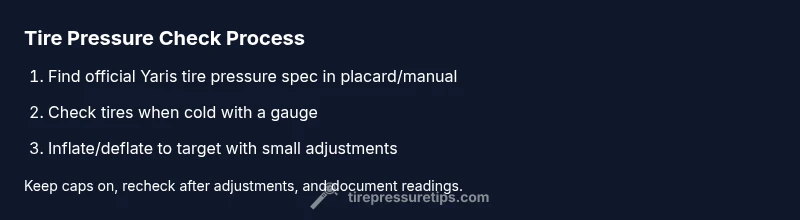
The following steps outline a practical routine you can perform at home or on the road, following best practices. For each tire, check the pressure with a trusted gauge, compare to the official target, and adjust in small increments. Remember, do not rely on the TPMS alone; you need a direct measurement for accuracy. If you notice a persistent discrepancy after adjustment, consider a professional inspection.
- After ensuring the car is cold, remove the valve cap from a tire and press the gauge onto the valve stem firmly to get a steady reading.
- Record the four readings and compare them to the official target. If a tire is underinflated, add air in small increments and recheck. If overinflated, release air until near the target.
- Repeat for all tires, including the spare if applicable, then recheck and reseat valve caps.
- If TPMS indicates a dramatic difference between tires, inspect for leaks or punctures and consult a tire technician if needed.
Common Pitfalls and How to Avoid Them
Several everyday mistakes can sabotage tire pressure efforts. Overreliance on TPMS readings without direct gauge checks can mask slow leaks or sensor errors. Checking pressure only when the tires are hot after driving can yield an inaccurate cold-start reading. Failing to adjust pressures when the vehicle is loaded with passengers or cargo can lead to uneven wear and handling changes. The Tire Pressure Tips approach is to combine direct gauge readings with TPMS data, document measurements, and revisit the targets periodically. Regular checks help catch leaks early and extend tire life.
Authority Sources for Tire Pressure
For rigorous, evidence-based guidance on tire pressure, consult authoritative sources such as the National Highway Traffic Safety Administration (NHTSA) and major publications that explain how pressure affects handling and safety. Useful information is available from:
- https://www.nhtsa.gov/road-safety/tires
- https://www.nhtsa.gov/equipment/tires
- https://www.consumerreports.org/cars-t-driving/tire-pressure-what-you-need-to-know/
These sources corroborate practical checks, safety considerations, and the importance of following the vehicle’s recommended PSI. The Tire Pressure Tips team uses this information to inform our guidance and recommendations.
Quick Safety Reminder and Maintenance Mindset
Tire pressure maintenance is a safety habit, not a one-time task. Regular checks help preserve tread life, fuel efficiency, and vehicle handling. Keep a small gauge in your glovebox, check tires monthly, before long trips, and whenever you notice a change in ride quality. Handling, braking, and steering performance all benefit from consistent tire pressure management.
AUTHORITY SOURCES
- National Highway Traffic Safety Administration (NHTSA) – Tires and road safety guidance: https://www.nhtsa.gov/road-safety/tires
- NHTSA – Tire pressure and safety considerations: https://www.nhtsa.gov/equipment/tires
- Consumer Reports – Tire pressure essentials: https://www.consumerreports.org/cars-t-driving/tire-pressure-what-you-need-to-know/
These references provide foundational context for how tire pressure affects safety and vehicle performance, and they support the step-by-step practices described in this guide.
Tools & Materials
- digital tire pressure gauge(Choose a gauge that reads to 1 psi and is easy to read)
- air compressor or portable inflator(Useful for on-the-road top-ups; ensure it has a psi gauge)
- car owner's manual(Model-specific pressures and instructions)
- pen and notepad(For recording readings and dates)
Steps
Estimated time: 25-40 minutes
- 1
Find the official tire pressure spec for your Yaris
Consult the door jamb placard and the owner's manual to locate the cold PSI target for front and rear tires. This value is specific to your trim, load, and wheel size. Validate that you’re looking at the correct formula for your configuration, then note the numbers for future checks.
Tip: Check when tires are cold and vehicle has not been driven for several hours. - 2
Prepare the car and tools
Park on a level surface, apply the parking brake, and gather your gauge, inflator, and manual. Remove the valve caps from the tires you’ll measure to ensure a clean, unobstructed seal.
Tip: Keep the caps in a safe place so you don’t lose them. - 3
Check tire pressures
Starting with one tire, press the gauge onto the valve stem firmly to obtain a stable reading. Repeat for all four tires and, if applicable, the spare. Record each value for reference.
Tip: Take readings quickly after removing the cap to avoid air loss. - 4
Adjust to the recommended pressure
If a tire is underinflated, add air in small increments and recheck. If overinflated, release air until the reading matches the target. Do not exceed the target by more than a small margin.
Tip: Make iterative adjustments and recheck after a minute for settling. - 5
Recheck and reseal
After adjustments, recheck all tires to confirm alignment with targets. Reattach valve caps and ensure the stems are clean and free of debris.
Tip: If TPMS shows a large difference after adjustments, consider a professional check. - 6
Document and monitor
Note the pressures and the date. Check monthly or before long trips because pressure can drift with temperature and load changes.
Tip: Use the same gauge for consistency to avoid reading drift.
Frequently Asked Questions
Why is tire pressure important for Yaris safety?
Proper tire pressure helps with steering, braking, and tire wear. Underinflation increases heat and tire failure risk, while overinflation can reduce traction. Always follow the vehicle’s recommended PSI.
Proper tire pressure helps with safety. Follow the Yaris's recommended PSI to maintain steering and braking, and check regularly.
How often should I check tire pressure on a Yaris?
Check at least once a month and before long trips. Temperature changes can cause readings to shift, so recheck when weather varies.
Check monthly and before trips; temperature changes can affect readings.
What if TPMS shows a warning?
TPMS indicates underinflated or overinflated tires. If the warning persists after adjusting to target, seek professional inspection.
If TPMS warns, verify pressures and consult a tire professional if needed.
Can I use a spare tire for routine inflation?
Spare tires often have different pressure requirements. Use the regular tires' target PSI and avoid inflating to the spare's rating.
Don't inflate regular tires using the spare's pressure; use the car's target PSI.
Should I adjust pressure for load or speed?
Yes, load and speeds can affect tire pressure. Do not exceed the recommended range; adjust to the specified values.
Load and speed can affect pressure; follow the spec on the placard.
How does temperature affect tire pressure?
Colder temperatures lower tire pressure; warmer temperatures raise it. Measure when tires are cold and adjust to the correct level.
Temperature affects pressure; measure cold and adjust to the target PSI.
Watch Video
What to Remember
- Check cold pressures with a reliable gauge
- Always verify against the Yaris placard
- Temperature changes affect readings, measure cold
- Recheck after adjustments to confirm accuracy