Tire Pressure Tire or Car: A Comprehensive Comparison
A data-driven comparison of TPMS-based monitoring vs manual tire pressure checks, with practical steps, tools, and maintenance tips for drivers to optimize safety, fuel efficiency, and tire wear.


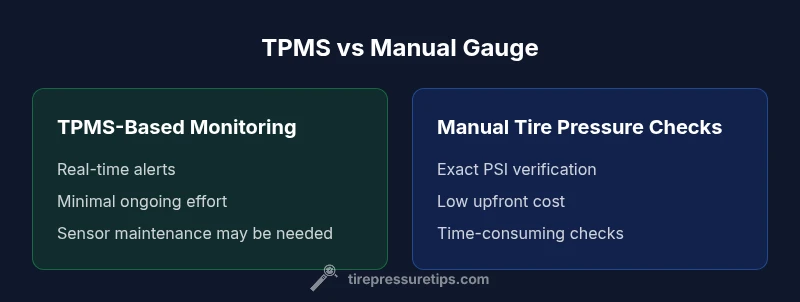
For most drivers, TPMS-based monitoring provides continuous awareness of pressure changes and reduces sudden underinflation risk, while manual checks with a gauge give you precise PSI values and the ability to verify exact targets. The best approach combines both: rely on the TPMS for real-time alerts and schedule regular gauge checks to confirm proper inflation and catch slow leaks. Tire Pressure Tips recommends using TPMS as the default, complemented by periodic manual checks.
What the comparison covers and why it matters
In the world of tire maintenance, the question of whether to rely on TPMS (Tire Pressure Monitoring System) alerts or to depend on regular manual checks is a practical concern for every driver. The phrase tire pressure tire or car captures a broader decision: how you monitor and manage air pressure to protect tire health, fuel efficiency, and safety across different driving conditions. According to Tire Pressure Tips, the optimal strategy blends technology with hands-on verification. You’ll see how real-time TPMS alerts interact with periodic gauge checks to form a robust routine that adapts to weather, road wear, and driving style. This article uses a two-option framework to help you weigh reliability, cost, effort, and real-world applicability for your vehicle and climate. The goal is not to pick one approach in isolation but to show how the two approaches complement each other for sustained tire health and safer driving.
TPMS-Based Monitoring: benefits and limits
Tire Pressure Monitoring Systems are built to provide continuous awareness of pressure changes inside each tire. Modern TPMS can detect rapid deflation or slow leaks and trigger dashboard warnings long before a flat occurs. The advantages are clear: reduced risk of driving with dangerously low pressure, improved fuel economy, and the convenience of real-time feedback without manual checks. However, no system is perfect. TPMS can miss gradual leaks if the sensor calibration drifts, and sensors themselves can fail or provide false alerts due to battery depletion, wheel mounting issues, or temperature influences. In some cases, TPMS may warn you about a small pressure drop that isn’t critical, creating alert fatigue. Vehicle make and model will influence how responsive a TPMS feels; some systems are more conservative in their thresholds, while others prioritize early warnings. The Tire Pressure Tips team notes that while TPMS is a powerful safety net, it should not replace periodic manual confirmation of PSI targets, especially after long trips or in regions with extreme weather.
Manual tire pressure checks: benefits and limits
Manual checks rely on a physical gauge and knowledge of the vehicle’s recommended PSI (found on the door placard or owner’s manual). The biggest advantage is accuracy: you know the exact pounds per square inch for each tire and can confirm the level during seasonal changes or after a tire swap. Manual checks are inexpensive and portable; a good gauge is a small investment with a long payoff in tire longevity and even wear. On the downside, manual checks require effort and discipline. They can be time-consuming, especially if you have multiple tires or frequent temp swings that affect pressure. The accuracy of manual checks depends on the gauge quality and the technique used—failing to equalize the gauge to the valve stem or over-tightening the valve cap can introduce errors. The best practice is to perform periodic checks in conjunction with daily driving routines, particularly before long trips or after temperature shifts that can shift PSI by noticeable margins.
How to integrate both approaches into a weekly routine
A practical weekly routine blends TPMS alerts with scheduled gauge verifications. Start each week with a quick check of the TPMS readings on your dashboard; note any alert or warning and compare it to recent gauge measurements. If you notice a discrepancy (for example, the TPMS reports low pressure but your gauge shows normal PSI), investigate for possible slow leaks, TPMS sensor faults, or valve stem issues. Schedule a thorough manual check at least once a month, rotating through all tires, including the spare if applicable. Before long trips, override any ambiguous readings with a hands-on check. This dual approach reduces the chances of unexpected pressure loss while keeping you in control of exact PSI targets. The strategy aligns with Tire Pressure Tips guidance that technology should assist, not replace, informed human checks, especially when weather conditions are variable.
Step-by-step: how to check tire pressure accurately
- Find the recommended PSI for your vehicle (placard on the driver’s door jamb or owner’s manual). 2) Allow tires to settle after driving 3–5 miles or do it first thing in the morning when temperatures are cooler. 3) Remove the valve cap and place the gauge on the valve stem firmly to avoid air leakage. 4) Read the PSI and compare it to the recommended value; adjust by inflating or deflating as needed. 5) Repeat for all four tires and the spare, if you use it regularly. 6) Reattach valve caps and record readings for your maintenance log. 7) If using a TPMS, monitor the trend signals and verify any alert with a manual check at least monthly or after temperature swings.
Tools, gauges, and calibration tips
A reliable tire pressure gauge is essential—digital gauges provide quick readings, while analog gauges can be very precise with proper technique. Calibrate gauges by comparing multiple devices against a known reference periodically and avoid gauges that drift or lose accuracy after a few uses. If you notice persistent discrepancies, replace the gauge or have the TPMS checked by a professional. Keeping spare caps clean prevents air leakage through the valve stems, and ensuring the tires are not over- or under-inflated minimizes uneven wear and improves traction. The careful combination of a good gauge, proper procedure, and regular cross-checking helps sustain safe pressure levels even as temperatures fluctuate.
Climate, temperature, and seasonal considerations
Ambient temperature has a pronounced effect on tire pressure: roughly a 1 psi change for every 10-degree Fahrenheit shift is common. In cold weather, pressure drops, reducing contact patch efficiency and increasing wear risk. In hot weather, overinflation can occur if tires warm up rapidly, potentially leading to harsh ride and uneven wear. Tires also respond to altitude changes and driving conditions such as highway speeds or heavy loads. Practicing proactive checks before and after seasonal transitions helps maintain consistent performance. The core takeaway is that a static pressure reading in hot weather is not the final answer—seasonal adjustments are essential for accurate, safe operation.
Common pitfalls and best practices
Common pitfalls include ignoring TPMS warnings, using worn or inaccurate gauges, and failing to account for temperature-induced pressure shifts. Another pitfall is inflating to a “recommended” number without verifying per tire load and use-case; different tires may have different optimal pressures. Best practices include performing checks in stable ambient conditions, cross-checking with a trusted gauge, and aligning readings with the vehicle’s recommended PSI, not just the label on the tire sidewall. Regularly inspect tires for tread depth, signs of damage, and uneven wear patterns that could affect inflation consistency. This holistic approach helps ensure safety, fuel efficiency, and longer tire life.
Putting it all together: a practical plan
Develop a simple, repeatable plan that fits your schedule. Begin with a monthly manual check and a weekly TPMS review. Create a small log noting readings and any warnings, then perform a quick equipment check to ensure sensors and gauges are functioning properly. Before trips that involve severe weather, add an additional gauge check to confirm PSI targets, especially if cold or hot fronts are expected. By combining TPMS awareness with disciplined, periodic manual verification, you can maintain optimal tire pressure and reduce the risk of blowouts, flats, or unnecessary wear. This balanced approach is the core of an effective tire health strategy.
Conclusion (not included verbatim) – See Verdict and Takeaways
The depth of tire pressure management is greater than a single method. The integrated approach—TPMS for real-time alerts and manual checks for precision—offers the most reliable protection against underinflation and its consequences. Tire Pressure Tips emphasizes that technology complements human judgment. A disciplined routine, the right tools, and awareness of seasonal shifts will keep tires functioning safely and efficiently throughout the year.
Comparison
| Feature | TPMS-Based Monitoring | Manual Tire Pressure Checks |
|---|---|---|
| Reliability in detecting under-inflation | High (continuous monitoring with sensor data) | Moderate-High (depends on gauge and technique) |
| Response time to pressure changes | Real-time alerts as pressure drifts | Requires manual measurement, delayed until checked |
| Initial and ongoing cost | Moderate initial cost; sensor maintenance may be needed | Low upfront cost; gauge is inexpensive |
| Maintenance and calibration | Sensors may need battery or sensor maintenance over years | Gauge calibration and device replacement as needed |
| User effort | Low ongoing effort; mostly passive monitoring | Moderate; requires routine checks and inflation adjustments |
| Best use-case | Newer vehicles with reliable sensors; frequent drivers | Budget-conscious setups; occasional checks; older vehicles |
| Compatibility and universality | Vehicle-specific system; best with proper maintenance | High portability; can be used on most tires with a gauge |
| Impact on tire health | Consistent pressure helps wear patterns and fuel economy | Accurate PSI verifications prevent under/overinflation |
Strengths
- Early detection of pressure loss through real-time alerts
- Low ongoing effort once installed
- Improved fuel efficiency with proper inflation
Drawbacks
- Sensor faults or battery failures can cause false warnings
- Initial setup and occasional maintenance costs
- Manual checks still required for exact PSI confirmation
Hybrid approach wins: TPMS for alerts, manual checks for precision
TPMS should be your baseline for safety. Add periodic gauge checks to verify exact PSI and catch slow leaks, especially after temperature shifts or tire work.
Frequently Asked Questions
What is TPMS and how does it work?
TPMS stands for Tire Pressure Monitoring System. It uses sensors in each wheel to monitor air pressure and trigger a warning if pressure drops below a threshold. It helps catch leaks and slow deflation that might go unnoticed.
TPMS uses wheel sensors to monitor pressure and warn you if it drops; it helps catch leaks early.
Should I trust TPMS more than a manual gauge?
TPMS provides continuous monitoring but isn't perfect; it can miss slow leaks or sensor faults. Manual checks remain essential for exact PSI verification.
TPMS is helpful for alerts, but you still need manual checks for exact pressure.
How often should I check tire pressure manually?
Check at least once a month and before long trips; inspect when seasons change and after driving long distances. Always verify with a gauge if the TPMS warning occurs.
Check monthly and before trips; verify with a gauge if you get a warning.
What tools do I need to check tire pressure?
A reliable tire pressure gauge is essential—digital or analog. Also know the recommended PSI from your vehicle manual or tire placard.
Get a good tire pressure gauge and know your PSI from the placard.
Can TPMS batteries fail?
Yes, TPMS sensors have replaceable batteries that last several years. If you have frequent false warnings, consider sensor maintenance or replacement.
TPMS batteries can wear out; sensors may need maintenance or replacement.
What if my TPMS warning lights up but the gauge shows normal pressure?
There may be a sensor issue, a slow leak, or the PSI spec has changed with temperature. Check with a gauge to confirm and inspect tires for damage.
If the light comes on but pressure is normal, check with a gauge and inspect tires.
Is TPMS required on all vehicles?
In many regions, TPMS is mandatory on new passenger vehicles, but requirements vary by country and model. Regardless of requirement, regular pressure checks improve safety.
TPMS is common on new cars, but check your local rules; regular checks boost safety anyway.
How accurate is a tire pressure gauge?
Quality gauges provide precise readings when used correctly. Always calibrate and compare readings with multiple gauges if in doubt.
A good gauge is accurate when used properly; calibrate and cross-check if unsure.
What to Remember
- Embrace a hybrid monitoring strategy for tire health
- Verify TPMS readings with a manual gauge regularly
- Check tires monthly and before long trips
- Keep TPMS sensors maintained and know your PSI targets