Forester Tire Pressure Guide: Check, Adjust, and Maintain
Learn how to check, adjust, and maintain tire pressure on a Subaru Forester. This guide covers TPMS, temperature effects, and best practices for safety and fuel efficiency.


You will learn how to check and adjust tire pressure on a Subaru Forester, including how to interpret TPMS warnings, when to adjust for load, speed, and temperature, and how to maintain correct tire pressure for safety, fuel efficiency, and tire wear. Gather a pressure gauge, a reliable inflator, and your vehicle’s placard as you begin this essential maintenance routine.
The Importance of Proper Forester Tire Pressure
Maintaining correct tire pressure on your Subaru Forester is not just about avoiding a nasty ignore-it-until-it-beeps moment. Proper pressure affects handling, braking performance, fuel economy, tire longevity, and overall safety. When tires sit at the wrong pressure, the contact patch between tire and road changes, influencing grip and heat buildup. The Tire Pressure Tips team emphasizes that small, consistent adjustments keep your traction predictable across wet, dry, and snow-coated surfaces. In cold mornings, air contracts and PSI drops; in hot afternoons, it expands. That’s why regular checks matter more than “set it and forget it.” Keeping forester tires within the recommended range also reduces uneven wear on edges and shoulders, postponing tire replacement and saving you money in the long run.
The Forester and Tire Pressure: Why It Matters
The Forester’s suspension and weight distribution respond best when tire pressure hovers within the vehicle’s designated range. Underinflation makes rolling resistance higher, which lowers fuel economy and causes the tire to flex excessively, generating heat that can accelerate wear. Overinflation reduces the footprint of the tire’s contact patch, degrading grip and ride comfort. The Tire Pressure Tips analysis shows that drivers who monitor tire pressure monthly and before long trips report fewer tire issues and steadier fuel mileage. Consistency, not perfection, is the goal; use a gauge you trust and recheck after any temperature swing or load change.
Tools & Materials
- Tire pressure gauge (dial or digital)(Calibrate annually; ensure range covers 20–60 psi for most passenger tires)
- Air compressor or inflator (onsite or portable)(Gas station or home unit; handy for quick adjustments to the placard-recommended value)
- Owner’s manual or door placard(Identify exact PSI targets for front and rear tires, and for different load conditions)
- Valve caps and tool to remove caps(Keep valves clean; replace caps after checking to prevent dirt ingress)
- Notebook or digital log(Track readings over weeks to notice trends or slow leaks)
- Soapy water (optional)(Use to detect slow leaks around valve stems or bead seats)
Steps
Estimated time: 20-40 minutes
- 1
Gather tools and prepare the vehicle
Park on a level surface, apply parking brake, and wait for the car to be cold if possible. Collect your tire gauge, inflator, placard, and a notebook. Note whether you’ll be carrying extra load, as this can affect PSI targets.
Tip: Cold tires yield more accurate readings; avoid inflating after a long drive - 2
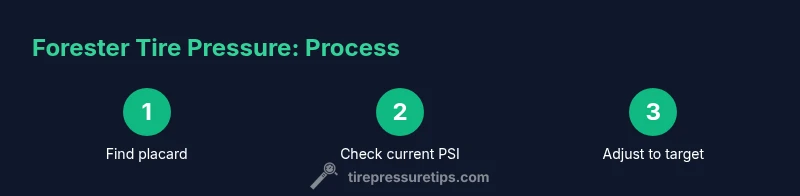
Locate the recommended psi
Check the placard on the door jamb or refer to the owner’s manual to find the recommended PSI for both front and rear tires and for different load conditions. For most Forester models, the numbers are clearly listed for standard conditions.
Tip: Front and rear may differ; don’t assume equal values - 3
Remove valve caps and position gauge
Take off the valve caps and firmly press the gauge onto the valve stem to get a stable reading. If you’re using an inflator, attach it and set it to the target pressure first.
Tip: Finger-tighten caps after reading; loose caps can cause leaks - 4
Measure cold tire pressures
Record the reading for each tire when the tires are cold. If you’ve just driven, wait at least 3 hours or perform the reading before you drive beyond a few miles.
Tip: Consistency in timing improves comparability between tires - 5
Adjust to the target pressure
Inflate or deflate as needed to reach the recommended PSI. If inflating, add air in small increments and recheck after each adjustment.
Tip: Do not exceed the upper limit of the placard range - 6
Repeat for all tires and reseal
Check the spare and ensure it’s within a reasonable range as well. Replace valve caps and log the results if you’re tracking maintenance.
Tip: Keep a short log of readings for trend monitoring
Frequently Asked Questions
What is the recommended tire pressure for a Subaru Forester?
Check the door placard or owner's manual for the exact PSI. It can vary by trim, load, and tire size.
Check your door placard for the exact PSI recommended for your Forester.
Does TPMS replace manual tire pressure checks?
TPMS alerts you when pressure falls below a threshold, but it isn’t a precise measurement. Use a gauge to confirm exact values.
Yes, TPMS warns you if pressure is low, but you should still measure with a gauge.
How often should I check Forester tire pressure?
Aim to check once a month and before long trips, especially when temperatures shift or you switch seasons.
Check at least monthly and before trips, especially during seasonal changes.
Is it safe to drive with underinflated tires?
Driving on underinflated tires increases risk of heat buildup, blowouts, and reduced handling.
No—driving with low pressure is risky and can lead to dangerous blowouts.
How do seasonal changes impact tire pressure on a Forester?
Cold temperatures lower pressure, while hot temperatures raise it. Adjust pressures accordingly when seasons change.
Seasonal temperature changes affect PSI; check and adjust as needed.
Should I inflate to the maximum PSI listed on the tire sidewall?
No. Always use the vehicle’s recommended PSI from the placard, not the tire’s maximum sidewall PSI.
Don’t inflate to the max; use the recommended PSI from the placard.
Watch Video
What to Remember
- Know your Forester’s PSI targets from placard.
- Use a reliable gauge for accurate readings.
- Temperature affects tire pressure; check after weather changes.
- Check tires monthly and before long trips.