Ford Focus PSI: Check and Maintain Tire Pressure
Learn to check and maintain Ford Focus PSI accurately with TPMS tips, gauges, and seasonal guidance. Practical steps to read tires correctly, prevent under/overinflation, and extend tire life.


This guide shows you how to accurately check and adjust Ford Focus PSI, from understanding the recommended range to using a gauge and TPMS insights. You'll learn which pressures to target for front and rear tires, how to handle seasonal changes, and how to avoid common mistakes. Follow the step-by-step process for safe, reliable readings.
Ford Focus PSI: What it is and why it matters
PSI stands for pounds per square inch, the unit used to express tire pressure. The Ford Focus relies on correct psi to maintain optimal grip, steering response, and even tire wear. When pressures are too low or too high, you sacrifice fuel economy, wear on the tire shoulders, and increase the risk of blowouts on rough roads. According to Tire Pressure Tips, maintaining the right Ford Focus PSI also helps TPMS systems provide accurate warnings and reduces rolling resistance, which can improve mpg. Always start with the door jamb placard and your owner’s manual to confirm the exact numbers for your model year and trim. The placard lists the recommended front and rear pressures, and these numbers may change with load, speed, or seasonal conditions. Keep in mind that tire pressures do not stay constant; they shift with ambient temperature, road conditions, and vehicle load. In daily use, plan to check psi at least once a month and before long trips. This habit protects tire life and vehicle safety, and helps you get the most out of your Ford Focus. A practical understanding of ford focus psi helps you maintain safety and efficiency.
Understanding official PSI ranges and where to find exact numbers
The official tire pressure specification for a Ford Focus is shown on the vehicle’s door jamb placard or in the owner’s manual. The exact numbers can vary by model year, trim, and whether the vehicle carries a heavy load. Front and rear tires may have different recommended pressures, and these change if you routinely carry passengers or gear. Always verify the target psi for cold tires from the placard before any inspection. Temperature, tire type, and wheel size can influence the recommended range, so use the placard as the primary source, and cross-check with the manual if you’re unsure. Remember, psi is measured when tires are cold (ideally after the car has been at rest for several hours).
Tools and gauges to measure ford focus psi accurately
To get a precise reading of your Ford Focus PSI, you’ll want a reliable gauge and a source of air if you need to top off. A good dial or digital gauge reads to at least 0.5 psi precision and remains accurate after repeated use. Use a dedicated gauge for tire pressure; avoid relying on a device that’s designed for other measurements. Have an air compressor or air pump nearby, or access a service station with a precise readout. Keep valve caps tight and clean, and record your readings so you can track changes over time. Finally, ensure you’re checking on tires that are cold for best accuracy, and avoid checking right after a long highway drive.
A quick overview of the check process
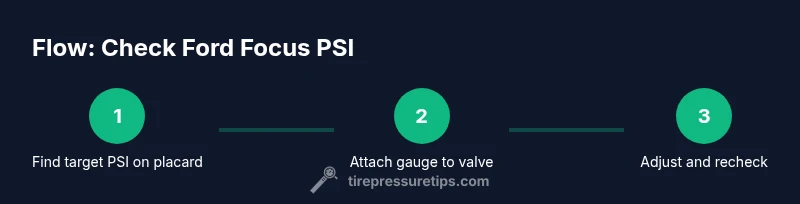
Checking Ford Focus PSI involves several steps: locate the correct psi value on the placard, ensure tires are cold, remove the valve cap, attach the gauge securely, read the pressure, and compare to the recommended range. If pressure is low, add air in small increments and recheck. If it’s high, release air gradually and recheck. This quick loop—check, adjust, recheck—helps reduce overcorrection and ensures you reach the target range efficiently.
Seasonal changes and maintaining optimal psi
Seasonal temperature shifts have a real effect on tire pressure. Cold weather tends to lower psi, while heat from driving or hot days can raise it. For Ford Focus drivers, this means you should recheck PSI more often in winter and after a significant temperature change. Pre-season checks before a road trip or long drive are also wise. If you notice tires look visibly underinflated or overinflated, perform a measurement with a reliable gauge and adjust accordingly. Remember that the placard values assume cold tires, so your readings after driving should be treated as estimates until the tires cool again.
TPMS: TPMS and Ford Focus psi readings
Tire Pressure Monitoring Systems (TPMS) are designed to alert you when a tire’s pressure falls outside the recommended range. However, TPMS warnings are not a substitute for regular manual checks. A TPMS light can indicate a slow leak, a faulty sensor, or a problem with the system’s calibration. If you see a TPMS warning while psi appears normal, recheck with a manual gauge, inspect for leaks, and consider the possibility of a sensor needing service. Regular TPMS maintenance helps ensure you aren’t driving with inaccurate data.
Troubleshooting common issues and mistakes
Common mistakes include inflating to a number that's too high for the load or underinflating due to a mistaken assumption about tire wear. Another frequent error is not checking tires after they’ve been driven when they were hot; always measure when cold for accuracy. Seasonal swings, heavy loads, and mismatched tire types can all complicate psi targets. If you’re unsure about a reading, recheck with a different gauge or have the tires inspected by a professional.
Safety and maintenance: keeping tires in top condition
Maintenance is ongoing, not a one-off action. Keep a small gauge in your glove box, check all tires regularly, and set reminders for cold-weather checks. Maintaining proper Ford Focus PSI improves fuel economy, handling, and tire longevity while reducing the risk of tire failure on the road. When in doubt, consult the owner’s manual and model-specific service notes from Tire Pressure Tips.
Authority sources
For additional context and safety guidelines, refer to official government and major publications on tire pressure and TPMS. These sources provide foundational guidance that aligns with Tire Pressure Tips recommendations and can help you verify Ford Focus PSI targets and best practices for tire maintenance.
Tools & Materials
- Tire pressure gauge (dial or digital)(Read to 0.5 psi precision; use a dedicated gauge)
- Air compressor or access to air pump(Allow precise adjustments; ensure gauge reads accurately)
- Owner's manual / vehicle placard(Check exact Ford Focus psi for your model)
- Notebook or mobile app for logging readings(Optional but helpful for tracking changes)
- Valve caps and storage(Keep caps clean and installed)
Steps
Estimated time: 15-25 minutes
- 1
Prepare your tools and locate targets
Gather your gauge, air source, and the vehicle’s tire pressure placard. Confirm the exact psi targets for the Ford Focus and write them down for quick reference.
Tip: Keep your gauge in good condition; calibrate if needed. - 2
Park safely and warm tires if needed
Park on a flat surface, engage parking brake, and allow tires to cool before measuring. If you’ve just driven, wait at least 30 minutes for a cold reading.
Tip: Warm tires skew higher readings, so cool-down matters. - 3
Remove valve caps and attach gauge
Carefully remove the valve caps and press the gauge onto the valve stem. Ensure a tight seal to avoid losing air during measurement.
Tip: If using an automotive gauge, hold steady to prevent air leakage. - 4
Read and compare psi
Read the psi result, note whether it’s below, within, or above the target range. Record each tire’s value to track trends.
Tip: If readings vary more than 2 psi between tires, inspect for leaks. - 5
Adjust in small increments
If low, add air in 1-2 psi increments and recheck after each addition. If high, release air gradually and recheck until within range.
Tip: Never exceed the placard values; you can always add more air later. - 6
Final check and record
With all tires within range, replace valve caps and record the final pressures. Recheck after about 3 days as a quick sanity check.
Tip: Use cold readings for future references.
Frequently Asked Questions
What is the Ford Focus PSI recommended for most trims?
The recommended PSI varies by model year, trim, and load. Always check the door jamb placard or owner’s manual for exact numbers. Use cold readings to verify.
Check the door jamb placard for your exact Ford Focus PSI, then verify with a cold-reading using a reliable gauge.
How often should I check Ford Focus psi?
Check PSI monthly and before long trips. Also recheck after any significant temperature change or after rotating tires.
Check your tire pressure at least monthly and before long trips. Recheck after temperature changes or tire rotations.
What if TPMS warns but readings look normal?
Recheck with a manual gauge, inspect tires for slow leaks, and consider sensor calibration or replacement if readings remain off.
If TPMS warns while readings seem normal, recheck with a manual gauge and inspect for leaks; TPMS calibration may be needed.
Does tire type affect psi targets on a Ford Focus?
Yes. Different tire sizes or compounds can slightly shift the ideal PSI. Always base targets on the placard values for your specific tire setup.
Different tires can change the ideal PSI; rely on your placard values for your exact tire setup.
Can temperature changes skew PSI readings?
Absolutely. Cold temperatures lower PSI and heat raises it. Expect to check PSI more often during seasonal transitions.
Yes, temperature changes affect PSI; check more often during weather shifts.
Should I replace tires if psi remains inconsistent?
If PSI readings are inconsistent across tires or repeatedly out of range, have the tires and TPMS system inspected by a professional.
If readings stay inconsistent, get your tires and TPMS checked by a professional.
Watch Video
What to Remember
- Check cold tires for accurate readings.
- Follow the placard values for Ford Focus PSI.
- Recheck after adjusting to ensure accuracy.
- TPMS complements manual checks, not replaces them.
- Document readings to monitor changes over time.